


The Human Rights Network for Tibet and Taiwan on Monday called on Beijing to provide details on the 11th Panchen Lama, who was kidnapped by the Chinese government 26 years ago.
The 11th Panchen Lama, born Gedhun Choekyi Nyima, was abducted along with his family by the Chinese Communist Party (CCP) in 1995 when he was six years old.
In the Gelug school of Tibetan Buddhism that is practiced in Tibet, the Panchen Lama is responsible for seeking out the next reincarnation of the Dalai Lama, and his authority is second only to the Dalai Lama.
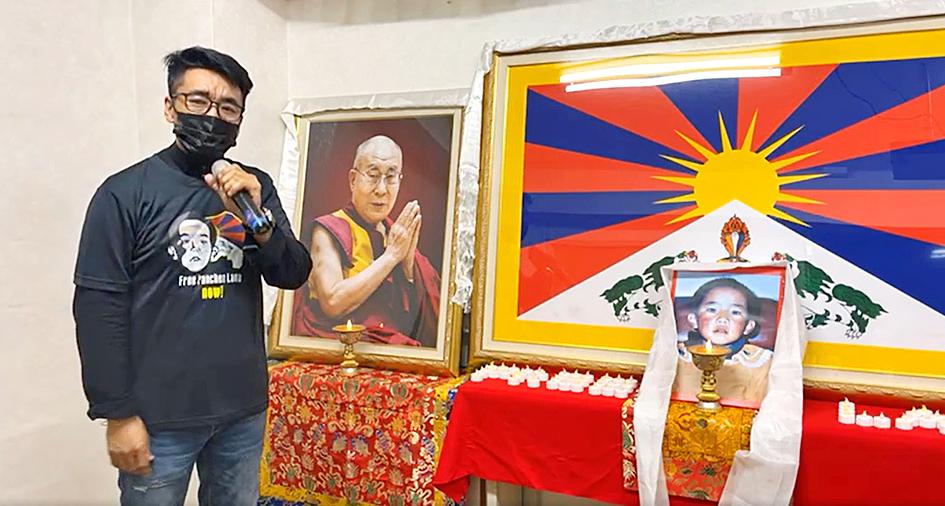
Photo copied by Chen Yu-fu, Taipei Times
Network founder Tashi Tsering said no information about Gedhun or his family has been revealed since their abduction.
“The only picture we have of him is from when he was six, just before he was kidnapped. He’s the youngest political prisoner in history worldwide,” he said.
Tibetan government-in-exile representative to Taiwan Kelsang Gyaltsen Bawa said Beijing should release Gedhun to reduce his suffering amid the COVID-19 pandemic.
Kelsang also expressed hope for Taiwanese to weather the pandemic unharmed.
“In the past, human rights groups and Buddhists called for the unconditional release of the 11th Panchen Lama, but the Chinese government always lied. They said he was living a healthy, happy life and didn’t want to be disturbed,” Kelsang said.
Gedhun’s case is the longest-running enforced-disappearance case on record at the UN, he said, adding that the UN Human Rights Council has unsuccessfully appealed to Beijing several times for visitation rights to see Gedhun.
The US Department of State on April 22 said in a news release that “we respect Tibetans’ right to select, educate and venerate their own leaders, like the Dalai Lama and the Panchen Lama, according to their own beliefs, and without government interference.”
A report by the UN’s Working Group on Enforced or Involuntary Disappearances on Dec. 8 last year said Gedhun’s kidnapping “violates the religious traditions and customs of Tibetan Buddhists,” and called on China to explain its actions, Taiwan Association for Human Rights secretary-general Shih Yi-hsiang (施逸翔) said.
China responded one month later, saying it was unable to confirm the whereabouts of Gedhun, he said.
“This is something the whole global community should be concerned about. China should release Gedhun at once and provide a comprehensive report to the UN’s human rights bodies,” Shih said.

The Centers for Disease Control (CDC) yesterday reported the first case of a new COVID-19 subvariant — BA.3.2 — in a 10-year-old Singaporean girl who had a fever upon arrival in Taiwan and tested positive for the disease. The girl left Taiwan on March 20 and the case did not have a direct impact on the local community, it said. The WHO added the BA.3.2 strain to its list of Variants Under Monitoring in December last year, but this was the first imported case of the COVID-19 variant in Taiwan, CDC Deputy Director-General Lin Ming-cheng (林明誠) said. The girl arrived in Taiwan on

South Korea is planning to revise its controversial electronic arrival card, a step Taiwanese officials said prompted them to hold off on planned retaliatory measures, a South Korean media report said yesterday. A Yonhap News Agency report said that the South Korean Ministry of Foreign Affairs is planning to remove the “previous departure place” and “next destination” fields from its e-arrival card system. The plan, reached after interagency consultations, is under review and aims to simplify entry procedures and align the electronic form with the paper version, a South Korean ministry official said. The fields — which appeared only on the electronic form

A bipartisan group of US senators has introduced a bill to enhance cooperation with Taiwan on drone development and to reduce reliance on supply chains linked to China. The proposed Blue Skies for Taiwan Act of 2026 was introduced by Republican US senators Ted Cruz and John Curtis, and Democratic US senators Jeff Merkley and Andy Kim. The legislation seeks to ease constraints on Taiwan-US cooperation in uncrewed aerial systems (UAS), including dependence on China-sourced components, limited access to capital and regulatory barriers under US export controls, a news release issued by Cruz on Wednesday said. The bill would establish a "Blue UAS

The Ministry of Foreign Affairs (MOFA) is suspending retaliation measures against South Korea that were set to take effect tomorrow, after Seoul said it is updating its e-arrival system, MOFA said today. The measures were to be a new round of retaliation after Taiwan on March 1 changed South Korea's designation on government-issued alien resident certificates held by South Korean nationals to "South Korea” from the "Republic of Korea," the country’s official name. The move came after months of protests to Seoul over its listing of Taiwan as "China (Taiwan)" in dropdown menus on its new online immigration entry system. MOFA last week


 RSS
RSS