


Ridership on the Taiwan Railways Administration’s (TRA) system on Sunday fell about 60 percent following a surge in locally transmitted cases of COVID-19 in Taipei and New Taipei City, the agency said yesterday.
About 200,000 people on Sunday used the TRA system, down from an average of 640,000 people on a regular weekend, Taipei Railway Station Master Tu Wei-ting (涂維庭) said.
TRA estimated a 50 percent decline in ridership during the peak morning hours yesterday, the first work day under stricter disease prevention measures.
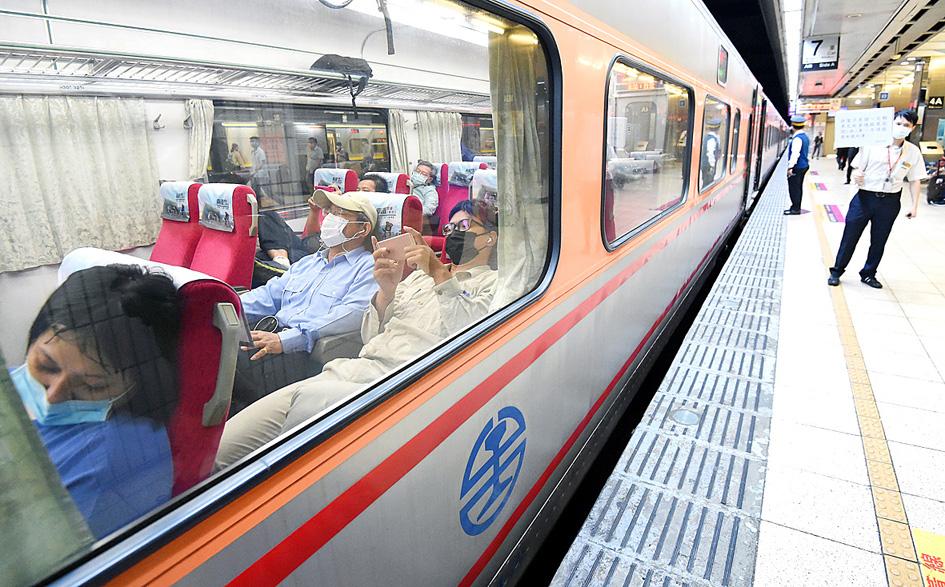
Photo: Liao Chen-huei, Taipei Times
Overall, passengers observed disease prevention guidelines stipulated by the agency, including no standing passengers on express trains, Tu said, adding that commuter trains were not crowded.
“In addition to on the trains, eating and drinking is banned on platforms and in waiting areas,” he said. “We hope that all passengers comply with the regulations in light of the severity of the outbreak.”
On weekdays, peak hours are typically from 7am to 9am and 5pm to 7pm, Tu said.
The agency would ensure that during those two hours in the morning and in the evening, the number of people on the platforms does not exceed 50 percent of the foot traffic, he said, adding that if the platforms become too crowded, people would be asked to wait at the ticketing gates.
On the platforms, people must observe social distancing guidelines stipulated by the Central Epidemic Command Center, Tu said.
Chien Hsin-li (簡信立), a section chief in the TRA’s transportation safety department, said that the agency’s service and mechanical engineering personnel have been divided into two groups so that they can report to work at different locations to avoid potential cross-infections.
Railway stations are to be disinfected once per hour and trains at least once per day, Chien said, adding that a more thorough disinfection of trains would be conducted every month.
In Taipei and New Taipei City, ridership on the cities’ MRT railway or public bus systems has dramatically declined since the CECC raised the COVID-19 alert for the two municipalities to level 3 on Saturday last week.
From 6am to 9am yesterday, the number of MRT passengers fell 40 percent, compared with the same time last week, Taipei Rapid Transit Corp said.

The military has spotted two Chinese warships operating in waters near Penghu County in the Taiwan Strait and sent its own naval and air forces to monitor the vessels, the Ministry of National Defense (MND) said. Beijing sends warships and warplanes into the waters and skies around Taiwan on an almost daily basis, drawing condemnation from Taipei. While the ministry offers daily updates on the locations of Chinese military aircraft, it only rarely gives details of where Chinese warships are operating, generally only when it detects aircraft carriers, as happened last week. A Chinese destroyer and a frigate entered waters to the southwest
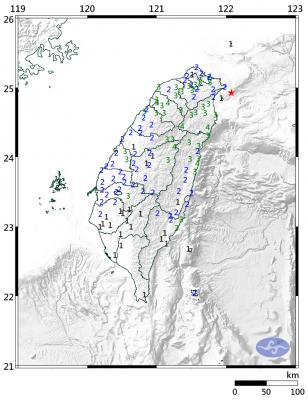
A magnitude 6.1 earthquake struck off the coast of Yilan County at 8:39pm tonight, the Central Weather Administration (CWA) said, with no immediate reports of damage or injuries. The epicenter was 38.7km east-northeast of Yilan County Hall at a focal depth of 98.3km, the CWA’s Seismological Center said. The quake’s maximum intensity, which gauges the actual physical effect of a seismic event, was a level 4 on Taiwan’s 7-tier intensity scale, the center said. That intensity level was recorded in Yilan County’s Nanao Township (南澳), Hsinchu County’s Guansi Township (關西), Nantou County’s Hehuanshan (合歡山) and Hualien County’s Yanliao (鹽寮). An intensity of 3 was

Japanese Prime Minister Sanae Takaichi’s comment last year on Tokyo’s potential reaction to a Taiwan-China conflict has forced Beijing to rewrite its invasion plans, a retired Japanese general said. Takaichi told the Diet on Nov. 7 last year that a Chinese naval blockade or military attack on Taiwan could constitute a “survival-threatening situation” for Japan, potentially allowing Tokyo to exercise its right to collective self-defense. Former Japan Ground Self-Defense Force general Kiyofumi Ogawa said in a recent speech that the remark has been interpreted as meaning Japan could intervene in the early stages of a Taiwan Strait conflict, undermining China’s previous assumptions
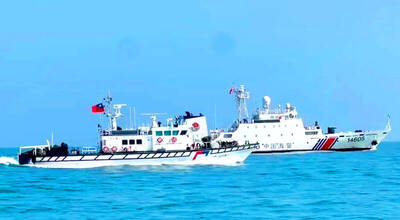
Instead of focusing solely on the threat of a full-scale military invasion, the US and its allies must prepare for a potential Chinese “quarantine” of Taiwan enforced through customs inspections, Stanford University Hoover fellow Eyck Freymann said in a Foreign Affairs article published on Wednesday. China could use various “gray zone” tactics in “reconfiguring the regional and ultimately the global economic order without a war,” said Freymann, who is also a nonresident research fellow at the US Naval War College. China might seize control of Taiwan’s links to the outside world by requiring all flights and ships entering or leaving Taiwan


 RSS
RSS