


With the onset of summer and sweltering weather, health officials have offered basic tips for people to avoid dehydration and heatstroke.
People over 65, infants and toddlers, as well as people who work outdoors or in confined spaces, athletes and those with chronic illnesses are at high risk of heat-related illness, Health Promotion Administration (HPA) Deputy Director-General Wu Chao-chun (吳昭軍) said.
Wu offered simple tips to stay cool, such as wearing light-colored, loose clothing made from breathable fabric and avoiding staying in direct sunlight.
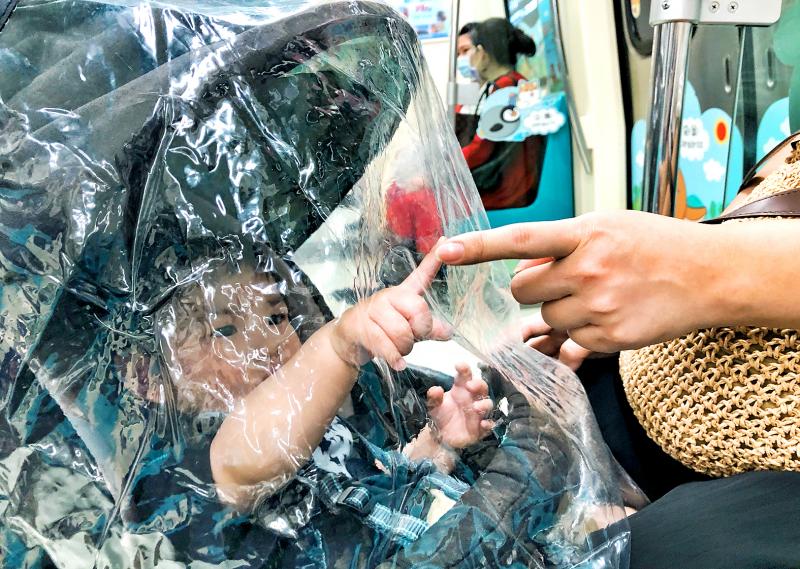
Photo: Peter Lo, Taipei Times
“People can also turn off indoor lighting and other electrical devices when not needed to avoid generating heat. They should stay indoors as much as possible to stay cool,” he said.
“Never leave a child alone inside a parked vehicle or other enclosed space, no matter for how short,” he added.
It is important to drink plenty of liquid and people should not wait until they feel thirsty before drinking water, Wu said, adding that people should drink at least 2 liters of water every day.
“If a doctor instructs them to reduce their liquid intake, people should ask the specific amount of water they should drink. They should also eat more fruits and vegetables, which have high water content, plenty of vitamins, minerals and dietary fiber to help maintain a healthy body,” Wu said.
He warned against drinking alcohol or beverages with a high sugar content, as these would dehydrate the body, causing the person to become more thirsty.
The HPA urged people working outdoors or in confined spaces, as well as athletes, to pay attention to their body condition, and take a rest and drink water when necessary.
Elderly people, infants and young children should avoid going outdoors during the hottest hours of the day, it said.
If they must go out, they should walk in the shade, wear suitable clothing and apply sunscreen, the agency added.
People must watch out for warning signs of heatstroke, such as a high body temperature, dry and red skin, and an increased heartbeat, the HPA said.
Severe cases might include an inability to sweat, headache, dizziness, nausea, vomiting, confusion, muscle cramps and fainting, it said.
People with such symptoms must quickly remove themselves from the hot environment and cool down by loosening or removing outer clothing, wiping their body with a wet towel and fanning themselves, it said.
They can drink cold water mixed with a pinch of salt, or electrolyte drinks, and seek medical treatment, it added.
“The more alert people are, the less the damage from heat would be,” Wu said.

The Centers for Disease Control (CDC) yesterday reported the first case of a new COVID-19 subvariant — BA.3.2 — in a 10-year-old Singaporean girl who had a fever upon arrival in Taiwan and tested positive for the disease. The girl left Taiwan on March 20 and the case did not have a direct impact on the local community, it said. The WHO added the BA.3.2 strain to its list of Variants Under Monitoring in December last year, but this was the first imported case of the COVID-19 variant in Taiwan, CDC Deputy Director-General Lin Ming-cheng (林明誠) said. The girl arrived in Taiwan on

South Korea is planning to revise its controversial electronic arrival card, a step Taiwanese officials said prompted them to hold off on planned retaliatory measures, a South Korean media report said yesterday. A Yonhap News Agency report said that the South Korean Ministry of Foreign Affairs is planning to remove the “previous departure place” and “next destination” fields from its e-arrival card system. The plan, reached after interagency consultations, is under review and aims to simplify entry procedures and align the electronic form with the paper version, a South Korean ministry official said. The fields — which appeared only on the electronic form

A bipartisan group of US senators has introduced a bill to enhance cooperation with Taiwan on drone development and to reduce reliance on supply chains linked to China. The proposed Blue Skies for Taiwan Act of 2026 was introduced by Republican US senators Ted Cruz and John Curtis, and Democratic US senators Jeff Merkley and Andy Kim. The legislation seeks to ease constraints on Taiwan-US cooperation in uncrewed aerial systems (UAS), including dependence on China-sourced components, limited access to capital and regulatory barriers under US export controls, a news release issued by Cruz on Wednesday said. The bill would establish a "Blue UAS

The Ministry of Foreign Affairs (MOFA) is suspending retaliation measures against South Korea that were set to take effect tomorrow, after Seoul said it is updating its e-arrival system, MOFA said today. The measures were to be a new round of retaliation after Taiwan on March 1 changed South Korea's designation on government-issued alien resident certificates held by South Korean nationals to "South Korea” from the "Republic of Korea," the country’s official name. The move came after months of protests to Seoul over its listing of Taiwan as "China (Taiwan)" in dropdown menus on its new online immigration entry system. MOFA last week


 RSS
RSS