

A military enthusiast yesterday posted photographs of Taiwanese F-16 jets taking off from Daniel K. Inouye International Airport in Honolulu with two refueling aircraft, presumably returning to Taiwan from the US for upgrades.
Asked about the matter, the Ministry of National Defense declined to comment.
The jets had been part of training at Luke Air Force Base in Arizona and had briefly landed in Honolulu, where the photographer, Aeros808, had spotted them, a source said.
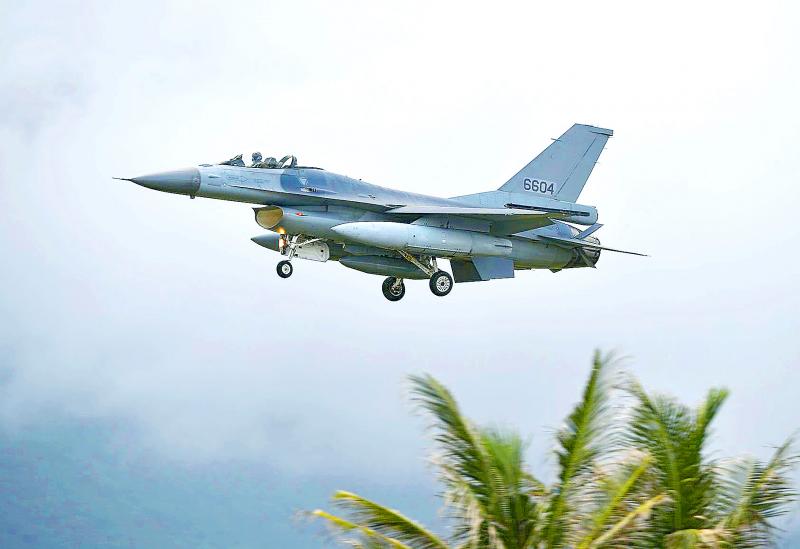
Photo: Yu Tai-lang, Taipei Times
The jets did not land in Guam, which had been done in 1996 when the US Air Force delivered F-16s to Taiwan, the source said, adding that the jets were refueled mid-air eight times.
The air force had launched two F-16Vs to escort the jets, while officials cleared the perimeter of Hualien Air Base of unauthorized people.
The jets are to undergo an inspection before their departure for Ching Chuang Kang Air Base, where they are to be upgraded, the source said.
Separately, the navy said that it has commissioned the Chungshan Institute of Science and Technology to manufacture a range of mid to long-range radars, which would be used to upgrade naval radar stations across the nation.
The upgrades would improve the navy’s ability to monitor Chinese naval movements, it said.
The navy has numerous radar stations on Taiwan proper, and on Kinmen, Matsu and Penghu.
Many of the stations operate outdated equipment and cannot deliver results that meet the navy’s expectations, it said.
The first phase of the upgrades, at an estimated cost of NT$250 million (US$8.93 million), is expected to be completed by the end of this year, the navy said.
The navy is contemplating following the air force’s lead in establishing an information hub for all radar feeds to minimize casualties in the event of an attack.
Such a hub would have to be implemented in stages, as it is dependent on regional radar station locations and how cables are to be routed, the navy said.
‘SHANDONG’
In other news, the Chinese People’s Liberation Army Navy’s Shandong carrier group is slowly moving northward after wrapping up “routine exercises” in the South China Sea earlier this month, the Ministry of National Defense said.
The ministry said that it is closely monitoring the carrier group and would keep tabs on its movement regardless of whether it moves through the Taiwan Strait or takes another route.
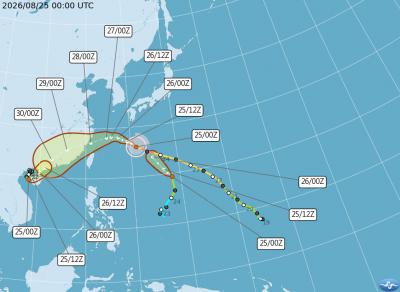
Typhoon Saudel has shown signs of weakening but is still expected to affect Taiwan when it comes closest to the nation on Friday, the Central Weather Administration (CWA) said today. The radius of Saudel shrank to about 220km as of 8am today from 250km a day earlier, and its maximum sustained winds were down to 155kph from 184kph previously, the weather agency said. As of 8am, Typhoon Saudel was 980km east of Taipei, moving west-northwest at 18kph, it said. Under the influence of a Pacific high pressure system, the storm is moving northward, meaning it is less likely to make landfall in Taiwan,

Minister of Sports Lee Yang (李洋) today said the Chinese Taipei Basketball Association (CTBA) has been urged not to undermine Taiwan’s credibility in international competitions, after a Taiwanese team advanced to the semi-finals of the 45th William Jones Cup over the Philippines last week due to a controversial new rule guaranteeing a semi-final place to the host team. The Republic of China Blue team advanced to the semi-finals after winning just one game in the group round due to a “host guarantee” spot, overtaking the Philippines, who held a 5-1 record ahead of the semi-finals. The Blue team finished the tournament
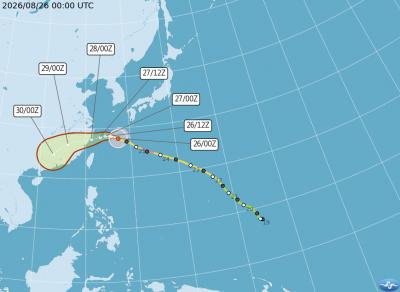
A sea warning for Typhoon Saudel, which has shifted to a more northerly track as it nears Taiwan, is expected early tomorrow, the Central Weather Administration (CWA) said today. As of this morning, Saudel was about 650km east-northeast of Taipei, moving west-northwest at 12kph with maximum sustained winds of 162kph, CWA data showed. Although Saudel remains a moderate typhoon, it has weakened and is expected to weaken further as it nears Taiwan due to unfavorable atmospheric and ocean conditions, CWA forecaster Lin Po-tung (林伯東) said. The storm is forecast to make its closest approach to Taiwan tomorrow and on Friday, Lin added. According to
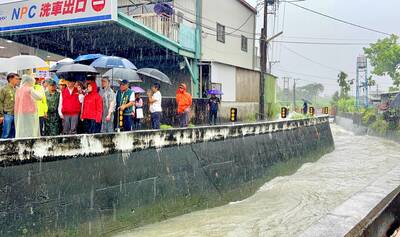
SEA WARNING EXPECTED: As atmospheric conditions are unfavorable for its development, the storm’s intensity is continuing to weaken, a CWA official said Typhoon Saudel is continuing to weaken and shift its path northward, with a sea warning expected to be issued this evening, the Central Weather Administration (CWA) said yesterday. The agency did not rule out issuing a land warning for outlying Lienchiang County (Matsu) tomorrow morning, although all storm warnings could be lifted by Friday night. Saudel is expected to be closest to Taiwan from tomorrow night to Friday, bringing localized heavy rain to northern and southern Taiwan, as well as central mountainous areas, the agency said. As of 2pm yesterday, the center of moderate Typhoon Saudel was about 890km east-northeast


 RSS
RSS