


Aboriginal rights advocates yesterday protested in Taipei, demanding that their names be written in the Roman alphabet on identification cards and official papers, and that Chinese versions of their name be dropped.
At the protest in front of the Ministry of the Interior, demonstrators urged the government to amend regulations that require a Chinese name and an Aboriginal name in the Roman alphabet on identification cards and official documents.
A restaurant chain recently had a big promotion for people whose names contained “salmon” (鮭魚), “but when we want to use only Aboriginal names with our own script system, we cannot do so, because the law does not permit it,” said Savungaz Valincinan, a Bunun graduate student at National Dong Hwa University.
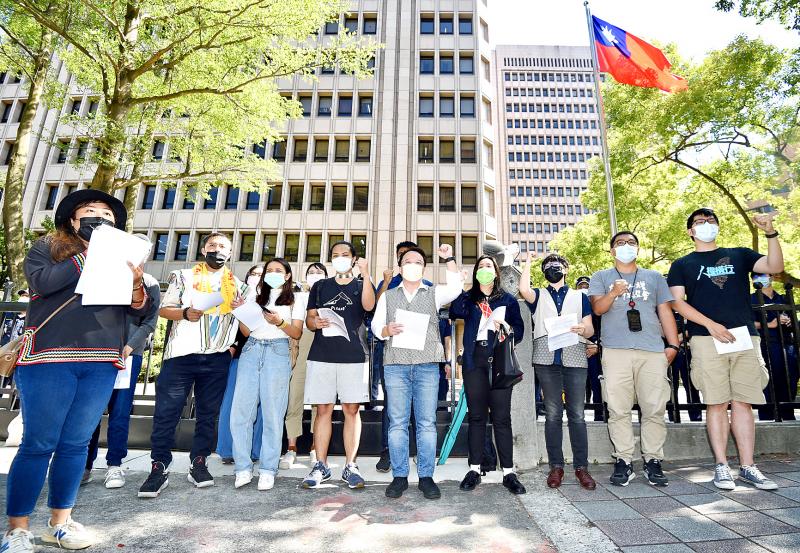
Photo: Peter Lo, Taipei Times
“This is unreasonable and unfair,” she said.
The Aboriginal Language Development Act (原住民族語言發展法) guarantees the use of “Indigenous scripts” to record Aboriginal languages, which covers Aboriginal names, she said.
The protesters said that some people have gone to their local household registration offices to apply to change to a traditional name, but were rejected as officials cited the Name Act (姓名條例), which states only three choices: a Chinese name, listed together with its rendering in Aboriginal script; a phonetic translation of an Aboriginal name, written in Chinese; and a phonetic translation in Chinese, listed together with its spelling in Aboriginal script.
“Our people were forced to use Chinese to write our names, but Chinese characters cannot be transliterated to closely match the sounds and meanings of our Aboriginal names,” said Bawtu Payen, an Atayal.
Lin Cheng-ching (林承慶), an Amis, said that the regulations contravene the Constitution’s guarantee of “equality among all racial groups” and protection against infringement on a person’s name or personality under the Civil Code, and contravenes the UN International Covenant on Civil and Political Rights, and International Covenant on Economic, Social and Cultural Rights.
National Taiwan University professor Ciwang Teyra, of the Truku community, said that Taiwan signed on to the two UN covenants and has promoted human rights protections, “but if our Aboriginal names cannot be listed without Chinese characters ... it implies discrimination based on ethnicity.”
Deputy head of the ministry’s Department of Household Registration Cheng Hsin-wei (鄭信偉) said that the Name Act and the Indigenous Peoples Basic Act (原住民基本法) would have to be amended for the protesters’ request to be met.
“Discussion is needed on whether to continue with the current regulation, and the group’s petition will be forwarded to our staff, and be processed as outlined in the Administrative Appeal Act (訴願法),” he said.
Additional reporting by Jason Pan

Considering that most countries issue more than five denominations of banknotes, the central bank has decided to redesign all five denominations, the bank said as it prepares for the first major overhaul of the banknotes in more than 24 years. Central bank Governor Yang Chin-lung (楊金龍) is expected to report to the Legislative Yuan today on the bank’s operations and the redesign’s progress. The bank in a report sent to the legislature ahead of today’s meeting said it had commissioned a survey on the public’s preferences. Survey results showed that NT$100 and NT$1,000 banknotes are the most commonly used, while NT$200 and NT$2,000

The Centers for Disease Control (CDC) yesterday reported the first case of a new COVID-19 subvariant — BA.3.2 — in a 10-year-old Singaporean girl who had a fever upon arrival in Taiwan and tested positive for the disease. The girl left Taiwan on March 20 and the case did not have a direct impact on the local community, it said. The WHO added the BA.3.2 strain to its list of Variants Under Monitoring in December last year, but this was the first imported case of the COVID-19 variant in Taiwan, CDC Deputy Director-General Lin Ming-cheng (林明誠) said. The girl arrived in Taiwan on

South Korea is planning to revise its controversial electronic arrival card, a step Taiwanese officials said prompted them to hold off on planned retaliatory measures, a South Korean media report said yesterday. A Yonhap News Agency report said that the South Korean Ministry of Foreign Affairs is planning to remove the “previous departure place” and “next destination” fields from its e-arrival card system. The plan, reached after interagency consultations, is under review and aims to simplify entry procedures and align the electronic form with the paper version, a South Korean ministry official said. The fields — which appeared only on the electronic form

The Ministry of Foreign Affairs (MOFA) is suspending retaliation measures against South Korea that were set to take effect tomorrow, after Seoul said it is updating its e-arrival system, MOFA said today. The measures were to be a new round of retaliation after Taiwan on March 1 changed South Korea's designation on government-issued alien resident certificates held by South Korean nationals to "South Korea” from the "Republic of Korea," the country’s official name. The move came after months of protests to Seoul over its listing of Taiwan as "China (Taiwan)" in dropdown menus on its new online immigration entry system. MOFA last week


 RSS
RSS