


The Taipei District Court yesterday sentenced two former aides of Chinese Nationalist Party (KMT) lawmakers to prison for espionage and contravening the National Security Act (國家安全法).
Prosecutors in August last year charged former aides Lin Yung-ta (林雍達), Chen Wei-jen (陳惟仁) and Lee Yi-hsien (李易諴) with stealing classified materials from lawmakers at the legislature and passing them on to their Chinese handler, and for allegedly trying to hack into President Tsai Ing-wen’s (蔡英文) medical records.
Lee died from colon cancer one month later.

Photo: Liao Chen-huei, Taipei Times
Prosecutors said that the trio were recruited by Chinese Ministry of State Security intelligence officer Huang Guanlong (黃冠龍).
The court sentenced Lin to five months in prison for trying to develop a spy network and related charges. The sentence can be commuted to a fine of NT$150,000.
It sentenced Chen to 10 months in prison, which Chen must serve.
In a separate charge of trying to obtain confidential documents for another state, the court gave Chen another three-month prison term, which can be commuted to a fine of NT$90,000.
It was the first ruling in the case and can be appealed.
The judges in their ruling condemned the trio’s activities, saying that China is hostile toward Taiwan, but they took advantage of their jobs at the legislature to help Beijing undermine national security by spying and obtaining classified information.
Lee was an aide to former KMT legislator Chang Li-shan (張麗善), who is now Yunlin County commissioner, while Chen and Lin worked for former KMT legislator Chen Shu-huey (陳淑慧), who is now Chiayi deputy mayor.
Evidence showed that Chen in 2017 offered money to a computer technician working for a government contractor to hack into the National Health Insurance database to obtain medical records and personal information about Tsai and other top officials.
Using their access as legislative aides, the trio collected internal reports and meeting records at the legislature and ministries, with a special focus on the Ministry of Foreign Affairs and the Mainland Affairs Council, an investigation found.
The trio also used their connections with local reporters covering politics to collect confidential material, and compile lists of lawmakers and their office personnel, as well as politicians, government officials, media workers, researchers and other staff at the legislature to be passed on to their Chinese handlers, investigators said.
Chen in 2016 offered NT$200,000 to a research assistant working for a KMT policy think tank to obtain documents about the party’s guidelines and internal decisions on cross-strait relations, they said.
Evidence showed that Chen and Lee in 2016 befriended a journalist who covers police and judicial news, and asked him to gather information from National Police Agency officials about the activities and personal data of Falun Gong practicioners in Taiwan.
Chen also tried to befriend a police officer, surnamed Peng (彭), who worked as a security escort for Democratic Progressive Party (DPP) caucus whip Ker Chien-ming (柯建銘), to access Ker’s office and private rooms, investigators said.
Chen asked Peng to steal internal DPP memos and guidelines on the 2016 presidential election campaign, they said.
Chinese officials recruited Chen in 2012, promising him money, and Chen later that year invited Lin on a trip to Macau, they said.
He then met Huang in Zhuhai, Guangdong Province, agreeing to work for him, and Lee joined in later, as he had debt problems, investigators said.

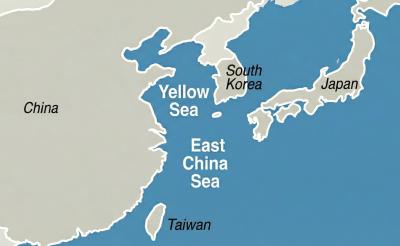
China has reserved offshore airspace in the Yellow Sea and East China Sea from March 27 to May 6, issuing alerts usually used to warn of military exercises, although no such exercises have been announced, the Wall Street Journal (WSJ) reported yesterday. Reserving such a large area for 40 days without explanation is an “unusual step,” as military exercises normally only last a few days, the paper said. These alerts, known as Notice to Air Missions (Notams), “are intended to inform pilots and aviation authorities of temporary airspace hazards or restrictions,” the article said. The airspace reserved in the alert is

South Korea is planning to revise its controversial electronic arrival card, a step Taiwanese officials said prompted them to hold off on planned retaliatory measures, a South Korean media report said yesterday. A Yonhap News Agency report said that the South Korean Ministry of Foreign Affairs is planning to remove the “previous departure place” and “next destination” fields from its e-arrival card system. The plan, reached after interagency consultations, is under review and aims to simplify entry procedures and align the electronic form with the paper version, a South Korean ministry official said. The fields — which appeared only on the electronic form

A bipartisan group of US senators has introduced a bill to enhance cooperation with Taiwan on drone development and to reduce reliance on supply chains linked to China. The proposed Blue Skies for Taiwan Act of 2026 was introduced by Republican US senators Ted Cruz and John Curtis, and Democratic US senators Jeff Merkley and Andy Kim. The legislation seeks to ease constraints on Taiwan-US cooperation in uncrewed aerial systems (UAS), including dependence on China-sourced components, limited access to capital and regulatory barriers under US export controls, a news release issued by Cruz on Wednesday said. The bill would establish a "Blue UAS

More than 6,000 Taiwanese students have participated in exchange programs in China over the past two years, despite the Mainland Affairs Council’s (MAC) “orange light” travel advisory, government records showed. The MAC’s publicly available registry showed that Taiwanese college and university students who went on exchange programs across the Strait numbered 3,592 and 2,966 people respectively. The National Immigration Agency data revealed that 2,296 and 2,551 Chinese students visited Taiwan for study in the same two years. A review of the Web sites of publicly-run universities and colleges showed that Taiwanese higher education institutions continued to recruit students for Chinese educational programs without


 RSS
RSS