


In a bid to prevent people affiliated with criminal gangs from joining the party, Democratic Progressive Party (DPP) Taipei chapter head Enoch Wu (吳怡農) yesterday proposed a set of “reform measures.”
“This is the only way forward for our party to make progress in politics with democratic values,” Wu told a convention of chapter heads that was led by President Tsai Ing-wen (蔡英文), who is the DPP chairperson. “The DPP must not betray the trust of its members, so I am asking chapter heads to push for and to implement these policies.”
The meeting was called in response to allegations that Chao Chieh-yu (趙介佑) was involved in racketeering, assault and kidnapping related to organized crime. Chao was expelled from the party this week after the allegations came to light.
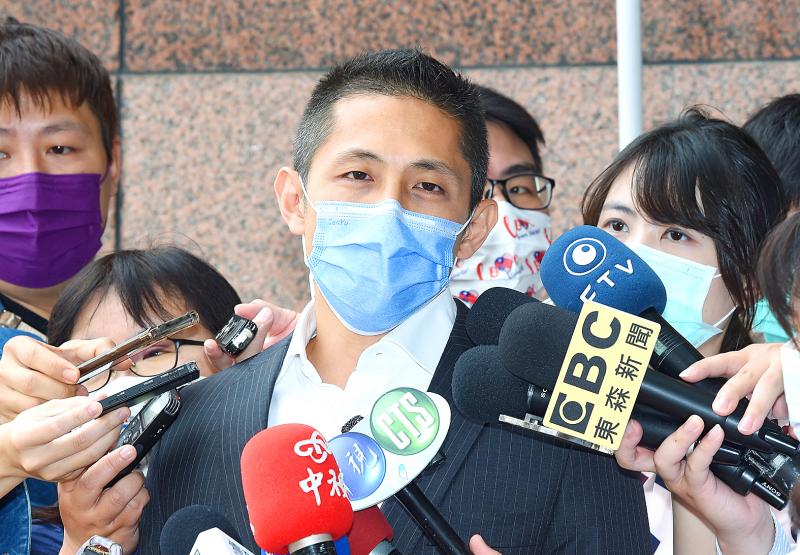
Photo: Liao Chen-huei, Taipei Times
Wu proposed three measures to screen people who apply to join the DPP.
The application must be filled out with authentic personal data; applicants must provide personal phone numbers, to prevent several people using the same number; and each applicant must pay a membership fee from their own pocket, he said.
The Taipei chapter will lead by example by vigorously screening every applicant and authenticating personal information that they submit, he said, adding that his office would keep in contact with every member of the city chapter and root out people affiliated with organized crime.
A prohibition on gang affiliation was approved at the DPP’s 2013 National Congress, but it was not fully implemented, Wu said.
The Taipei chapter has 250,000 members, but only about 30 percent have submitted complete personal information, so screening would be stepped up, every member would be contacted and payment of membership fees checked to remove “puppet members,” he said.
The checks are based on the 2013 provisions, disqualifying applicants who have been convicted of breaches of the Organized Crime Prevention Act (組織犯罪防制條例), the Narcotics Hazard Prevention Act (毒品危害防制條例) or the Controlling Guns, Ammunition and Knives Act (槍砲彈藥刀械管制條例), he said, adding that if members are found to have lied about a criminal background, they would be expelled from the party.
DPP spokesman Chou Chiang-chieh (周江杰) criticized the Chinese Nationalist Party (KMT), saying that its comments about Chao were hypocritical.
“Why would the KMT not look at itself first? It had people running in elections who were arrested over drugs and other offenses, a legislative candidate who committed a firearms offense and others with criminal records,” Chou said.
“The KMT condemn us for having members who are linked to gangs, but KMT Chairman Johnny Chiang (江啟臣) is afraid to implement a prohibition clause for his party like we have,” he said.

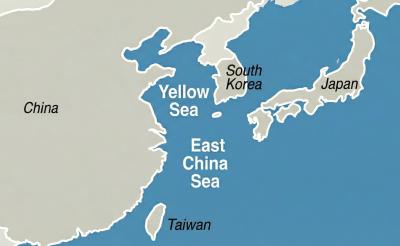
China has reserved offshore airspace in the Yellow Sea and East China Sea from March 27 to May 6, issuing alerts usually used to warn of military exercises, although no such exercises have been announced, the Wall Street Journal (WSJ) reported yesterday. Reserving such a large area for 40 days without explanation is an “unusual step,” as military exercises normally only last a few days, the paper said. These alerts, known as Notice to Air Missions (Notams), “are intended to inform pilots and aviation authorities of temporary airspace hazards or restrictions,” the article said. The airspace reserved in the alert is

South Korea is planning to revise its controversial electronic arrival card, a step Taiwanese officials said prompted them to hold off on planned retaliatory measures, a South Korean media report said yesterday. A Yonhap News Agency report said that the South Korean Ministry of Foreign Affairs is planning to remove the “previous departure place” and “next destination” fields from its e-arrival card system. The plan, reached after interagency consultations, is under review and aims to simplify entry procedures and align the electronic form with the paper version, a South Korean ministry official said. The fields — which appeared only on the electronic form

A bipartisan group of US senators has introduced a bill to enhance cooperation with Taiwan on drone development and to reduce reliance on supply chains linked to China. The proposed Blue Skies for Taiwan Act of 2026 was introduced by Republican US senators Ted Cruz and John Curtis, and Democratic US senators Jeff Merkley and Andy Kim. The legislation seeks to ease constraints on Taiwan-US cooperation in uncrewed aerial systems (UAS), including dependence on China-sourced components, limited access to capital and regulatory barriers under US export controls, a news release issued by Cruz on Wednesday said. The bill would establish a "Blue UAS

More than 6,000 Taiwanese students have participated in exchange programs in China over the past two years, despite the Mainland Affairs Council’s (MAC) “orange light” travel advisory, government records showed. The MAC’s publicly available registry showed that Taiwanese college and university students who went on exchange programs across the Strait numbered 3,592 and 2,966 people respectively. The National Immigration Agency data revealed that 2,296 and 2,551 Chinese students visited Taiwan for study in the same two years. A review of the Web sites of publicly-run universities and colleges showed that Taiwanese higher education institutions continued to recruit students for Chinese educational programs without


 RSS
RSS