


The Chinese Nationalist Party (KMT) caucus yesterday accused the government of conducting “surveillance of the opposition” after the installation of CCTV cameras in front of its office in the Legislative Yuan in Taipei.
KMT Legislator Alex Fai (費鴻泰) told a conference outside the legislative chamber that the cameras — which have facial recognition and sound recording capabilities — were installed without the caucus’ assent.
The lack of such devices outside the Democratic Progressive Party (DPP) caucus office just down the corridor suggests the decision was politically motivated, Fai said, asking: “When did Taiwan become a police state?”
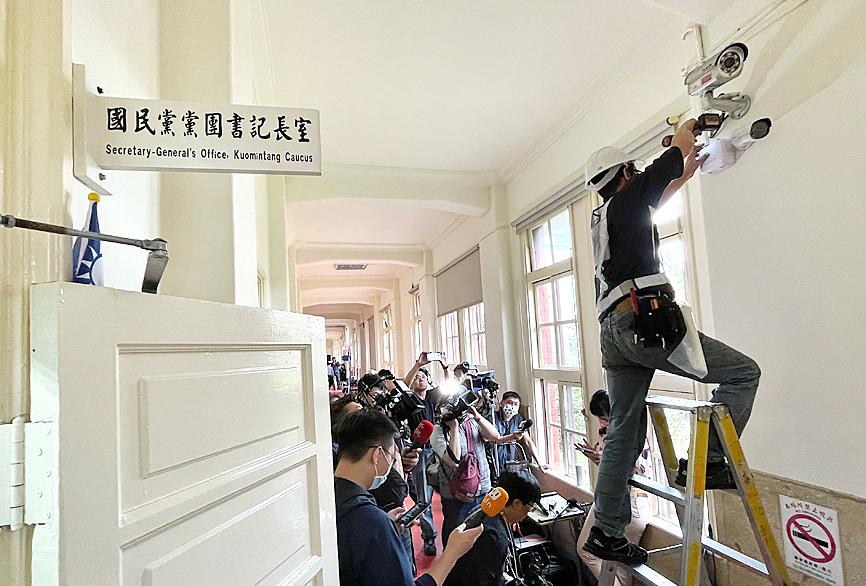
Photo: Liu Hsin-de, Taipei Times
KMT caucus secretary-general Cheng Li-wen (鄭麗文) said that the cameras that were installed in 2014 were not so out-of-date that replacement was necessary.
Legislative Speaker You Si-kun (游錫堃) should explain the matter, she said.
KMT lawmakers also lodged a protest on the legislative floor.
You asked Legislative Yuan Secretary-General Lin Jih-jia (林志嘉) to halt installations until the matter is looked into and a report is delivered within 10 days.
Cameras were installed in 2012 following a request by the KMT caucus, which at the time was concerned about possible break-ins at office, Lin said.
As with the originals, the replacement cameras can only record video, and have no sound recording or facial recognition capabilities, he said.
The KMT caucus is free to sign a statement that it does not wish the installation to continue, he said.
Taiwan People’s Party Legislator Ann Kao (高虹安) said that no one would oppose the installations if they were for security purposes, but there should be more communication between the two sides prior to any such work.
There should also be strict regulations on how footage from the cameras is allowed to be used, Kao said.
Meanwhile, the DPP on Facebook yesterday said that the KMT caucus’ actions were out of line with the Occupational Hazard Insurance and Protection Act (勞工職業災害保險及保護法) and that its accusations about being surveilled were nonsense.
The KMT caucus said that the DPP, as the ruling party and having a legislative majority, should not shy from answering legitimate questions on possible abuse of surveillance footage.
It can do better than smearing the opposition and shifting the focus, the caucus said.

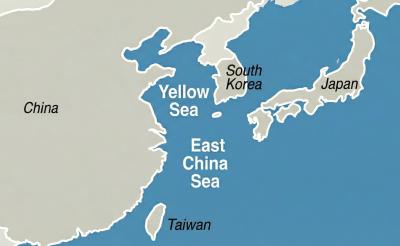
China has reserved offshore airspace in the Yellow Sea and East China Sea from March 27 to May 6, issuing alerts usually used to warn of military exercises, although no such exercises have been announced, the Wall Street Journal (WSJ) reported yesterday. Reserving such a large area for 40 days without explanation is an “unusual step,” as military exercises normally only last a few days, the paper said. These alerts, known as Notice to Air Missions (Notams), “are intended to inform pilots and aviation authorities of temporary airspace hazards or restrictions,” the article said. The airspace reserved in the alert is

More than 6,000 Taiwanese students have participated in exchange programs in China over the past two years, despite the Mainland Affairs Council’s (MAC) “orange light” travel advisory, government records showed. The MAC’s publicly available registry showed that Taiwanese college and university students who went on exchange programs across the Strait numbered 3,592 and 2,966 people respectively. The National Immigration Agency data revealed that 2,296 and 2,551 Chinese students visited Taiwan for study in the same two years. A review of the Web sites of publicly-run universities and colleges showed that Taiwanese higher education institutions continued to recruit students for Chinese educational programs without

A bipartisan group of US senators has introduced a bill to enhance cooperation with Taiwan on drone development and to reduce reliance on supply chains linked to China. The proposed Blue Skies for Taiwan Act of 2026 was introduced by Republican US senators Ted Cruz and John Curtis, and Democratic US senators Jeff Merkley and Andy Kim. The legislation seeks to ease constraints on Taiwan-US cooperation in uncrewed aerial systems (UAS), including dependence on China-sourced components, limited access to capital and regulatory barriers under US export controls, a news release issued by Cruz on Wednesday said. The bill would establish a "Blue UAS
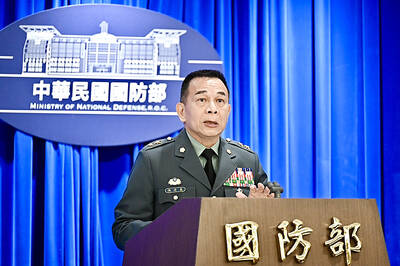
The Republic of China Army Command yesterday relieved Kinmen Defense Battalion commander after authorities indicted the officer on charges connected to using methamphetamine. The Kinmen District Prosecutors’ Office on Wednesday detained Colonel He (何) after the Coast Guard linked him to drug shipments and proceeded to charge him yesterday for using and possessing crystal meth. The man was released on a NT$50,000 bail and banned from leaving Kinmen, the office said. Army Chief of Staff Lieutenant General Chen Chien-yi (陳建義) told a news conference yesterday that He has been removed and another officer is taking over the unit as the acting commander. The military


 RSS
RSS