


Award-winning Hong Kong actor Anthony Wong (黃秋生), one of the few Hong Kong celebrities to have openly supported Hong Kong’s democracy movement, has received an employment gold card.
Wong’s receipt of the card, which is a combined work and residence permit given to highly skilled foreign professionals, was on Sunday confirmed by the National Development Council and Wong’s manager.
The actor is in quarantine in Taiwan and plans to stay until June. He has received many offers of work here, although nothing is yet set in stone, his manager said.
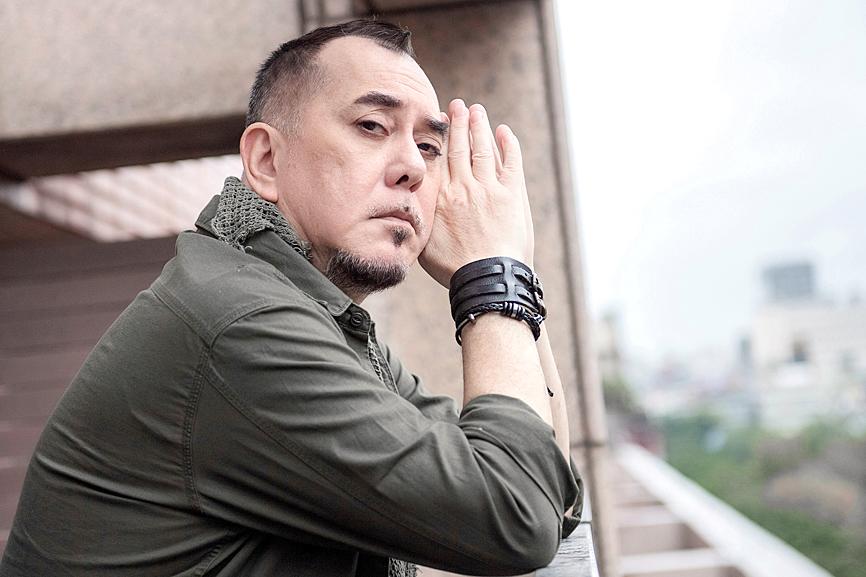
Photo courtesy of LiTV via CNA
Wong first hinted that he was considering moving to Taiwan in May last year, when a person commented on Facebook that he should become a naturalized Taiwanese citizen.
At the time, Wong responded that he was “making preparations,” without elaborating.
The 59-year-old actor has won numerous awards in Taiwan, Hong Kong and China throughout his decades-long career. He is best known in the West for his roles in the 1992 action film Hard Boiled, the 2002 crime thriller Infernal Affairs and as General Yang in the 2008 film The Mummy: Tomb of the Dragon Emperor.
However, after voicing his support for the pro-democracy movement in Hong Kong in 2014, he faced a shortage of roles.
Recently, he has been taking on roles in independent films and his performance in Still Human won him Best Actor at the Hong Kong Film Awards in 2019.
The gold card is a combination of a work permit, residence visa, alien resident permit and re-entry permit. Card holders are covered under the National Health Insurance program, receive tax benefits and can freely change jobs in Taiwan.
Since the gold card initiative’s inception in February 2018, 2,147 cards had been issued as of the end of last month.
They include 1,673 for foreign professionals who work in the economic sector, 269 in technology, 182 in culture and the arts, 165 in finance, 149 in education, eight in architecture and one in sports, council data showed.

Considering that most countries issue more than five denominations of banknotes, the central bank has decided to redesign all five denominations, the bank said as it prepares for the first major overhaul of the banknotes in more than 24 years. Central bank Governor Yang Chin-lung (楊金龍) is expected to report to the Legislative Yuan today on the bank’s operations and the redesign’s progress. The bank in a report sent to the legislature ahead of today’s meeting said it had commissioned a survey on the public’s preferences. Survey results showed that NT$100 and NT$1,000 banknotes are the most commonly used, while NT$200 and NT$2,000

The Centers for Disease Control (CDC) yesterday reported the first case of a new COVID-19 subvariant — BA.3.2 — in a 10-year-old Singaporean girl who had a fever upon arrival in Taiwan and tested positive for the disease. The girl left Taiwan on March 20 and the case did not have a direct impact on the local community, it said. The WHO added the BA.3.2 strain to its list of Variants Under Monitoring in December last year, but this was the first imported case of the COVID-19 variant in Taiwan, CDC Deputy Director-General Lin Ming-cheng (林明誠) said. The girl arrived in Taiwan on

South Korea is planning to revise its controversial electronic arrival card, a step Taiwanese officials said prompted them to hold off on planned retaliatory measures, a South Korean media report said yesterday. A Yonhap News Agency report said that the South Korean Ministry of Foreign Affairs is planning to remove the “previous departure place” and “next destination” fields from its e-arrival card system. The plan, reached after interagency consultations, is under review and aims to simplify entry procedures and align the electronic form with the paper version, a South Korean ministry official said. The fields — which appeared only on the electronic form

The Ministry of Foreign Affairs (MOFA) is suspending retaliation measures against South Korea that were set to take effect tomorrow, after Seoul said it is updating its e-arrival system, MOFA said today. The measures were to be a new round of retaliation after Taiwan on March 1 changed South Korea's designation on government-issued alien resident certificates held by South Korean nationals to "South Korea” from the "Republic of Korea," the country’s official name. The move came after months of protests to Seoul over its listing of Taiwan as "China (Taiwan)" in dropdown menus on its new online immigration entry system. MOFA last week


 RSS
RSS