


The Central Epidemic Command Center (CECC) yesterday expanded the eligibility for COVID-19 vaccination to the fourth priority group — people who need to travel abroad for special reasons — adding that out-of-pocket vaccines would be available from Wednesday next week.
Minister of Health and Welfare Chen Shih-chung (陳時中), who heads the center, said although Taiwan’s COVID-19 vaccination program was on Monday expanded to include the top three groups in the priority list, people are still “not enthusiastic” about getting vaccinated.
“Only 1,220 people received a vaccine shot on Tuesday, and a total of 27,113 people have received COVID-19 vaccination” so far, he said.

Photo: CNA
The fourth priority group refers to people who have been proposed by a competent authority and approved by the CECC as special cases who need to travel, Chen said.
They include diplomats and public-sector expatriates; staff members of foreign representative offices and their family members — given their country of origin offers vaccination to Taiwanese diplomats there under the principle of reciprocity; and athletes or contestants representing the nation.
The group consists of about 5,000 people, Chen said, adding that the number of people in the top four priority groups total about 618,000.
As authorities are listing eligible vaccine recipients to the center, the CECC urged people who have been notified that they are eligible to book a vaccine appointment with a designated hospital in advance and take their National Health Insurance card to get vaccinated.
Chen said the center would also release an additional 10,000 doses of COVID-19 vaccines for people who need to travel abroad, starting on Wednesday next week.
He said people who need to travel abroad “for business, work, study, medical treatment or humanitarian reasons” can apply for the paid vaccine, but those who are traveling for tourism purposes would not be allowed to apply for the time being.
People who wish to receive a paid vaccination can book an appointment with one of the 31 designated vaccination hospitals that have a travel medicine outpatient clinic, he said.
There is at least one vaccination hospital in each city or county, including the outlying islands.
“They would need to pay the hospital’s registration fee, examination fee and injection fee, but they would not pay the cost of the vaccine,” as they are not allowed to choose the vaccine brand at this time, Chen said.
The vaccine is free of charge also because the recipients are included in the government-funded vaccination program, albeit at a lower priority, so they would only be paying the administrative fees to get vaccinated earlier, he said.
The paid vaccines are not limited to Republic of China citizens, and foreign residents can also apply to receive vaccination, the CECC said.
The center has capped the total administration fees that the hospitals can charge for paid vaccines at NT$600 for medical centers, NT$550 for regional hospitals and NT$500 for district hospitals, Chen said.
“Getting vaccinated is preparing for the future,” he said, adding that while Taiwan does not have local outbreaks, getting vaccinated can provide better protection against COVID-19, as national borders will be gradually opened.
The two doses of the vaccine should be administered at least eight weeks apart and it takes about two weeks for the body to build up immunity after vaccination, so it could be too late to receive a vaccine when national borders open, Chen said, urging eligible vaccine recipients to get vaccinated as soon as possible.
Quarantine rules could be eased if Taiwan’s vaccine coverage rate reaches a safe level and the center is working toward reducing the quarantine period for arriving travelers who have been vaccinated against COVID-19, Chen said, adding that possible options and standards are still being discussed.
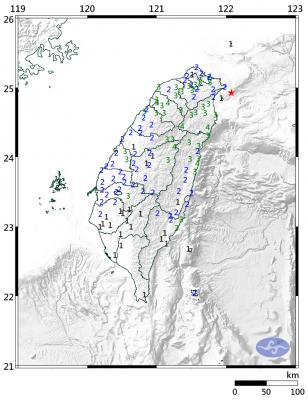
A magnitude 6.1 earthquake struck off the coast of Yilan County at 8:39pm tonight, the Central Weather Administration (CWA) said, with no immediate reports of damage or injuries. The epicenter was 38.7km east-northeast of Yilan County Hall at a focal depth of 98.3km, the CWA’s Seismological Center said. The quake’s maximum intensity, which gauges the actual physical effect of a seismic event, was a level 4 on Taiwan’s 7-tier intensity scale, the center said. That intensity level was recorded in Yilan County’s Nanao Township (南澳), Hsinchu County’s Guansi Township (關西), Nantou County’s Hehuanshan (合歡山) and Hualien County’s Yanliao (鹽寮). An intensity of 3 was
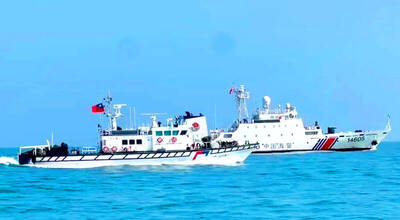
Instead of focusing solely on the threat of a full-scale military invasion, the US and its allies must prepare for a potential Chinese “quarantine” of Taiwan enforced through customs inspections, Stanford University Hoover fellow Eyck Freymann said in a Foreign Affairs article published on Wednesday. China could use various “gray zone” tactics in “reconfiguring the regional and ultimately the global economic order without a war,” said Freymann, who is also a nonresident research fellow at the US Naval War College. China might seize control of Taiwan’s links to the outside world by requiring all flights and ships entering or leaving Taiwan
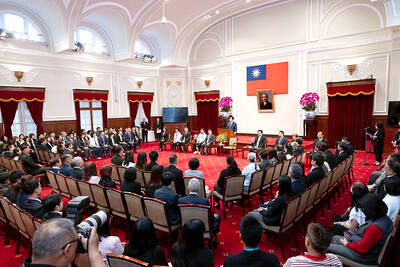
The next minimum wage hike is expected to exceed NT$30,000, President William Lai (賴清德) said yesterday during an award ceremony honoring “model workers,” including migrant workers, at the Presidential Office ahead of Workers’ Day today. Lai said he wished to thank the awardees on behalf of the nation and extend his most sincere respect for their hard work, on which Taiwan’s prosperity has been built. Lai specifically thanked 10 migrant workers selected for the award, saying that although they left their home countries to further their own goals, their efforts have benefited Taiwan as well. The nation’s industrial sector and small businesses lay
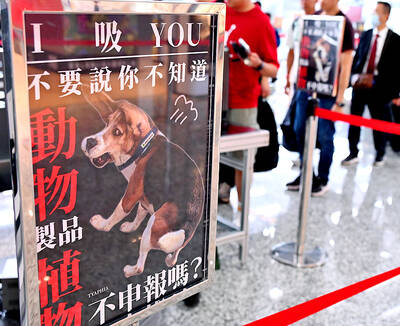
Quarantine awareness posters at Taiwan Taoyuan International Airport have gone viral for their use of wordplay. Issued by the airport branch of the Animal and Plant Health Inspection Agency, the posters feature sniffer dogs making a range of facial expressions, paired with advisory messages built around homophones. “We update the messages for holidays and campaign needs, periodically refreshing materials to attract people’s attention,” quarantine officials said. “The aim is to use the dogs’ appeal to draw focus to quarantine regulations.” A Japanese traveler visiting Taiwan has posted a photo on X of a poster showing a quarantine dog with a


 RSS
RSS