


The public’s erroneous expectation that news be provided free of charge should be corrected, a representative of the Taipei Newspapers Association said yesterday, recommending that the government play a role in guiding such a transition.
Association secretary-general and Commercial Times deputy general manager Chen Chih-kuang (陳志光) made the remark at a forum held by the Fair Trade Commission in Taipei on digital platforms and online advertising.
Due to the influence of digital platforms, readers have come to believe that reading news for free should be the norm, but this could be changed with assistance from the government, Chen said.
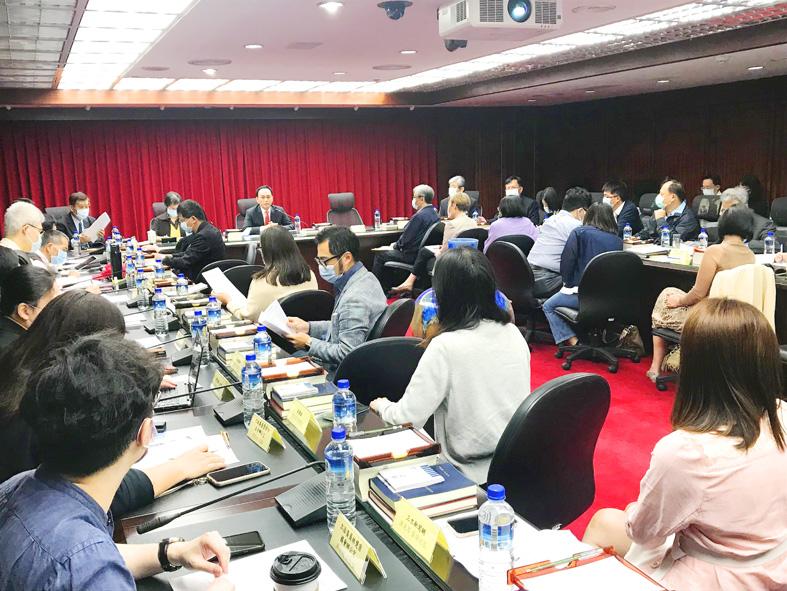
Photo: Lee Ya-wen, Taipei Times
Taiwan should join the debate surrounding Australia’s controversial News Media Bargaining Code, which requires large platforms to pay media outlets for the content provided on their sites, he said.
Taiwanese media are valuable in the Chinese-speaking market, Chen said, suggesting that Taiwan’s media associations band together to promote legislation combating big tech’s influence on news media.
The association in a statement said that over the past 20 years, Facebook and Google have been benefiting from the free media furnished by local providers, severely damaging the development of the industry.
The Australian law is just the start to reconciling the two, it said, adding that the government must respond to keep up with the times.
The association recommended six points to consider:
First, the public’s erroneous expectation that news should be provided free of charge must be corrected so that media businesses can get back on track, it said.
The Australian model has set a benchmark for how the government could help local media negotiate and keep up with the new “news for pay” standard, it added.
Second, the nation must find a way to join transnational negotiations to better understand other countries’ rapidly changing approaches toward anti-monopolistic legislation, the association said.
Third, the nation must not undervalue itself, it said.
Taiwan has nearly the same population as Australia and is far more influential in the Internet technology field, it said.
Since Canberra was the first to pass legislation, it has become a leader in the global pushback against tech monopolies, to be followed by Canada, the UK, the EU, India and other nations, it said, adding that Taiwan must not stay on the sidelines.
Fourth, Taiwan is the most important region for the production of Chinese-language news media, and therefore has significant bargaining power over Google and Facebook, the association said.
The government should adopt the collective bargaining tactics of Australia, Canada and other nations, and work with the nation’s media associations to speak with a unified voice, it said.
Fifth, by promoting legislation inspired by the Australian law, it could ensure the continued development of the nation’s dynamic traditional media landscape, it added.
Last, even with its peripheral standing in the English-language media market, Australia has managed to gain global influence by using the leverage afforded by the government and industry to seize the chance provided by changes in the industry, while also supporting local businesses transition into the next online era, it said.
This foresight could serve as an example to Taiwan moving forward, the association added.

A group of Taiwanese-American and Tibetan-American students at Harvard University on Saturday disrupted Chinese Ambassador to the US Xie Feng’s (謝鋒) speech at the school, accusing him of being responsible for numerous human rights violations. Four students — two Taiwanese Americans and two from Tibet — held up banners inside a conference hall where Xie was delivering a speech at the opening ceremony of the Harvard Kennedy School China Conference 2024. In a video clip provided by the Coalition of Students Resisting the CCP (Chinese Communist Party), Taiwanese-American Cosette Wu (吳亭樺) and Tibetan-American Tsering Yangchen are seen holding banners that together read:

UNAWARE: Many people sit for long hours every day and eat unhealthy foods, putting them at greater risk of developing one of the ‘three highs,’ an expert said More than 30 percent of adults aged 40 or older who underwent a government-funded health exam were unaware they had at least one of the “three highs” — high blood pressure, high blood lipids or high blood sugar, the Health Promotion Administration (HPA) said yesterday. Among adults aged 40 or older who said they did not have any of the “three highs” before taking the health exam, more than 30 percent were found to have at least one of them, Adult Preventive Health Examination Service data from 2022 showed. People with long-term medical conditions such as hypertension or diabetes usually do not
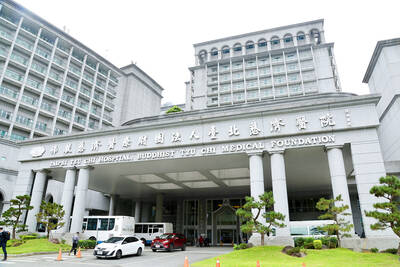
POLICE INVESTIGATING: A man said he quit his job as a nurse at Taipei Tzu Chi Hospital as he had been ‘disgusted’ by the behavior of his colleagues A man yesterday morning wrote online that he had witnessed nurses taking photographs and touching anesthetized patients inappropriately in Taipei Tzu Chi Hospital’s operating theaters. The man surnamed Huang (黃) wrote on the Professional Technology Temple bulletin board that during his six-month stint as a nurse at the hospital, he had seen nurses taking pictures of patients, including of their private parts, after they were anesthetized. Some nurses had also touched patients inappropriately and children were among those photographed, he said. Huang said this “disgusted” him “so much” that “he felt the need to reveal these unethical acts in the operating theater
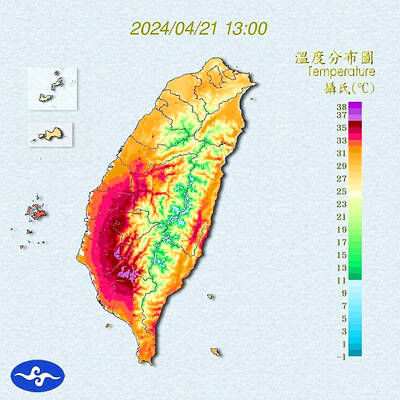
Heat advisories were in effect for nine administrative regions yesterday afternoon as warm southwesterly winds pushed temperatures above 38°C in parts of southern Taiwan, the Central Weather Administration (CWA) said. As of 3:30pm yesterday, Tainan’s Yujing District (玉井) had recorded the day’s highest temperature of 39.7°C, though the measurement will not be included in Taiwan’s official heat records since Yujing is an automatic rather than manually operated weather station, the CWA said. Highs recorded in other areas were 38.7°C in Kaohsiung’s Neimen District (內門), 38.2°C in Chiayi City and 38.1°C in Pingtung’s Sandimen Township (三地門), CWA data showed. The spell of scorching


 RSS
RSS