


More people in Taiwan are dying from strokes, particularly young people, Ministry of Health and Welfare statistics showed.
The number of deaths in Taiwan due to a stroke, mainly from the rupture of cerebral blood vessels, was about 12,000 in 2019, the highest in 12 years, ministry data showed.
Strokes, also known as cerebrovascular accidents, are no longer exclusive to elderly people, as more people are at higher risk due to not drinking enough water throughout the day, ignoring chronic health conditions, taking on too much stress at work, keeping irregular hours or having an unhealthy lifestyle, health officials said.
The ministry’s data showed that one in five people who died from a stroke were not senior citizens: About 20 percent were 45 or younger, 40 percent were aged 50 to 59, and 480 people were aged 40 to 49.
Overall, strokes cause more than 10,000 deaths in Taiwan each year, officials said, adding that researchers have estimated that about 10 million people in Taiwan are over the age of 35, and there is an estimated stroke incidence rate of three per every 1,000 people, so about 30,000 people have a stroke each year, mostly caused by cerebral infarction or the rupture of cerebral vessels.
Ten percent of people who died from a stroke in 2015 were under the age of 45, and that figure has climbed steadily each year since, the ministry’s data showed.
“In our clinical rehabilitation work, we have been seeing young people experiencing a stroke, although some might be caused by hereditary conditions,” said Tsai Po-yi (蔡泊意), an attending physician at Taipei Veterans General Hospital’s Department of Physical Medicine and Rehabilitation.
“We had one case who was under the age of 30, who has a family history of high blood pressure, and he stopped taking medicine for it, believing he [was too young to be affected], but he suffered a stroke within a month,” Tsai said.
“Also we see people with jobs in the tech industry, who are under much stress ... and often work into the night, being struck down by stroke,” she added.
Chen Lung (陳龍), a doctor and Taiwan Stroke Society board member, said that young people are now prone to having high blood pressure, high cholesterol and high blood sugar.
For example, a high-school student who attended classes in the day and had part-time jobs at night had a stroke when playing computer games, he said.
People who keep irregular hours and are under stress at work can experience a dysfunctional autonomic nervous system and blood pressure abnormalities, he said.
Tsai said that thickening of the blood can lead to clotting, so people should drink water regularly, at one-and-a-half to two-hour intervals, and when exercising, every hour.
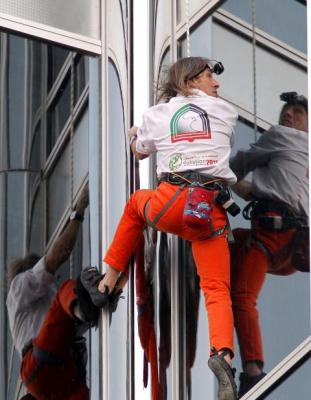
Alain Robert, known as the "French Spider-Man," praised Alex Honnold as exceptionally well-prepared after the US climber completed a free solo ascent of Taipei 101 yesterday. Robert said Honnold's ascent of the 508m-tall skyscraper in just more than one-and-a-half hours without using safety ropes or equipment was a remarkable achievement. "This is my life," he said in an interview conducted in French, adding that he liked the feeling of being "on the edge of danger." The 63-year-old Frenchman climbed Taipei 101 using ropes in December 2004, taking about four hours to reach the top. On a one-to-10 scale of difficulty, Robert said Taipei 101
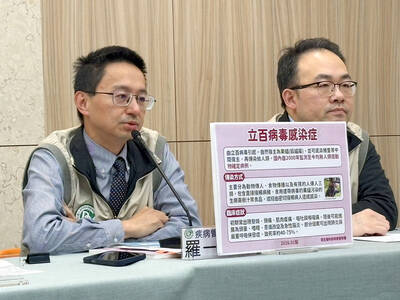
Nipah virus infection is to be officially listed as a category 5 notifiable infectious disease in Taiwan in March, while clinical treatment guidelines are being formulated, the Centers for Disease Control (CDC) said yesterday. With Nipah infections being reported in other countries and considering its relatively high fatality rate, the centers on Jan. 16 announced that it would be listed as a notifiable infectious disease to bolster the nation’s systematic early warning system and increase public awareness, the CDC said. Bangladesh reported four fatal cases last year in separate districts, with three linked to raw date palm sap consumption, CDC Epidemic Intelligence

Taiwanese and US defense groups are collaborating to introduce deployable, semi-autonomous manufacturing systems for drones and components in a boost to the nation’s supply chain resilience. Taiwan’s G-Tech Optroelectronics Corp subsidiary GTOC and the US’ Aerkomm Inc on Friday announced an agreement with fellow US-based Firestorm Lab to adopt the latter’s xCell, a technology featuring 3D printers fitted in 6.1m container units. The systems enable aerial platforms and parts to be produced in high volumes from dispersed nodes capable of rapid redeployment, to minimize the risk of enemy strikes and to meet field requirements, they said. Firestorm chief technology officer Ian Muceus said
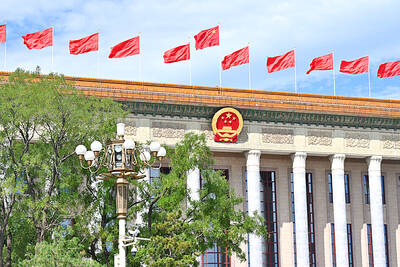
MORE FALL: An investigation into one of Xi’s key cronies, part of a broader ‘anti-corruption’ drive, indicates that he might have a deep distrust in the military, an expert said China’s latest military purge underscores systemic risks in its shift from collective leadership to sole rule under Chinese President Xi Jinping (習近平), and could disrupt its chain of command and military capabilities, a national security official said yesterday. If decisionmaking within the Chinese Communist Party has become “irrational” under one-man rule, the Taiwan Strait and the regional situation must be approached with extreme caution, given unforeseen risks, they added. The anonymous official made the remarks as China’s Central Military Commission Vice Chairman Zhang Youxia (張又俠) and Joint Staff Department Chief of Staff Liu Zhenli (劉振立) were reportedly being investigated for suspected “serious


 RSS
RSS