


Police last week recovered 13 stolen racing pigeons within 14 hours, as training intensifies ahead of spring competitions.
At about 6pm on Friday last week, police officers on patrol in New Taipei City’s Rueifang District (瑞芳) noticed that a vehicle had been parked for a long time in front of a restaurant that serves alcohol.
Suspecting the driver might be drunk, the officers slowly drove past to see if it would elicit a reaction. When the vehicle pulled out after them, they turned around and blocked it.
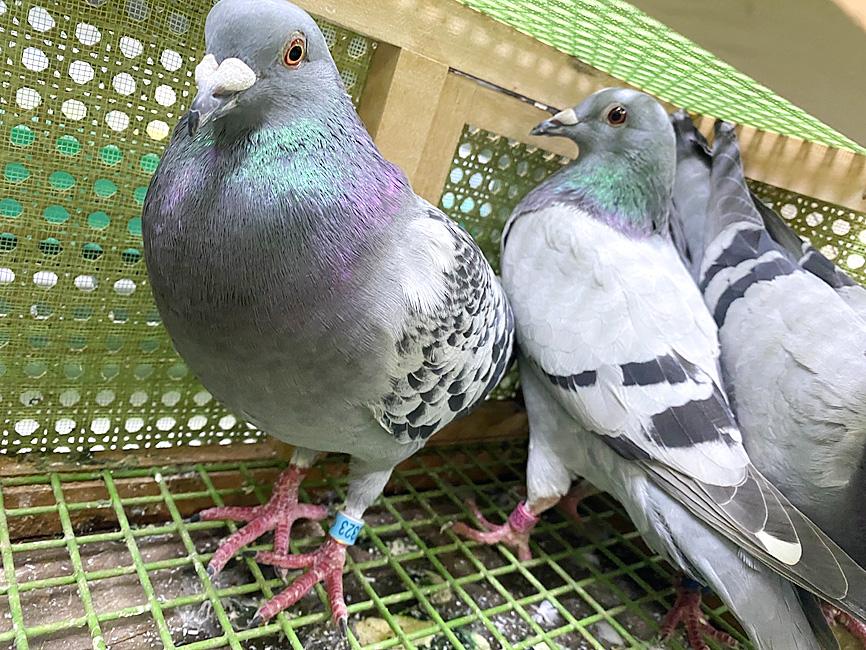
Photo copied by Lin Chia-tung, Taipei Times
While performing an alcohol test on the driver, surnamed Chang (張), the officers noticed a cooing sound coming from the trunk, where they said they discovered 11 pigeons, rope nets and other equipment for catching the birds.
Chang and a passenger, surnamed Lai (賴), said they caught the pigeons at Nuannuan Sports Park in Keelung to train for racing, not to hold for ransom, the officers said.
However, police discovered that Lai had been implicated in a Taipei pigeon extortion ring in 2015, while Chang had a record of stealing lumber.
Police said they believed the suspects were stealing racing pigeons to extort the owners for money.
At 8am the next day, an informant surnamed Yeh (葉) told Rueifang police that a group had discovered three pigeon thieves in the mountains between Keelung and Rueifang and were able to stop two from running away.
At the scene, police found two men, surnamed Hung (洪) and Lai (賴), with nets and two racing pigeons, and detained them on suspicion of theft.
Based on the tags around the pigeons’ legs, the 13 birds came from as far away as Taoyuan, Miaoli County and other regions, police said.
The owners did not yet know their pigeons had been stolen when police contacted them.
They thanked the officers for “holding on to the fruits of our training,” police said.
Pigeon racing has been a popular leisure activity among Taiwanese since the 1970s.
To compete, trained pigeons are released a set distance from their coops and timed to determine which returns the fastest.
Races are held four times a year to correspond with the seasons, one enthusiast said.
As the pedigree and training of the pigeons are critical to their performance, some enthusiasts buy purebred birds from Belgium, the Netherlands and other places for millions of New Taiwan dollars, in addition to the about 120,000 breeders in Taiwan who raise coveted breeds, statistics showed.
Considering their value, some people attempt to capture pigeons during training and extort their owners for their safe return.
Additional reporting by Cheng Ching-yi and Liu Ching-hou

Fast food chain McDonald's is to raise prices by up to NT$5 on some products at its restaurants across Taiwan, starting on Wednesday next week, the company announced today. The prices of all extra value meals and sharing boxes are to increase by NT$5, while breakfast combos and creamy corn soup would go up by NT$3, the company said in a statement. The price of the main items of those meals, if ordered individually, would remain the same. Meanwhile, the price of a medium-sized lemon iced tea and hot cappuccino would rise by NT$3, extra dipping sauces for chicken nuggets would go up

Nvidia Corp CEO Jensen Huang (黃仁勳) arrived in Taiwan yesterday ahead of upcoming AI and technology events, saying he plans to meet with clients and Taiwan Semiconductor Manufacturing Co Chairman C.C. Wei (魏哲家) during his visit. After landing at Taipei Songshan Airport, Huang posed for photos with fans and handed out Yakult drinks to reporters and supporters waiting at the scene, saying he has “a lot to do” during the trip. Asked about reports that Nvidia’s planned headquarters site in Taipei’s Beitou Shilin Technology Park could break ground on May 27, Huang said that if the company holds an event, he would

FUKUOKA SITUATION: Japanese media reported that the pathogen is expected to be identified by the summer, while the CDC downplayed the idea that it was hMPV A “mysterious cold-like illness” reported in Japan’s Fukuoka Prefecture does not seem to be a new disease, but Japanese authorities have been asked about the situation, the Centers for Disease Control (CDC) said yesterday. The Fukuoka Prefectural Medical Association on Wednesday told a news conference that a “mystery cold” that has become a hot topic on social media is “highly likely to be caused by some kind of viral infection,” Japan’s KBC News reported. “Many people are experiencing symptoms starting with a sore throat, followed by a runny nose, phlegm and a severe cough,” KBC News reported, citing association officials. Health authorities are

Carrefour Taiwan is to begin using a new name from the start of July, but it cannot divulge the name until then, the chairman of the supermarket chain's parent company said today. President Chain Store Co chairman Lo Chih-hsien (羅智先) was asked by reporters after a shareholders' meeting to confirm whether the company has settled on a new name for the supermarket brand. In March, the government-registered name of two Carrefour Taiwan branches was quietly changed to "Le Chia Kang" (樂家康) in Chinese, raising speculation that has been selected as the name. Lo said that because of local regulations and contractual obligations, the


 RSS
RSS