


The Central Epidemic Command Center (CECC) yesterday reported the nation’s first case of death from influenza this flu season and one new imported case of COVID-19.
The deceased was a man in his 80s who did not get vaccinated against the flu this season — which started in October — and was infected with the type A influenza virus, Centers for Disease Control (CDC) Epidemic Intelligence Center Director Guo Hung-wei (郭宏偉) said.
The man, who lived in southern Taiwan, had a history of diabetes, hypertension and stroke, and at times experienced coughing or choking when eating, CDC physician Lin Yung-ching (林詠青) said.
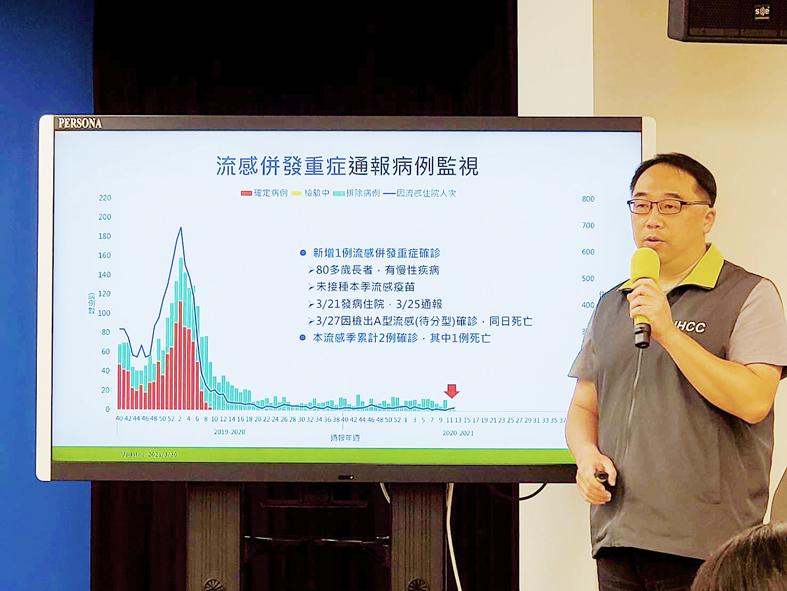
Photo: Lin Hui-chin, Taipei Times
On March 20, a family member noticed that he had difficulty breathing and phlegm in the throat.
He was hospitalized the next day for shortness of breath, low blood oxygen levels and vomiting, Lin said, adding that he was diagnosed with aspiration pneumonia in both lungs.
The man was transferred to the intensive care unit shortly after he experienced respiratory failure, and further examinations found that he had been infected with an influenza A virus, so he was given antibiotics and antiviral drugs, Lin said.
However, the man also developed kidney failure and septic shock, and died on Saturday, he said.
It was the first flu death and the second serious flu complication this season, he added.
While the number of serious flu complications and flu deaths have been significantly lower than in previous years, it does not mean that local communities are safe from circulating flu viruses, so people, especially those with underlying health conditions, should still take preventive measures against the disease, he added.
Eligibility for government-funded flu vaccines has since Jan. 30 been expanded to include everyone older than six months, so people with a higher risk of serious complications from flu infection are advised to get vaccinated, he said.
A Taiwanese woman in her 30s who returned to Taiwan from the UK on Sunday is the nation’s latest confirmed case of COVID-19, said CDC Deputy Director-General Chuang Jen-hsiang (莊人祥), who is also the CECC spokesman.
The woman left in September 2019 for the UK for studies and did not show any symptoms after returning to Taiwan, Chuang said.
However, she tested positive for COVID-19 in a specialized testing program at the centralized quarantine facility on Monday, he said.
Thirteen people who were seated close to her on the same flight to Taiwan have tested negative and remain isolated at centralized quarantine facilities, he added.
As of 10am yesterday, 10,891 people had received a dose of the AstraZeneca COVID-19 jab since vaccinations started in Taiwan on Monday last week, he said, adding that 10 more non-serious adverse events were reported on Monday.
The mild adverse events were symptoms such as fever, sore muscles, chills, headache and pain at the injection site, he added.

Considering that most countries issue more than five denominations of banknotes, the central bank has decided to redesign all five denominations, the bank said as it prepares for the first major overhaul of the banknotes in more than 24 years. Central bank Governor Yang Chin-lung (楊金龍) is expected to report to the Legislative Yuan today on the bank’s operations and the redesign’s progress. The bank in a report sent to the legislature ahead of today’s meeting said it had commissioned a survey on the public’s preferences. Survey results showed that NT$100 and NT$1,000 banknotes are the most commonly used, while NT$200 and NT$2,000

The Centers for Disease Control (CDC) yesterday reported the first case of a new COVID-19 subvariant — BA.3.2 — in a 10-year-old Singaporean girl who had a fever upon arrival in Taiwan and tested positive for the disease. The girl left Taiwan on March 20 and the case did not have a direct impact on the local community, it said. The WHO added the BA.3.2 strain to its list of Variants Under Monitoring in December last year, but this was the first imported case of the COVID-19 variant in Taiwan, CDC Deputy Director-General Lin Ming-cheng (林明誠) said. The girl arrived in Taiwan on

South Korea is planning to revise its controversial electronic arrival card, a step Taiwanese officials said prompted them to hold off on planned retaliatory measures, a South Korean media report said yesterday. A Yonhap News Agency report said that the South Korean Ministry of Foreign Affairs is planning to remove the “previous departure place” and “next destination” fields from its e-arrival card system. The plan, reached after interagency consultations, is under review and aims to simplify entry procedures and align the electronic form with the paper version, a South Korean ministry official said. The fields — which appeared only on the electronic form

The Ministry of Foreign Affairs (MOFA) is suspending retaliation measures against South Korea that were set to take effect tomorrow, after Seoul said it is updating its e-arrival system, MOFA said today. The measures were to be a new round of retaliation after Taiwan on March 1 changed South Korea's designation on government-issued alien resident certificates held by South Korean nationals to "South Korea” from the "Republic of Korea," the country’s official name. The move came after months of protests to Seoul over its listing of Taiwan as "China (Taiwan)" in dropdown menus on its new online immigration entry system. MOFA last week


 RSS
RSS