

A newly formed Chinese company using the likeness of a firm formed in Taiwan and technology developed with an investment from a government-affiliated organization could be just the tip of a national security iceberg and must be investigated, a legislator said yesterday.
After Hestia Power Inc (瀚薪科技), started with support and investment by the Industrial Technology Research Institute, was dissolved last month, staff from the company turned up in Shanghai at a new venture called Shanghai Hestia Power Inc (上海瀚薪科技), Taiwan People’s Party (TPP) Legislator Ann Kao (高虹安) told a news conference at the Legislative Yuan in Taipei.
The Shanghai firm has the same leaders and team members, and even uses the same logo, she said.
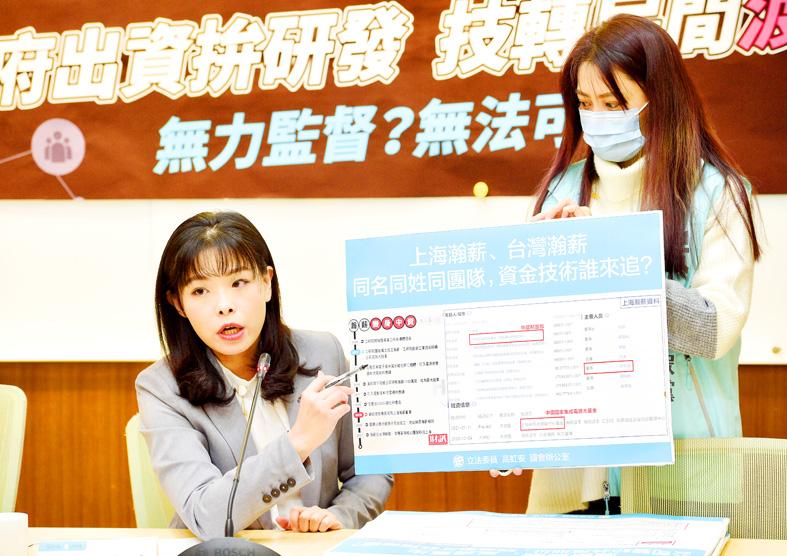
Photo: Peter Lo, Taipei Times
“This is a national security issue, for China to steal our core technology and skilled talent in the semiconductor industry,” she said, adding that the government must close legal loopholes to prevent such an incident from recurring.
“How can institute-subsidized research and development end up in China to aid them in surpassing Taiwan in a key sector of the semiconductor industry?” she said.
Institute officials said the institute is cooperating with an investigation into breach of trust and other possible contraventions.
The semiconductor industry and its supply chain are not affected by the incident, they said.
Hestia, which had been selected as one of Taiwan’s high-tech “future stars,” developed silicon-carbide materials used in semiconductors, an important component in electric vehicles and 5G networking technology, Kao said.
Lee Chuan-ying (李傳英), who headed Hestia, went to China before Hestia was dissolved, and then set up Phoenix Power Inc (凰騰公司), using Hestia’s address, she said.
There were suspicious aspects to the flow of money and transfer of technology and staff, she said, adding that there was possibly negligence or failure in Taiwan’s main protection mechanisms, including in the Trade Secrets Act (營業秘密法) and measures on the transfer of technology to foreign countries.
The government must amend regulations to stop China from stealing the nation’s key technologies.
Additional reporting by Jason Pan

A Hualien pomelo farmer refused to sell to China after the country announced it would permit more Taiwanese pomelo imports, prompting widespread support from Taiwanese consumers, who rallied to buy his fruit. China’s Taiwan Affairs Office last month said that China’s General Administration of Customs registered an additional 79 Taiwanese pomelo orchards and packing facilities in Hualien County, allowing more Taiwanese producers to export pomelos to China. “I am a Hualien fruit farmer and I refuse to sell to China,” Liu Tzu-hao (劉子豪) from Ruisui Township (瑞穗) said in an online post. Liu is a well-known farmer in the community and has served
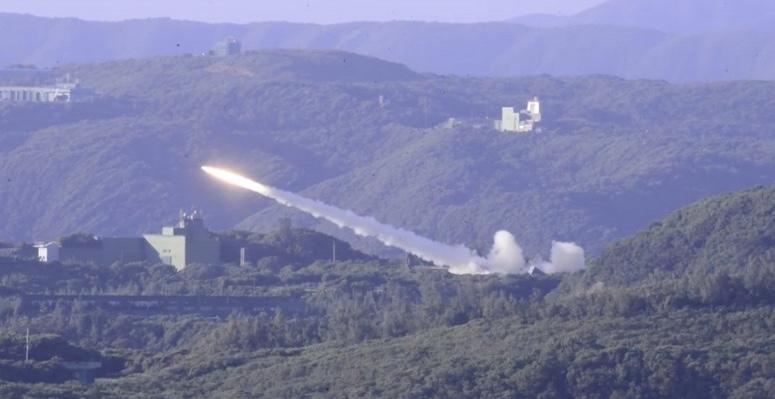
A Chinese military drone was spotted conducting reconnaissance off Taitung County as President William Lai (賴清德) visited Pingtung County this morning to inspect a drill of the armed forces’ precision-strike capabilities, prompting the military to closely monitor its actions. Today was the final day of a three-day military exercise at Jioupeng Base (九鵬基地) to test the joint combat capabilities of the armed forces and coast guard. The exercise began on Wednesday simulating air defense interception and yesterday tested long-range strike capabilities and new air defense weapons. This morning, the military conducted a final exercise involving air defense, anti-ship and drone operations. Military sources said

OCT. 31: The antiviral drugs Tamiflu and Eraflu have been distributed to about 4,000 medical facilities nationwide for people in seven groups who develop flu-like symptoms As the domestic influenza epidemic enters its peak season and continues to escalate, the Centers for Disease Control (CDC) yesterday announced that publicly funded influenza antiviral drugs for seven eligible groups have been extended to Oct. 31, allowing those who develop flu-like symptoms to receive the medication without undergoing a rapid influenza test. The CDC has extended the expanded use of flu antiviral drugs to seven groups: healthcare and influenza-prevention personnel; residents and staff at nursing homes, long-term care facilities and similar institutions; kindergarten and daycare workers and home-based caregivers; students from kindergarten through high school, vocational high school and the

Taiwanese Tsai Chin-shu (蔡金樹), who had been imprisoned in China for engaging in activity that “endangers national security,” said on Facebook on Friday that he has returned to Taiwan. Tsai, chairman of the Southern Taiwan Union of Cross-strait Relations Associations, had traveled frequently between Taiwan and China for years, and at one time ran a trading company in China’s Pingtan. In July 2018, he traveled to Quanzhou, Fujian Province, to attend a cross-strait food trade fair and stayed at a hotel in Xiamen. He checked out the following day and then disappeared. His family had made repeated appeals to the authorities


 RSS
RSS