


The New Power Party (NPP) yesterday urged the Executive Yuan to implement an integrated housing and land taxation system, as well as a vacant home tax to increase the nation’s housing supply.
An amendment to the Income Tax Act (所得稅法), which was approved by the Cabinet on Thursday last week, redefines “short-term property ownership” by extending the duration from the previous limit to five years from two years.
Under the new tax system, private individuals and institutions would pay a 45 percent tax on the profit they gain from selling homes or properties within two years of purchase, while those who sell within two to five years of purchase would pay a 35 percent tax.
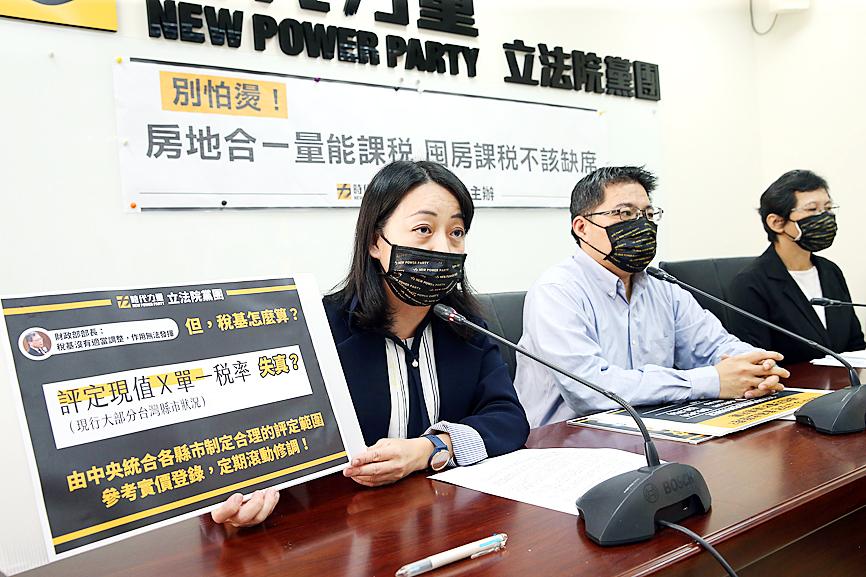
Photo: CNA
NPP Chairwoman Chen Jiau-hua (陳椒華) said that while the party recognizes the government’s efforts in tackling an urgent and thorny issue, simply redefining short-term property ownership would not stop those with “deep pockets” from hoarding houses.
The government should define a tax bracket for gains from housing sales, Chen said, adding that people earning high profits from housing transactions should pay higher taxes.
If homeowners are willing to decrease selling prices, they would pay less property transaction tax, she said.
“This would not only guarantee a reasonable return on investment for homeowners, but it would also effectively curb the excessive rise in housing prices,” Chen said.
The deductible in transactions involving owner-occupied homes in the integrated housing and land taxation system was stipulated based on the housing market in 2015, Chen said, adding that the Ministry of Finance should survey the current housing market and readjust the deductible.
NPP caucus director Claire Wang (王婉諭) said the government should change the tax base and implement a tax bracket in the new tax system, otherwise real housing justice would never be achieved.
The Ministry of Finance should consult local government officials and review the actual housing prices registered by homeowners before readjusting the tax base, Wang said, adding that this would ensure reasonable housing prices in every locality.
The NPP also proposed a tax bracket that would protect homeowners and lower the percentage of people owning multiple homes, Wang said, adding that more vacant homes would in turn be released to the housing market.
The Cabinet delayed levying a vacant home tax on grounds that 780,000 tenants at rental units would be asked to pay the tax instead, Chiu said.
However, the party’s research showed that the Cabinet was citing the number of homeowners owning more than four properties, he said.
“The Cabinet was presuming that these homeowners have rented out each and every house they own to others, which is illogical,” Chiu said.
It has been proven that levying a vacant home tax would cause homeowners to release additional houses they own to the market, which would help stabilize the housing market and inhibit the rise of home prices and rents, he said.
Some people have attributed a hike in home rents in South Korea to a vacant home tax there, which was implemented in 2017, but data show that the annual rent increase in South Korea has since been much lower than that in Taiwan, Chiu said.
The Cabinet should not be frightened by the situation in South Korea and use it as an excuse not to charge vacant home tax, he said.

Yangmingshan National Park authorities yesterday urged visitors to respect public spaces and obey the law after a couple was caught on a camera livestream having sex at the park’s Qingtiangang (擎天崗) earlier in the day. The Shilin Police Precinct in Taipei said it has identified a suspect and his vehicle registration number, and would summon him for questioning. The case would be handled in accordance with public indecency charges, it added. The couple entered the park at about 11pm on Thursday and began fooling around by 1am yesterday, the police said, adding that the two were unaware of the park’s all-day live

Fast food chain McDonald's is to raise prices by up to NT$5 on some products at its restaurants across Taiwan, starting on Wednesday next week, the company announced today. The prices of all extra value meals and sharing boxes are to increase by NT$5, while breakfast combos and creamy corn soup would go up by NT$3, the company said in a statement. The price of the main items of those meals, if ordered individually, would remain the same. Meanwhile, the price of a medium-sized lemon iced tea and hot cappuccino would rise by NT$3, extra dipping sauces for chicken nuggets would go up

Yangmingshan National Park’s Qingtiangang (擎天崗) nature area has gone viral after a park livestream camera observed a couple in the throes of intimate congress, which was broadcast live on YouTube, drawing large late-night crowds and sparking a backlash over noise, bright lights and disruption to wildlife habitat. The area’s livestream footage appeared to show a couple engaging in sexual activity on a picnic table in the park on Friday last week, with the uncensored footage streamed publicly online. The footage quickly spread across social media, prompting a tide of visitors to travel to the site to “check in” and recreate the

Minister of Digital Affairs Lin Yi-ching (林宜敬) yesterday cited regulatory issues and national security concerns as an expert said that Taiwan is among the few Asian regions without Starlink. Lin made the remarks on Facebook after funP Innovation Group chief executive officer Nathan Chiu (邱繼弘) on Friday said Taiwan and four other countries in Asia — China, North Korea, Afghanistan and Syria — have no access to Starlink. Starlink has become available in 166 countries worldwide, including Ukraine, Malaysia, the Philippines and Vietnam, in the six years since it became commercial, he said. While China and North Korea block Starlink, Syria is not


 RSS
RSS