


The Food and Drug Administration (FDA) is expanding its definition of baby food to include all food products that display an image of an infant or contain the words “infants” or “toddlers” (嬰幼兒) on its outer packaging, it said on Saturday.
The Consumers’ Foundation in December last year said that among 20 rice-based foods it randomly sampled for testing, four contained higher-than-allowed levels of cadmium, but as rice crackers were considered general food, rather than baby food, despite their packaging, they met the standards for adult consumption.
The allowable maximum levels of contaminants and toxins in food for adults and infants differ greatly. The allowable maximum level of cadmium in rice products for adults is 0.4 parts per million (ppm), while it is only 0.04ppm for infants.
The allowable maximum level of aflatoxin in rice products is 2 parts per billion (ppb) for adults and 0.1ppb for infants, while the maximum levels of inorganic arsenic for adults are 0.35ppm and 0.3ppm in brown and white rice respectively, and 0.1ppm for infants.
FDA Food Safety Division section chief Liao Chia-ding (廖家鼎) said the agency would tighten regulations on foods marketed as suitable for infants.
If the images and the wording on a food package clearly indicate it is baby food, the FDA would consider the product as such, he said.
Common baby food products, including milk powder, rice cereal and wheat cereal, are required to meet stricter standards.
According to the Sanitation Standard for Contaminants and Toxins in Food (食品中污染物質及毒素衛生標準), “infants” are babies born after the normal period of gestation to under 12 months old, and “toddlers” are those from 12 months to three years old.
If a rice cracker product clearly states “for infants and young children above six months old” on its label, the product would be considered a baby food or supplement, and it would be required to meet the standards for baby food, Liao said.
Linkou Chang Gung Memorial Hospital department of clinical toxicology director Yen Tsung-hai (顏宗海) said that cadmium and inorganic arsenic are listed as Group 1 carcinogens by the WHO.
Chronic exposure to cadmium can damage kidneys and cause bone disorders, while chronic exposure to inorganic arsenic can cause skin, liver and blood cancers, and chronic exposure to aflatoxins, particularly aflatoxin B1, is associated with a higher risk of liver damage, including cirrhosis and cancer, he said.
The toxins can cause considerable harm to an adult body, not to mention infants and young children, whose organs are still growing and developing, Yen said, adding that the FDA should expand the definition of baby food so that products that are clearly marketed as suitable for babies would meet those standards.
If the contaminants and toxins in baby foods exceed allowable maximum levels and a manufacturer fails to improve within a given period, they might face fines of NT$30,000 to NT$3 million (US$1,064 and US$106,432) under the Act Governing Food Safety and Sanitation (食品安全衛生管理法), Liao said.

Actor Darren Wang (王大陸) was sentenced to six months in prison, commutable to a fine, by the New Taipei District Court today for contravening the Personal Data Protection Act (個人資料保護法) in a case linked to an alleged draft-dodging scheme. Wang allegedly paid NT$3.6 million (US$114,380) to an illegal group to help him evade mandatory military service through falsified medical documents, prosecutors said. He transferred the funds to Chen Chih-ming (陳志明), the alleged mastermind of a draft-evasion ring, although he lost contact with him as he was already in detention on fraud charges, they said. Chen is accused of helping a

SECURITY: Starlink owner Elon Musk has taken pro-Beijing positions, and allowing pro-China companies to control Taiwan’s critical infrastructure is risky, a legislator said Starlink was reluctant to offer services in Taiwan because of the nation’s extremely high penetration rates in 4G and 5G services, the Ministry of Digital Affairs said yesterday. The ministry made the comments at a meeting of the legislature’s Transportation Committee, which reviewed amendments to Article 36 of the Telecommunications Management Act (電信管理法). Article 36 bans foreigners from holding more than 49 percent of shares in public telecommunications networks, while shares foreigners directly and indirectly hold are also capped at 60 percent of the total, unless specified otherwise by law. The amendments, sponsored by Chinese Nationalist Party (KMT) Legislator Ko

The eastern extension of the Taipei MRT Red Line could begin operations as early as late June, the Taipei Department of Rapid Transit Systems said yesterday. Taipei Rapid Transit Corp said it is considering offering one month of free rides on the new section to mark its opening. Construction progress on the 1.4km extension, which is to run from the current terminal Xiangshan Station to a new eastern terminal, Guangci/Fengtian Temple Station, was 90.6 percent complete by the end of last month, the department said in a report to the Taipei City Council's Transportation Committee. While construction began in October 2016 with an
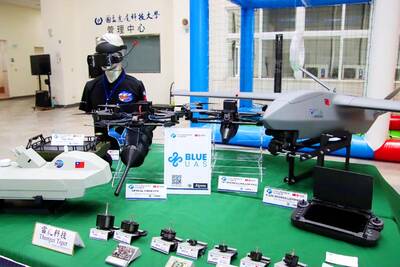
NON-RED SUPPLY: Boosting the nation’s drone industry is becoming increasingly urgent as China’s UAV dominance could become an issue in a crisis, an analyst said Taiwan’s drone exports to Europe grew 41.7-fold from 2024 to last year, with demand from Ukraine’s fight against Russian aggression the most likely driver of growth, a study showed. The Institute for Democracy, Society and Emerging Technology (DSET) in a statement on Wednesday said it found that many of Taiwan’s uncrewed aerial vehicle (UAV) sales were from Poland and the Czech Republic. These countries likely transferred the drones to Ukraine to aid it in its fight against the Russian invasion that started in 2022, it said. Despite the gains, Taiwan is not the dominant drone exporter to these markets, ranking second and fourth


 RSS
RSS