


Taiwan’s first-ever for-profit light festival organized by a local government last month netted a profit of NT$6.19 million (US$218,914) from the sale of 168,321 tickets, the Tainan City Government said in a news release on Monday.
The second iteration of the Longci Light Festival closed after 66 days on Sunday last week, and the large number of visitors was proof that municipalities could charge a reasonable admittance fee to public events, the Tainan Cultural Affairs Bureau said.
The festival in Tainan’s least populated district of Longci (龍崎) featured 14 light installations.

Photo: Wu Chun-feng, Taipei Times
Charging entrance fees was an experiment to test whether for-profit public events are viable, bureau director Chen Yung-chieh (陳雍杰) said.
Before the festival, the bureau had faced considerable criticism over the fees and whether it would be possible to attract a large number of visitors, but it sold 104,979 tickets at NT$50 apiece, or 70 percent of all available tickets, he said.
Admission was free on the first three days of the festival.
However this year the daily average visitor number was 2,600, compared with 4,000 daily visitors last year, Chen said.
“To enhance the quality of the visitor experience,” it aimed to limit the number of visitors, which it achieved by charging a fee, he said.
The bureau’s statistics showed that the district benefited economically from the festival, Chen said.
Local farmers, street vendors and restaurants have reported a significant increase in customers during the festival, he added.
“The popularity of the festival shows that people are increasingly accepting that they should pay to attend art and culture events,” Chen said.
The next Longci Light Festival would open in December, the bureau said.

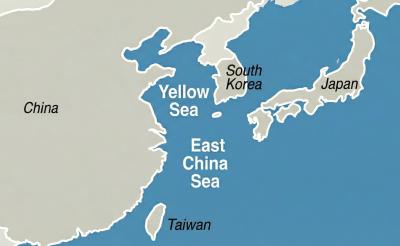
China has reserved offshore airspace in the Yellow Sea and East China Sea from March 27 to May 6, issuing alerts usually used to warn of military exercises, although no such exercises have been announced, the Wall Street Journal (WSJ) reported yesterday. Reserving such a large area for 40 days without explanation is an “unusual step,” as military exercises normally only last a few days, the paper said. These alerts, known as Notice to Air Missions (Notams), “are intended to inform pilots and aviation authorities of temporary airspace hazards or restrictions,” the article said. The airspace reserved in the alert is

NAMING SPAT: The foreign ministry called on Denmark to propose an acceptable solution to the erroneous nationality used for Taiwanese on residence permits Taiwan has revoked some privileges for Danish diplomatic staff over a Danish permit that lists “Taiwan” as “China,” Eric Huang (黃鈞耀), head of the Ministry of Foreign Affairs’ Department of European Affairs, told a news conference in Taipei yesterday. Reporters asked Huang whether the Danish government had responded to the ministry’s request that it correct the nationality on Danish residence permits of Taiwanese, which has been listed as “China” since 2024. Taiwan’s representative office in Denmark continues to communicate with the Danish government, and the ministry has revoked some privileges previously granted to Danish representatives in Taiwan and would continue to review

More than 6,000 Taiwanese students have participated in exchange programs in China over the past two years, despite the Mainland Affairs Council’s (MAC) “orange light” travel advisory, government records showed. The MAC’s publicly available registry showed that Taiwanese college and university students who went on exchange programs across the Strait numbered 3,592 and 2,966 people respectively. The National Immigration Agency data revealed that 2,296 and 2,551 Chinese students visited Taiwan for study in the same two years. A review of the Web sites of publicly-run universities and colleges showed that Taiwanese higher education institutions continued to recruit students for Chinese educational programs without
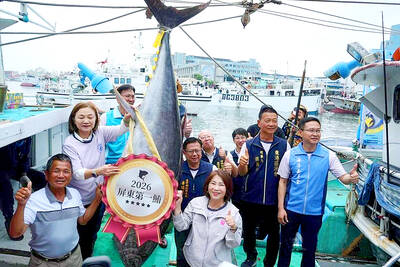
The first bluefin tuna of the season, brought to shore in Pingtung County and weighing 190kg, was yesterday auctioned for NT$10,600 (US$333.5) per kilogram, setting a record high for the local market. The auction was held at the fish market in Donggang Fishing Harbor, where the Siaoliouciou Island-registered fishing vessel Fu Yu Ching No. 2 delivered the “Pingtung First Tuna” it had caught for bidding. Bidding was intense, and the tuna was ultimately jointly purchased by a local restaurant and a local company for NT$10,600 per kilogram — NT$300 ,more than last year — for a total of NT$2.014 million. The 67-year-old skipper


 RSS
RSS