


China’s aggressive development of uncrewed air, ground and underwater vehicles is an increasing threat to Taiwan and the region, analysts at a government-funded think tank said.
Sheu Jyh-shyang (許智翔), a postdoctoral fellow at the Institute for National Defense and Security Research, said that in the past few years, uncrewed ground vehicles (UGVs) and drones have been used increasingly by the Chinese People’s Liberation Army (PLA).
In a research paper published on Jan. 29, Sheu cited Chinese media reports of drones being deployed in counterterrorism drills in China in 2019, and used for the transport of supplies to high altitudes in Tibet in September last year.

Photo: Tu Chu-min, Taipei Times
On Jan. 6, state-controlled China Central Television reported a PLA military exercise that included a number of drones and UGVs, Sheu said.
In that drill, the PLA used a tank-like robot, less than a year after it had commissioned the “Sharp Claw I” UGV, he said.
While the capabilities of China’s UGVs are limited to reconnaissance and light fire support, they would make a difference on the battlefield if the technologies develop further, Sheu said.
Despite limited maneuverability in a complex environment, UGVs can still support troops, he said, adding that Taiwan’s military might need to pay more attention to improving its UGVs’ capabilities.
Taiwan should also be prepared to deal with the threat posed by China’s rapid development of UGV systems, Sheu said.
Meanwhile, Ou Si-fu (歐錫富), another research fellow at the institute, said that China might be using uncrewed underwater vehicles (UUVs) for spying in regional waters.
In a paper published on Jan. 27, Ou said that on Dec. 20 last year, an Indonesian fisher caught an uncrewed underwater glider in waters off Selayar Island in South Sulawesi, which was identified by experts as a Chinese “Sea Wing” drone.
That gave rise to suspicions that China was spying in the strategic waterway between the South China Sea and Australia, Ou wrote in the paper published on the institute’s Web site.
On Jan. 13, Indonesian maritime security authorities spotted a Chinese research vessel, the Xiang Yang Hong 03, in Indonesian waters, with its tracking system turned off, Ou said, citing news reports.
The appearance of the research vessel and the UUV led to speculations that China was conducting underwater mapping in the area.
Since mapping of the underwater environment is required for smooth submarine operations, the data collected by the UUVs would likely enable China’s submarines to increase their activities in waterways along the Maritime Silk Road, Ou said.

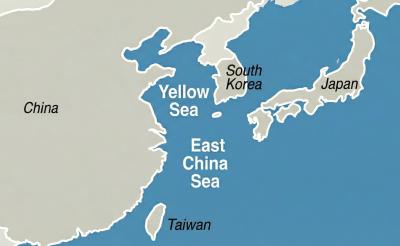
China has reserved offshore airspace in the Yellow Sea and East China Sea from March 27 to May 6, issuing alerts usually used to warn of military exercises, although no such exercises have been announced, the Wall Street Journal (WSJ) reported yesterday. Reserving such a large area for 40 days without explanation is an “unusual step,” as military exercises normally only last a few days, the paper said. These alerts, known as Notice to Air Missions (Notams), “are intended to inform pilots and aviation authorities of temporary airspace hazards or restrictions,” the article said. The airspace reserved in the alert is

NAMING SPAT: The foreign ministry called on Denmark to propose an acceptable solution to the erroneous nationality used for Taiwanese on residence permits Taiwan has revoked some privileges for Danish diplomatic staff over a Danish permit that lists “Taiwan” as “China,” Eric Huang (黃鈞耀), head of the Ministry of Foreign Affairs’ Department of European Affairs, told a news conference in Taipei yesterday. Reporters asked Huang whether the Danish government had responded to the ministry’s request that it correct the nationality on Danish residence permits of Taiwanese, which has been listed as “China” since 2024. Taiwan’s representative office in Denmark continues to communicate with the Danish government, and the ministry has revoked some privileges previously granted to Danish representatives in Taiwan and would continue to review
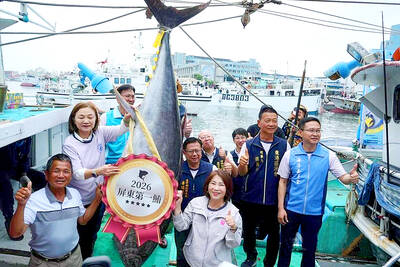
The first bluefin tuna of the season, brought to shore in Pingtung County and weighing 190kg, was yesterday auctioned for NT$10,600 (US$333.5) per kilogram, setting a record high for the local market. The auction was held at the fish market in Donggang Fishing Harbor, where the Siaoliouciou Island-registered fishing vessel Fu Yu Ching No. 2 delivered the “Pingtung First Tuna” it had caught for bidding. Bidding was intense, and the tuna was ultimately jointly purchased by a local restaurant and a local company for NT$10,600 per kilogram — NT$300 ,more than last year — for a total of NT$2.014 million. The 67-year-old skipper
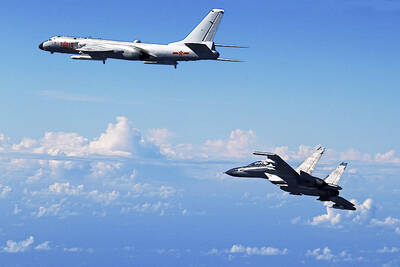
China has reserved offshore airspace over the Yellow Sea and East China Sea from March 27 to May 6, issuing alerts that are usually used to warn of military exercises, although no such exercises have been announced, the Wall Street Journal (WSJ) reported on Sunday. Reserving such a large area for 40 days without explanation is an “unusual step,” as military exercises normally only last a few days, the paper said. The alerts, known as notice to air missions (NOTAMs), “are intended to inform pilots and aviation authorities of temporary airspace hazards or restrictions,” the article said. The airspace reserved in the alert


 RSS
RSS