


The Chinese Nationalist Party (KMT) yesterday urged the government to rescind its decision to allow imports of US pork containing traces of ractopamine, saying that the policy might not lead to a trade agreement.
President Tsai Ing-wen (蔡英文) on Aug. 28 announced that from Jan. 1 Taiwan would set permissible residue levels of the animal feed additive in imported pork, and ease restrictions on imports of beef from US cattle aged 30 months or older.
The decision was “based on our national economic interests and consistent with our overall strategic goals for the future,” Tsai said at the time.
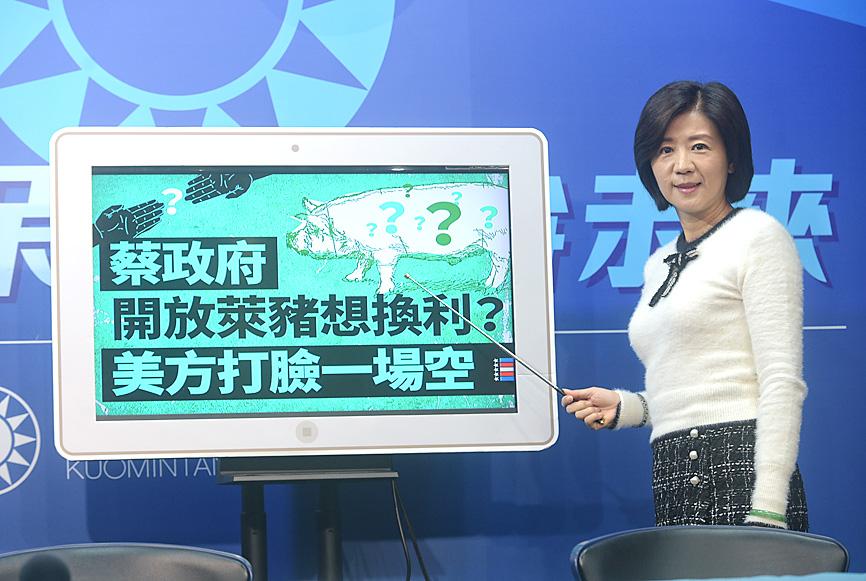
Photo: Chang Chia-ming, Taipei Times
KMT Culture and Communications Committee director-general Alicia Wang (王育敏) told a news conference in Taipei yesterday that US president-elect Joe Biden indicated in an interview that until the US solves its domestic labor, education and economic problems, it would not sign any new trade agreements with other countries.
In an interview with New York Times opinion columnist Thomas Friedman published on Wednesday last week, Biden said: “I’m not going to enter any new trade agreement with anybody until we have made major investments here at home and in our workers,” and in education.
Biden’s remarks mean that Taiwan might not be able to get a bilateral trade agreement or free-trade agreement in return for the meat imports regulatory changes, Wang said.
“If this is the case, we have to ask the Tsai administration ... will it still allow imports of ractopamine pork on Jan. 1 as scheduled?” Wang said, adding that the KMT wants Tsai to withdraw the decision.
Some Taiwanese had reluctantly accepted the ractopamine policy if it meant Taiwan would sign a trade deal with the US, she said, adding that the reality indicated that was not the case.
There is still time to reverse the decision, committee deputy director-general Lee Yong-ping (李永萍) said.
The Democratic Progressive Party’s (DPP) change of stance could at the time be explained by a possible tacit understanding between the Tsai administration and a US government led by Republican US President Donald Trump, Lee said.
However, Biden — a Democrat — is to be inaugurated on Jan. 20, she said.
The Republican and Democratic parties disagree on issues including trade, environmental protection, food safety and labor, she said.
“Is the US’ election of a new president, Biden, not a change in circumstances?” Lee asked, alluding to Tsai’s comment in her Aug. 28 speech that “circumstances have changed,” allowing Taiwan to “further open the market.”
It is unknown whether Biden’s administration would give Taiwan further support because of its changed policy on US pork imports, Lee said, adding that the DPP government should cancel the plan.

The Centers for Disease Control (CDC) yesterday reported the first case of a new COVID-19 subvariant — BA.3.2 — in a 10-year-old Singaporean girl who had a fever upon arrival in Taiwan and tested positive for the disease. The girl left Taiwan on March 20 and the case did not have a direct impact on the local community, it said. The WHO added the BA.3.2 strain to its list of Variants Under Monitoring in December last year, but this was the first imported case of the COVID-19 variant in Taiwan, CDC Deputy Director-General Lin Ming-cheng (林明誠) said. The girl arrived in Taiwan on

South Korea is planning to revise its controversial electronic arrival card, a step Taiwanese officials said prompted them to hold off on planned retaliatory measures, a South Korean media report said yesterday. A Yonhap News Agency report said that the South Korean Ministry of Foreign Affairs is planning to remove the “previous departure place” and “next destination” fields from its e-arrival card system. The plan, reached after interagency consultations, is under review and aims to simplify entry procedures and align the electronic form with the paper version, a South Korean ministry official said. The fields — which appeared only on the electronic form
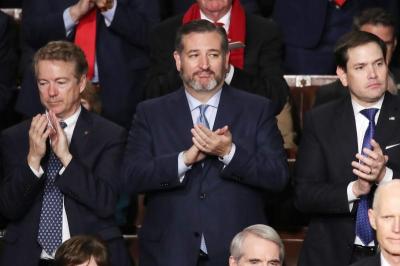
A bipartisan group of US senators has introduced a bill to enhance cooperation with Taiwan on drone development and to reduce reliance on supply chains linked to China. The proposed Blue Skies for Taiwan Act of 2026 was introduced by Republican US senators Ted Cruz and John Curtis, and Democratic US senators Jeff Merkley and Andy Kim. The legislation seeks to ease constraints on Taiwan-US cooperation in uncrewed aerial systems (UAS), including dependence on China-sourced components, limited access to capital and regulatory barriers under US export controls, a news release issued by Cruz on Wednesday said. The bill would establish a "Blue UAS

The Ministry of Foreign Affairs (MOFA) is suspending retaliation measures against South Korea that were set to take effect tomorrow, after Seoul said it is updating its e-arrival system, MOFA said today. The measures were to be a new round of retaliation after Taiwan on March 1 changed South Korea's designation on government-issued alien resident certificates held by South Korean nationals to "South Korea” from the "Republic of Korea," the country’s official name. The move came after months of protests to Seoul over its listing of Taiwan as "China (Taiwan)" in dropdown menus on its new online immigration entry system. MOFA last week


 RSS
RSS