


The Taiwan Roadkill Observation Network, a citizen science initiative, has over the past nine years recorded nearly 150,000 instances of roadkill, helping officials create better policies for environmental protection, traffic safety and disease prevention.
The strategy can help researchers overcome labor, time, regional or other limitations to collecting sufficient amounts of data.
Project head Lin Te-en (林德恩), an assistant researcher at the Council of Agriculture’s Endemic Species Research Institute, on Sunday said that traffic accidents provide the easiest opportunity to discover creatures previously unknown to scientists.
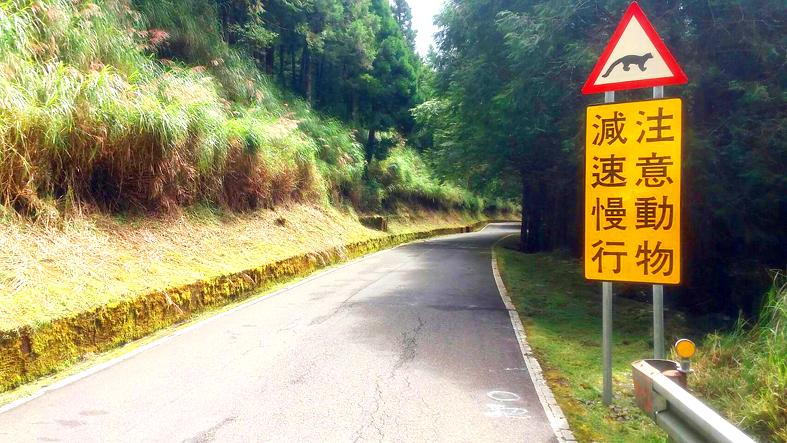
Photo courtesy of the Forestry Bureau, the Council of Agriculture
Taiwan has a number of rare animals that “researchers have never seen alive, only dead,” Lin said.
For example, while the institute has spent 16 years surveying highly elusive snakes, it has only found about 4,000 live specimens, but in just nine years, the network found nearly 40,000 of the snakes killed on roads, he said.
With this massive amount of data, researchers are able to derive important information about the creatures, he added.
For example, researchers previously believed that the invasive green iguana was only found in Tainan, Kaohsiung and Pingtung County, but last year, the network in just a short time found three of the iguanas in Taitung County, Lin said.
This shows that they have already established themselves in the area, he said, adding that the local government should implement emergency measures to stem their spread.
Of the roadkill recorded by the network, 35 percent were reptiles, nearly 30 percent were amphibians and 20 percent were mammals.
The large amount of data on reptile roadkill has become the basis for the government’s conservation strategy, Lin said.
Based on the information, it has raised the threat level for the Chinese box turtle and yellow pond turtle to endangered, while other creatures have been removed from the protected species list as their numbers have increased, he added.
The Directorate-General of Highways and the Freeway Bureau has used the data to determine where to place animal crossing signs, as well as protective fencing and biological corridors, the network said.
The Bureau of Animal and Plant Health Inspection and Quarantine also uses the roadkill found by the network as valuable samples in the study of infectious diseases, such as rabies and avian influenza, it added.
The network has been organizing annual meetings to analyze results and plans to release its first national year-end report next year to provide roadkill data to government agencies and the public, Lin said.
Since the animals in many of the photographs taken by participants are difficult to identify, the network also plans to offer a second level of training to teach volunteers how to identify animals from skulls, scales and feathers, he added.
“Through shared intelligence, we can work together to help these wild animals find the ‘right path,’” Lin said.
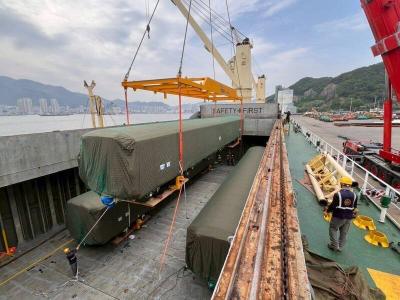
The first of 10 new high-capacity trains purchased from South Korea’s Hyundai Rotem arrived at the Port of Taipei yesterday to meet the demands of an expanding metro network, Taipei Rapid Transit Corp (TRTC) said yesterday. The train completed a three-day, 1,200km voyage from the Port of Masan in South Korea, the company said. Costing NT$590 million (US$18.79 million) each, the new six-carriage trains feature a redesigned interior based on "human-centric" transportation concepts, TRTC said. The design utilizes continuous longitudinal seating to widen the aisles and optimize passenger flow, while also upgrading passenger information displays and driving control systems for a more comfortable
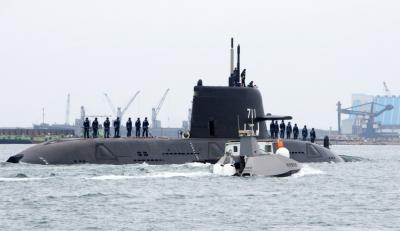
Taiwan's first indigenous defense submarine, the SS-711 Hai Kun (海鯤, or Narwhal), departed for its 13th sea trial at 7am today, marking its seventh submerged test, with delivery to the navy scheduled for July. The outing also marked its first sea deployment since President William Lai (賴清德) boarded the submarine for an inspection on March 19, drawing a crowd of military enthusiasts who gathered to show support. The submarine this morning departed port accompanied by CSBC Corp’s Endeavor Manta (奮進魔鬼魚號) uncrewed surface vessel and a navy M109 assault boat. Amid public interest in key milestones such as torpedo-launching operations and overnight submerged trials,
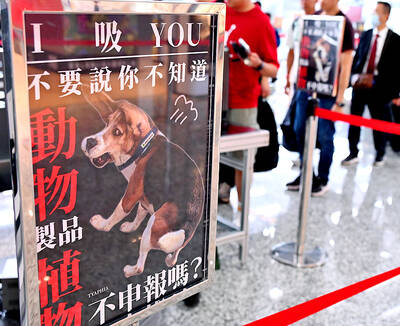
Quarantine awareness posters at Taiwan Taoyuan International Airport have gone viral for their use of wordplay. Issued by the airport branch of the Animal and Plant Health Inspection Agency, the posters feature sniffer dogs making a range of facial expressions, paired with advisory messages built around homophones. “We update the messages for holidays and campaign needs, periodically refreshing materials to attract people’s attention,” quarantine officials said. “The aim is to use the dogs’ appeal to draw focus to quarantine regulations.” A Japanese traveler visiting Taiwan has posted a photo on X of a poster showing a quarantine dog with a

Taiwan’s coffee community has launched a “one-person-one-e-mail” campaign, calling for people to send a protest-e-mail to the World Coffee Championships (WCC) urging it to redesignate Taiwanese competitors as from “Taiwan,” rather than “Chinese Taipei.” The call followed sudden action last week after the WCC changed all references to Taiwanese competitors from “Taiwan” to “Chinese Taipei,” including recent World Latte Art champion Bala (林紹興), who won the World Latte Art Championship in San Diego earlier this month. When Bala received the trophy, he was referred to as representing Taiwan, as well as in the announcement on the WCC’s Web site, until it


 RSS
RSS