


A tourism commercial featuring trips to New Taipei City’s Sansia (三峽) and Yingge (鶯歌) districts was among the winners at the Travel Weekly Magellan Awards, the Tourism Bureau said yesterday.
The commercial, titled “Taiwan — The Perfect Solo Travel Destination for Culture & Small Towns,” was produced by the Tourism Bureau and the Los Angeles-based Black Buddha Media Group.
The Magellan Awards on Monday last week announced that the ad had won the gold medal in the Asia-Overall Destinations-Culture Arts category.
Prior to this year’s win, its tourism commercials had won silvers at the Magellan Awards in the Eco-Friendly Green Destination category last year and the Asia’s Adventure Destination category in 2018, the bureau said.
Brad Shih (施照輝), director of the Tourism Bureau’s Los Angeles office, said that the tourism market in the US is changing amid the COVID-19 pandemic.
Small tour groups and social distancing guidelines would become the “new normal” in the travel industry, Shih said.
The commercial, which was produced last year, targeted “millennials” and “generation Z,” the demographics succeeding millennials and preceding “generation alpha,” he said.
It highlighted safety for women traveling in Taiwan alone, as well as the diversity of Taiwanese culture, depicting a woman visiting Yingge and Sanxia, which are known for their ceramics and historic sites respectively, he said.
Taipei Economic and Cultural Office in Los Angeles Director General Louis Huang (黃敏境) said that Taiwan is a free and democratic country, with people of different ethnic groups, genders, sexual orientations and faiths enjoying equal rights.
The nation was the first in Asia to legalize same-sex marriage, showing that equality, as well as other advanced values, can take roots in a society in East Asia, Huang said, adding that Taiwan is an eco-friendly and safe destination for women, transit passengers and solo travelers.
Tourism Bureau Director General Chang Shi-chung (張錫聰) said that people around the world are eagerly waiting for borders to reopen so that they can freely travel again.
“We would continue to make all the required preparations for the arrival of international travelers,” Chang said. “We know that Taiwan would be one of the top destinations for international travelers given the nation’s success in containing the spread of the pandemic.”
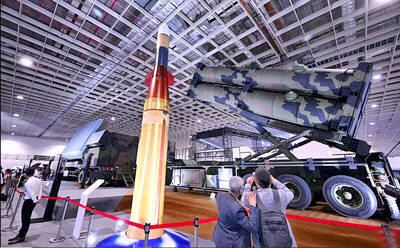
Taiwan is to commence mass production of the Tien Kung (天弓, “Sky Bow”) III, IV and V missiles by the second quarter of this year if the legislature approves the government’s NT$1.25 trillion (US$39.78 billion) special defense budget, an official said yesterday. Commenting on condition of anonymity, a defense official with knowledge of the matter said that the advanced systems are expected to provide crucial capabilities against ballistic and cruise missiles for the proposed “T-Dome,” an advanced, multi-layered air defense network. The Tien Kung III is an air defense missile with a maximum interception altitude of 35km. The Tien Kung IV and V
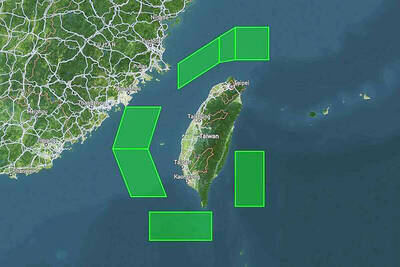
The disruption of 941 flights in and out of Taiwan due to China’s large-scale military exercises was no accident, but rather the result of a “quasi-blockade” used to simulate creating the air and sea routes needed for an amphibious landing, a military expert said. The disruptions occurred on Tuesday and lasted about 10 hours as China conducted live-fire drills in the Taiwan Strait. The Civil Aviation Administration (CAA) said the exercises affected 857 international flights and 84 domestic flights, affecting more than 100,000 travelers. Su Tzu-yun (蘇紫雲), a research fellow at the government-sponsored Institute for National Defense and Security Research, said the air
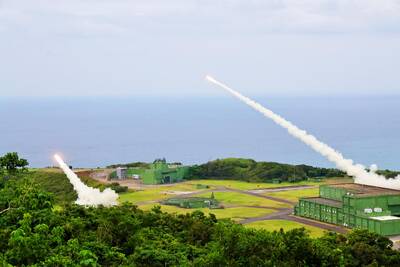
Taiwan lacks effective and cost-efficient armaments to intercept rockets, making the planned “T-Dome” interception system necessary, two experts said on Tuesday. The concerns were raised after China’s military fired two waves of rockets during live-fire drills around Taiwan on Tuesday, part of two-day exercises code-named “Justice Mission 2025.” The first wave involved 17 rockets launched at 9am from Pingtan in China’s Fujian Province, according to Lieutenant General Hsieh Jih-sheng (謝日升) of the Office of the Deputy Chief of the General Staff for Intelligence at the Ministry of National Defense. Those rockets landed 70 nautical miles (129.6km) northeast of Keelung without flying over Taiwan,
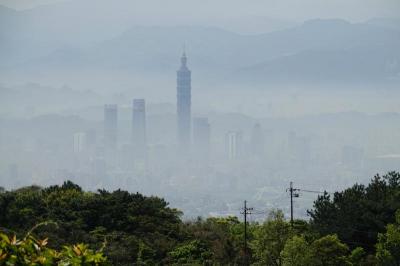
A strong continental cold air mass is to bring pollutants to Taiwan from tomorrow, the Ministry of Environment said today, as it issued an “orange” air quality alert for most of the country. All of Taiwan except for Hualien and Taitung counties is to be under an “orange” air quality alert tomorrow, indicating air quality that is unhealthy for sensitive groups. In China, areas from Shandong to Shanghai have been enveloped in haze since Saturday, the ministry said in a news release. Yesterday, hourly concentrations of PM2.5 in these areas ranged from 65 to 160 micrograms per cubic meter (mg/m³), and pollutants were


 RSS
RSS