


Civic groups yesterday urged legislators to create councilor-at-large seats in local governments to attract more young people to local leadership positions and to root out party cronyism.
The long-standing Chinese Nationalist Party (KMT) system of partisan clientelism, of which the Democratic Progressive Party (DPP) is also guilty, must be given up to allow room for local talent and smaller parties, Economic Democracy Union president Lin Hsiu-hsin (林秀幸) told a news conference at the Legislative Yuan in Taipei.
The nation cannot keep allowing party factions to run local governments, she said, calling on legislators to amend the Local Government Act (地方制度法) to allow for councilor-at-large seats, without changing the overall number of seats.
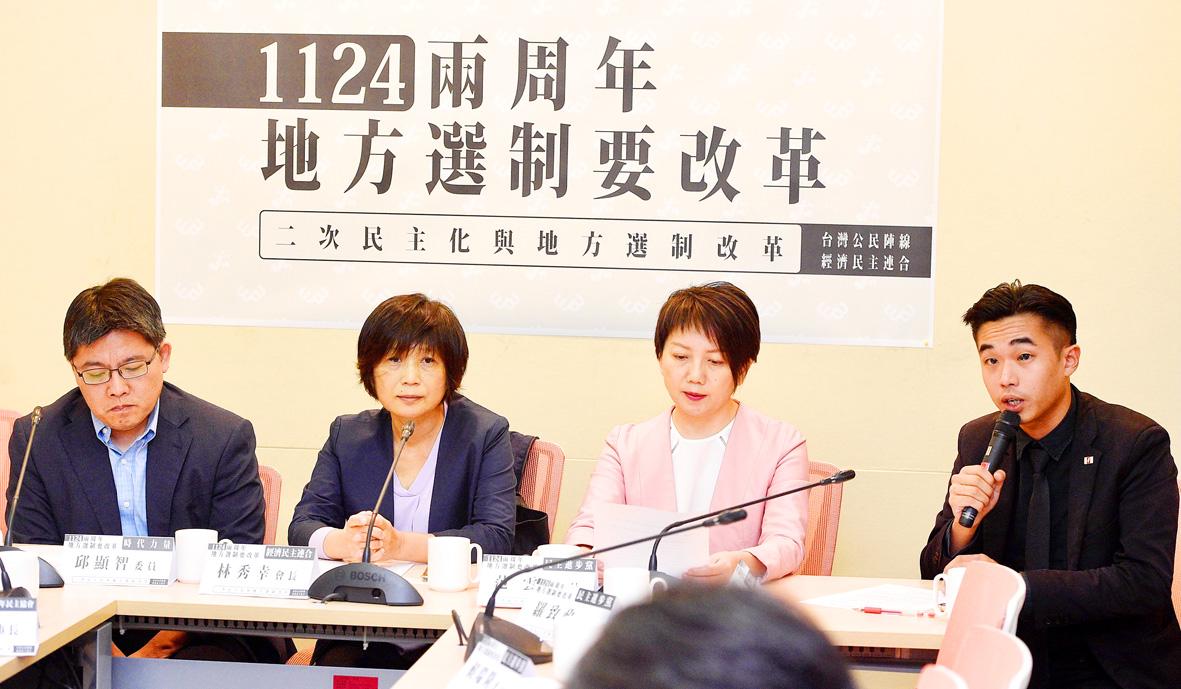
Photo: George Tsorng, Taipei Times
The nation’s local governments are its testing ground for democracy, but also its Achilles heel, Lin said.
Due to the threat posed by China, Taiwan is in a more perilous position than other third-wave democracies, she said.
To uproot historical threads of authoritarianism and prevent local governments from falling under China’s influence, the nation must go through a second democratic reformation and strengthen its sense of identity, she added.
After President Tsai Ing-wen (蔡英文) was elected in 2016, Beijing refused to communicate with the central government, instead dealing directly with local groups and individuals, she said.
After the 2018 elections, in which the KMT won 15 city and county seats, Beijing shifted its focus to local government leaders, hoping to bypass the central leadership, she added.
Local governments are the last mile on the nation’s road to democracy, but they are also China’s shortest path to disruption, Lin said, calling for electoral reform in the hopes of opening up local leadership.
Reform is urgent, as Beijing is skilled at manipulating social divisions to weaken the state, Lin added.
She cited as examples the debates regarding marriage equality and food imports from Japan, saying that Beijing manipulated borough wardens, influential political figures and religious groups into mobilizing in opposition.
Comparing party councilor votes in the 2014 local elections, Taiwan Citizen Front deputy secretary-general Chen Ku-hsiung (陳估熊) said that the DPP received 4.51 million votes to the KMT’s 4.48 million, but only won 291 seats compared with 386 for the KMT.
The discrepancy was even higher in the 2016 general election, when the DPP won 44 percent of all party votes, but only 32 percent of local seats, while the KMT took 42 percent of local seats, despite only winning 27 percent of party votes, Chen said.
Many young people ran for local seats in the 2018 elections, but even fewer were elected than a decade earlier, Taiwan Youth Association for Democracy secretary-general Chang Yu-meng (張育萌) said.
In 1998, representatives aged 30 to 39 comprised 21.7 percent of local councils, but today the proportion has shrunk to only 13 percent, Chang said.
This is not unusual, as young people elected 10 years ago have leaned on local and family resources for re-election, he added.
About 34.5 percent of councilors are aged 50 to 59, while 23.9 percent are older than 60, he said, adding that these demographics do not reflect their constituents or the nation at large.
Local politics has become a game between factions buying off the right people, Chang said, adding that this lack of oversight presents a golden opportunity for Beijing.
The groups hope for the addition of at-large seats and revisions to election deposit rules so that more young people could have a fighting chance in the next local elections, he said.

Kenting National Park service technician Yang Jien-fon (楊政峰) won a silver award in World Grand Prix Photography Awards Spring Season for his photograph of two male rat snakes intertwined in combat. Yang’s colleagues at Kenting National Park said he is a master of nature photography who has been held back by his job in civil service. The awards accept entries in all four seasons across six categories: architectural and urban photography, black-and-white and fine art photography, commercial and fashion photography, documentary and people photography, nature and experimental photography, and mobile photography. Awards are ranked according to scores and divided into platinum, gold and

More than half of the bamboo vipers captured in Tainan in the past few years were found in the city’s Sinhua District (新化), while other districts had smaller catches or none at all. Every year, Tainan captures about 6,000 snakes which have made their way into people’s homes. Of the six major venomous snakes in Taiwan, the cobra, the many-banded krait, the brown-spotted pit viper and the bamboo viper are the most frequently captured. The high concentration of bamboo vipers captured in Sinhua District is puzzling. Tainan Agriculture Bureau Forestry and Nature Conservation Division head Chu Chien-ming (朱健明) earlier this week said that the
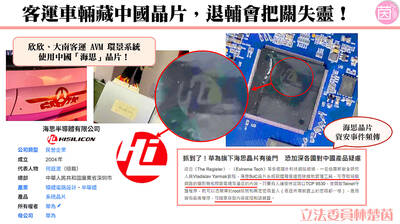
BREACH OF CONTRACT: The bus operators would seek compensation and have demanded that the manufacturer replace the chips with ones that meet regulations Two bus operators found to be using buses with China-made chips are to demand that the original manufacturers replace the systems and provide compensation for breach of contract, the Veterans Affairs Council said yesterday. Democratic Progressive Party Legislator Michelle Lin (林楚茵) yesterday said that Da Nan Bus Co and Shin-Shin Bus Co Ltd have fielded a total of 82 buses that are using Chinese chips. The bus models were made by Tron-E, while the systems provider was CYE Electronics, Lin said. Lin alleged that the buses were using chips manufactured by Huawei subsidiary HiSilicon Co, which presents a national security risk if the

The National Immigration Agency has banned two Chinese from returning to Taiwan, after they published social media content it described as disrespectful to national sovereignty. The agency imposed a two-month ban on a Chinese man surnamed Liang (梁) and a permanent ban on a woman surnamed Yang (楊), an influencer with 23 million followers, in October last year and last week respectively. Minister of the Interior Liu Shyh-fang (劉世芳) yesterday said on the sidelines of a legislative meeting that Chinese visitors to Taiwan are required to comply with the rules and regulations governing their entry permits. The government has handled the ban and


 RSS
RSS