


The establishment of the Taiwan-Australia Inter-Parliamentary Amity Association would help stabilize the “alliance of democratic values” between Taiwan and Australia, Deputy Legislative Speaker Tsai Chi-chang (蔡其昌) said yesterday at the association’s inauguration.
Tsai, the association’s deputy director, said that like Taiwan, Australia understands how irrational and unfriendly China has been.
Taiwan stands out internationally compared with belligerent, aggressive and unfriendly China, he said.
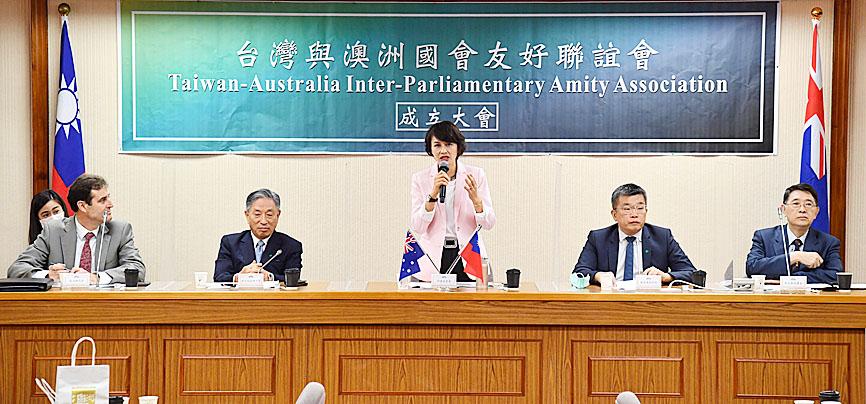
Photo: CNA
Australian Representative to Taiwan Gary Cowan said that Taiwan and Australia have been friends for many years and both embrace democracy.
Australia would continue to work with Taiwan, he said, adding that he hoped Canberra would become Taipei’s best partner in energy generation transition.
Ties have been bolstered amid a tumultuous year and Australia would continue to support Taiwan’s efforts to join the WHO as an observer, said Cowan, whose term in Taiwan is to end next year.
Deputy Minister of Foreign Affairs Tien Chung-kwang (田中光), a guest at the event, said that ties have been bolstered as a result of the COVID-19 pandemic, as Australia provided medical-grade isopropyl alcohol to Taiwan, while Taiwan reciprocated with fabric to make masks.
Democratic Progressive Party Legislator Chiu Yi-ying (邱議瑩), who launched the association, said that she was looking forward to increased collaborations, such as talks over a bilateral trade agreement, or research partnerships into renewable energy sources and other technologies.
Taiwanese paleontologists have discovered fossil evidence that pythons up to 4m long inhabited Taiwan during the Pleistocene epoch, reporting their findings in the international scientific journal Historical Biology. National Taiwan University (NTU) Institute of Ecology and Evolutionary Biology associate professor Tsai Cheng-hsiu (蔡政修) led the team that discovered the largest snake fossil ever found in Taiwan. The single trunk vertebra was discovered in Tainan at the Chiting Formation, dated to between 400,000 and 800,000 years ago in the Middle Pleistocene, the paper said. The area also produced Taiwan’s first avian fossil, as well as crocodile, mammoth, saber-toothed cat and rhinoceros fossils, it said. Discoveries

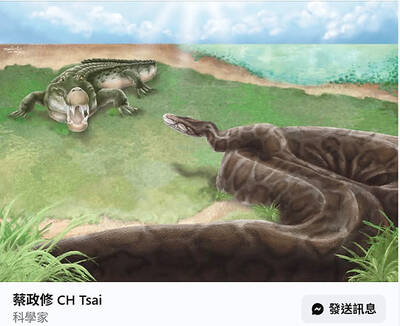
Taiwanese paleontologists have discovered fossil evidence that pythons up to 4m long inhabited Taiwan during the Pleistocene epoch, reporting their findings in the international scientific journal Historical Biology. National Taiwan University (NTU) Institute of Ecology and Evolutionary Biology associate professor Tsai Cheng-hsiu (蔡政修) led the team that discovered the largest snake fossil ever found in Taiwan. A single trunk vertebra was discovered in Tainan at the Chiting Formation, dated to between 800,000 to 400,000 years ago in the Middle Pleistocene, the paper said. The area also produced Taiwan’s first avian fossil, as well as crocodile, mammoth, sabre-toothed cat and rhinoceros fossils, it said. Discoveries
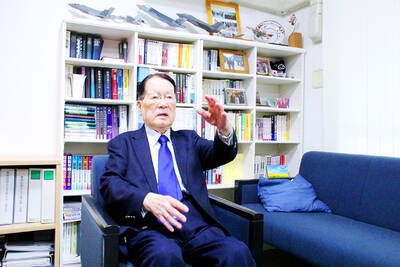
Whether Japan would help defend Taiwan in case of a cross-strait conflict would depend on the US and the extent to which Japan would be allowed to act under the US-Japan Security Treaty, former Japanese minister of defense Satoshi Morimoto said. As China has not given up on the idea of invading Taiwan by force, to what extent Japan could support US military action would hinge on Washington’s intention and its negotiation with Tokyo, Morimoto said in an interview with the Liberty Times (sister paper of the Taipei Times) yesterday. There has to be sufficient mutual recognition of how Japan could provide
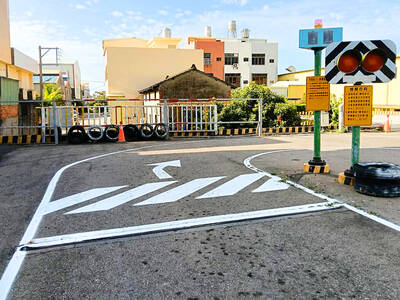
UPDATED TEST: The new rules aim to assess drivers’ awareness of risky behaviors and how they respond under certain circumstances, the Highway Bureau said Driver’s license applicants who fail to yield to pedestrians at intersections or to check blind spots, or omit pointing-and-calling procedures would fail the driving test, the Highway Bureau said yesterday. The change is set to be implemented at the end of the month, and is part of the bureau’s reform of the driving portion of the test, which has been criticized for failing to assess whether drivers can operate vehicles safely. Sedan drivers would be tested regarding yielding to pedestrians and turning their heads to check blind spots, while drivers of large vehicles would be tested on their familiarity with pointing-and-calling


 RSS
RSS