


The Chinese Nationalist Party (KMT) caucus yesterday once again blocked Premier Su Tseng-chang (蘇貞昌) from taking the podium at the Legislative Yuan in Taipei after he failed to meet its demand for an apology for the government’s handling of imports of US pork containing traces of ractopamine.
During the administration of former president Ma Ying-jeou (馬英九) of the KMT, the Democratic Progressive Party (DPP), then in opposition, strongly opposed the import of US pork containing the leanness-enhancing feed additive.
However, President Tsai Ing-wen (蔡英文) of the DPP on Aug. 28 announced that the government would lift the bans on US pork containing traces of ractopamine and US beef from cattle more than 30 months old.
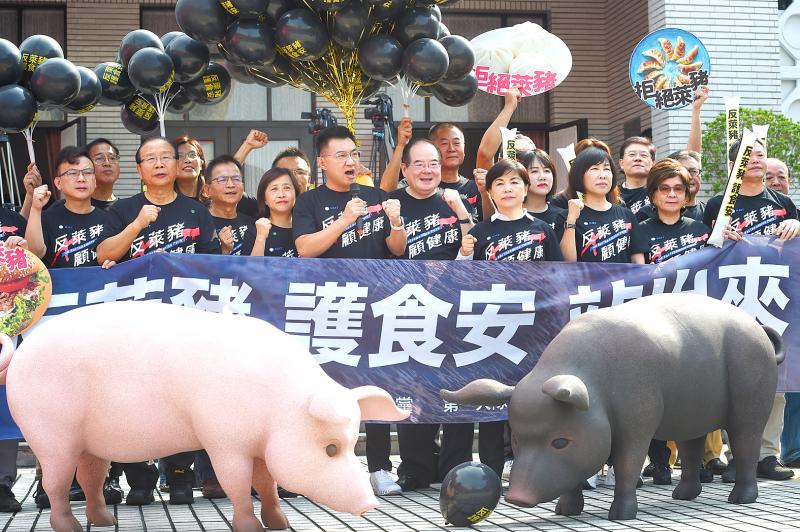
Photo: Fang Pin-chao, Taipei Times
The policy is scheduled to take effect on Jan. 1.
KMT Chairman Johnny Chiang (江啟臣) yesterday said that Su had shown no respect for the opposition and failed to apologize to the public for the DPP’s U-turn on the issue.
KMT caucus whip Lin Wei-chou (林為州) echoed Chiang’s statement, saying that all Su had to do to be allowed to take the podium was apologize on behalf of the government.
“As we’ve stated multiple times over the past three months, the KMT is concerned about public health and is against the decision to allow imports of US pork containing ractopamine,” Lin said.
The DPP’s former staunch opposition to pork containing leanness-enhancing feed additives is at odds with its Aug. 28 announcement, Lin said.
The KMT was under the same pressure from the US when it was in power and yet, while allowing the import of beef from cattle aged under 30 months, it maintained the ban on pork containing ractopamine, he said.
“Is it so hard to acknowledge that they have erred, to admit to the public that their hands were tied?” he asked.
Lin said that as long as the DPP refuses to apologize for having double standards on the issue, the KMT would continue to block Su from presenting reports to the legislature.
Meanwhile, the KMT yesterday held a news conference in front of the Legislative Yuan to publicize the annual “Autumn Struggle” labor protest march tomorrow.
The news conference featured the party’s slogans against the import of US pork, black balloons and two model pigs.
Chiang urged those wishing to protest the pork issue to wear black at the march and to refrain from carrying anything that could be considered a political symbol.
“If you don’t take a stand now, you won’t be able to later. Don’t aid and abet despotism,” he said.
Taiwanese paleontologists have discovered fossil evidence that pythons up to 4m long inhabited Taiwan during the Pleistocene epoch, reporting their findings in the international scientific journal Historical Biology. National Taiwan University (NTU) Institute of Ecology and Evolutionary Biology associate professor Tsai Cheng-hsiu (蔡政修) led the team that discovered the largest snake fossil ever found in Taiwan. The single trunk vertebra was discovered in Tainan at the Chiting Formation, dated to between 400,000 and 800,000 years ago in the Middle Pleistocene, the paper said. The area also produced Taiwan’s first avian fossil, as well as crocodile, mammoth, saber-toothed cat and rhinoceros fossils, it said. Discoveries

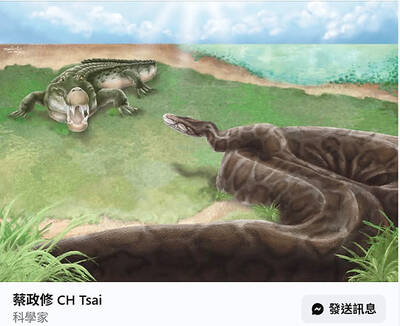
Taiwanese paleontologists have discovered fossil evidence that pythons up to 4m long inhabited Taiwan during the Pleistocene epoch, reporting their findings in the international scientific journal Historical Biology. National Taiwan University (NTU) Institute of Ecology and Evolutionary Biology associate professor Tsai Cheng-hsiu (蔡政修) led the team that discovered the largest snake fossil ever found in Taiwan. A single trunk vertebra was discovered in Tainan at the Chiting Formation, dated to between 800,000 to 400,000 years ago in the Middle Pleistocene, the paper said. The area also produced Taiwan’s first avian fossil, as well as crocodile, mammoth, sabre-toothed cat and rhinoceros fossils, it said. Discoveries
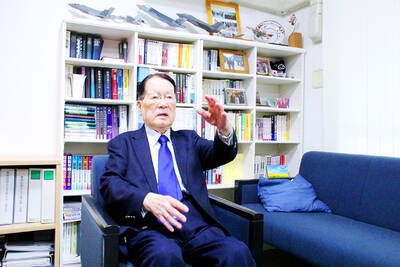
Whether Japan would help defend Taiwan in case of a cross-strait conflict would depend on the US and the extent to which Japan would be allowed to act under the US-Japan Security Treaty, former Japanese minister of defense Satoshi Morimoto said. As China has not given up on the idea of invading Taiwan by force, to what extent Japan could support US military action would hinge on Washington’s intention and its negotiation with Tokyo, Morimoto said in an interview with the Liberty Times (sister paper of the Taipei Times) yesterday. There has to be sufficient mutual recognition of how Japan could provide
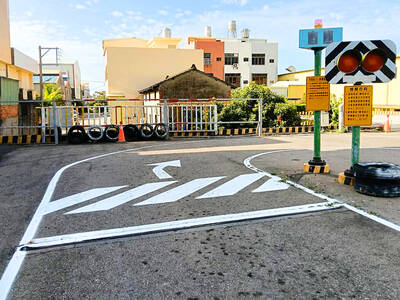
UPDATED TEST: The new rules aim to assess drivers’ awareness of risky behaviors and how they respond under certain circumstances, the Highway Bureau said Driver’s license applicants who fail to yield to pedestrians at intersections or to check blind spots, or omit pointing-and-calling procedures would fail the driving test, the Highway Bureau said yesterday. The change is set to be implemented at the end of the month, and is part of the bureau’s reform of the driving portion of the test, which has been criticized for failing to assess whether drivers can operate vehicles safely. Sedan drivers would be tested regarding yielding to pedestrians and turning their heads to check blind spots, while drivers of large vehicles would be tested on their familiarity with pointing-and-calling


 RSS
RSS