


Environmental groups yesterday criticized the government for spending more subsidies on gasoline-powered scooters than on electric ones, questioning its resolve to combat air pollution and promote sustainability.
The groups made the remarks in response to the legislature’s Social Welfare and Environmental Hygiene Committee yesterday reviewing the budget proposal for the Environmental Protection Administration (EPA), saying that lawmakers should urge the agency to make better use of its air pollution control fund.
A total of NT$1.1 billion (US$38.25 million) has been spent on subsidizing the purchases of 136,000 gasoline-powered scooters this year, including NT$600 million from the EPA, Taiwan Environment and Planning Association chairman Chao Chia-wei (趙家緯) told a news conference in Taipei.

Photo: Peter Lo, Taipei Times
By comparison, only NT$320 million was spent on subsidies for 24,000 electric scooters, with the funds partly coming from the Industrial Development Bureau, he said.
Even the most efficient gasoline-fueled scooters produce far more pollutants than electric ones, he said.
Citing UN Secretary-General Antonio Guterres, Chao said that “the time of fossil-fuel subsidies is over.”
Chao urged the EPA to follow the global carbon reduction trend and improve its fund allocation.
Former EPA deputy minister Thomas Chan (詹順貴) said that the Cabinet under Premier Su Tseng-chang (蘇貞昌) has reduced its efforts to combat air pollution.
The EPA’s air pollution control fund, with an annual budget of NT$7 billion to NT$8 billion, should stop subsidizing vehicles that cause air pollution, he said.
While the Cabinet in 2018 said that it aims to ban the sale of gasoline-powered scooters by 2035 and gasoline-powered vehicles by 2040, the goals were dropped after Su assumed office, Chan said.
Citizen of the Earth, Taiwan deputy executive director Tsai Chung-yueh (蔡中岳) said that the Executive Yuan last year announced sustainability goals, including raising the market share of newly sold scooters powered by alternative energy sources to 35 percent by 2030.
The government should stick to those goals, Tsai said, adding that as of September, the market share of such scooters was only 10 percent.
Additional reporting by CNA

Taiwanese paleontologists have discovered fossil evidence that pythons up to 4m long inhabited Taiwan during the Pleistocene epoch, reporting their findings in the international scientific journal Historical Biology. National Taiwan University (NTU) Institute of Ecology and Evolutionary Biology associate professor Tsai Cheng-hsiu (蔡政修) led the team that discovered the largest snake fossil ever found in Taiwan. The single trunk vertebra was discovered in Tainan at the Chiting Formation, dated to between 400,000 and 800,000 years ago in the Middle Pleistocene, the paper said. The area also produced Taiwan’s first avian fossil, as well as crocodile, mammoth, saber-toothed cat and rhinoceros fossils, it said. Discoveries

Taiwanese paleontologists have discovered fossil evidence that pythons up to 4m long inhabited Taiwan during the Pleistocene epoch, reporting their findings in the international scientific journal Historical Biology. National Taiwan University (NTU) Institute of Ecology and Evolutionary Biology associate professor Tsai Cheng-hsiu (蔡政修) led the team that discovered the largest snake fossil ever found in Taiwan. A single trunk vertebra was discovered in Tainan at the Chiting Formation, dated to between 800,000 to 400,000 years ago in the Middle Pleistocene, the paper said. The area also produced Taiwan’s first avian fossil, as well as crocodile, mammoth, sabre-toothed cat and rhinoceros fossils, it said. Discoveries

Whether Japan would help defend Taiwan in case of a cross-strait conflict would depend on the US and the extent to which Japan would be allowed to act under the US-Japan Security Treaty, former Japanese minister of defense Satoshi Morimoto said. As China has not given up on the idea of invading Taiwan by force, to what extent Japan could support US military action would hinge on Washington’s intention and its negotiation with Tokyo, Morimoto said in an interview with the Liberty Times (sister paper of the Taipei Times) yesterday. There has to be sufficient mutual recognition of how Japan could provide
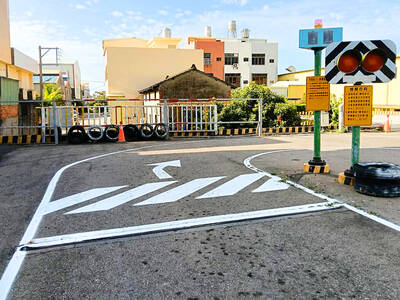
UPDATED TEST: The new rules aim to assess drivers’ awareness of risky behaviors and how they respond under certain circumstances, the Highway Bureau said Driver’s license applicants who fail to yield to pedestrians at intersections or to check blind spots, or omit pointing-and-calling procedures would fail the driving test, the Highway Bureau said yesterday. The change is set to be implemented at the end of the month, and is part of the bureau’s reform of the driving portion of the test, which has been criticized for failing to assess whether drivers can operate vehicles safely. Sedan drivers would be tested regarding yielding to pedestrians and turning their heads to check blind spots, while drivers of large vehicles would be tested on their familiarity with pointing-and-calling


 RSS
RSS