


The National Communications Commission (NCC) refusing to renew CTi News’ license might have a chilling effect, the Chinese Nationalist Party (KMT) said yesterday.
The NCC announced its decision earlier in the day. It was reportedly the first time the commission has rejected a license renewal request from a news station since it was established in 2006.
The NCC’s decision has “confirmed” the public’s suspicion of the use of political power to interfere with freedom of the press, the KMT said in a statement.

Photo: AFP/Sam Yeh
The closure of a news station while President Tsai Ing-wen (蔡英文) is in office might have a chilling effect, restrict the freedom of speech and lead to a serious regression of press freedom in Taiwan, the statement said.
Taiwan’s media environment — which respects journalists’ freedom to report the news — did not come easily, and supervision by the media has enabled Taiwan’s democracy to move toward a more open and transparent direction, the KMT said.
During the review process, many have called into question whether those in power were intervening in the NCC’s review “to exclude dissenting voices,” it said, adding that the fairness and objectivity of the NCC have come under criticism.
The KMT said it believes that the “biased approach” taken by the NCC during the hearing process would make a majority of Taiwanese unable to approve of yesterday’s result.
The KMT said that while the result was unsurprising, it urged the Democratic Progressive Party to reflect on the damage that would be done to the protection of free speech and press freedom in Taiwan by shutting down a news channel.
The use of administrative power to interfere with the position of the news media would only create a chilling effect in Taiwan, the KMT said.
“It is completely and utterly hypocritical for governments to invoke #PressFreedom only when it fits their agenda,” KMT Chairman Johnny Chiang (江啟臣) wrote on Twitter.
“Today was a sad day for this crucial #democratic freedom on #Taiwan!” Chiang added.
Additional reporting by CNA

Taiwanese paleontologists have discovered fossil evidence that pythons up to 4m long inhabited Taiwan during the Pleistocene epoch, reporting their findings in the international scientific journal Historical Biology. National Taiwan University (NTU) Institute of Ecology and Evolutionary Biology associate professor Tsai Cheng-hsiu (蔡政修) led the team that discovered the largest snake fossil ever found in Taiwan. The single trunk vertebra was discovered in Tainan at the Chiting Formation, dated to between 400,000 and 800,000 years ago in the Middle Pleistocene, the paper said. The area also produced Taiwan’s first avian fossil, as well as crocodile, mammoth, saber-toothed cat and rhinoceros fossils, it said. Discoveries

Taiwanese paleontologists have discovered fossil evidence that pythons up to 4m long inhabited Taiwan during the Pleistocene epoch, reporting their findings in the international scientific journal Historical Biology. National Taiwan University (NTU) Institute of Ecology and Evolutionary Biology associate professor Tsai Cheng-hsiu (蔡政修) led the team that discovered the largest snake fossil ever found in Taiwan. A single trunk vertebra was discovered in Tainan at the Chiting Formation, dated to between 800,000 to 400,000 years ago in the Middle Pleistocene, the paper said. The area also produced Taiwan’s first avian fossil, as well as crocodile, mammoth, sabre-toothed cat and rhinoceros fossils, it said. Discoveries

Whether Japan would help defend Taiwan in case of a cross-strait conflict would depend on the US and the extent to which Japan would be allowed to act under the US-Japan Security Treaty, former Japanese minister of defense Satoshi Morimoto said. As China has not given up on the idea of invading Taiwan by force, to what extent Japan could support US military action would hinge on Washington’s intention and its negotiation with Tokyo, Morimoto said in an interview with the Liberty Times (sister paper of the Taipei Times) yesterday. There has to be sufficient mutual recognition of how Japan could provide
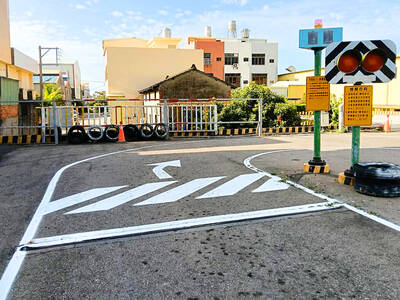
UPDATED TEST: The new rules aim to assess drivers’ awareness of risky behaviors and how they respond under certain circumstances, the Highway Bureau said Driver’s license applicants who fail to yield to pedestrians at intersections or to check blind spots, or omit pointing-and-calling procedures would fail the driving test, the Highway Bureau said yesterday. The change is set to be implemented at the end of the month, and is part of the bureau’s reform of the driving portion of the test, which has been criticized for failing to assess whether drivers can operate vehicles safely. Sedan drivers would be tested regarding yielding to pedestrians and turning their heads to check blind spots, while drivers of large vehicles would be tested on their familiarity with pointing-and-calling


 RSS
RSS