


The Ministry of Transportation and Communications is promoting a tour to Tainan’s Jacana Ecological Education Park in recognition of the efforts to restore the propagation of pheasant-tailed jacanas in the past 20 years.
The ministry began contributing to the efforts to restore the shorebird’s population when it was planning the construction of the nation’s high-speed rail system, it said.
The number of pheasant-tailed jacanas at the time had dwindled to fewer than 50 nationwide, but a field research last year found that their population had recovered to 1,741, which shows that the efforts to conserve the species have produced significant results, it said.
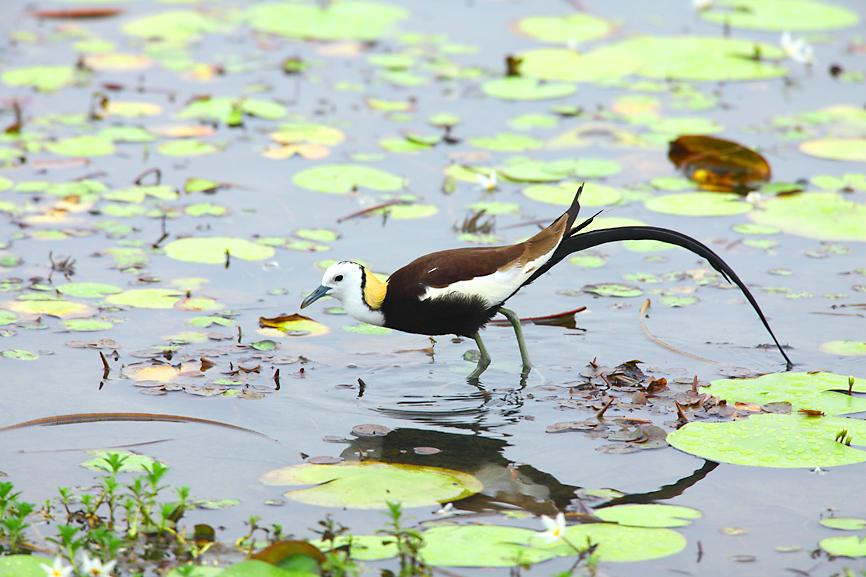
Photo courtesy of Jacana Ecological Education Park
To illustrate the conservation efforts of the past two decades, the ministry has published a picture book, titled Floating Leaves of Pheasant-Tailed Jacanas (水雉的浮葉), which is available for purchase at bookstores, the ministry said.
The story in the picture book shows the relationship between jacanas and water chestnuts, and how eco-friendly farming methods help preserve the species and their natural habitats, it said.
The conservation efforts also led to the establishment of the Jacana Ecological Education Park in 2007, which is now a tourist attraction, the ministry said.
Minister of Transportation and Communications Lin Chia-lung (林佳龍) yesterday visited an eco-friendly farm in Tainan and tried his hand at harvesting water chestnuts there.
He later visited the park and examined the conservation efforts there.
“The park was established to reduce the impact of the high-speed rail system on the habitats of jacanas, and it tells the story of a successful coexistence of economic development, transportation projects and the ecosystem,” Lin said.
Consumers should purchase water chestnuts with an eco-friendly label, he said.
The ministry is also planning to publish picture books on how it has helped protect leopard cats, milkweed butterflies and green sea turtles, he added.
The tour to the park is one of the best examples of high-quality domestic tours, which the Tourism Bureau is currently promoting, Lin said.
It not only allows tourists to harvest water chestnuts, an interesting and meaningful activity, but it also helps boost the local economy and bring job opportunities, he said.
Taiwan’s success in protecting jacanas has been recognized by the Jane Goodall Institute, the ministry said, adding that it is working with the institute and the park to host storytelling sessions with the picture book before Christmas, featuring Lin and Jane Goodall as storytellers.
Goodall would tell the story in English through a recorded video, the ministry said.

FUKUOKA SITUATION: Japanese media reported that the pathogen is expected to be identified by the summer, while the CDC downplayed the idea that it was hMPV A “mysterious cold-like illness” reported in Japan’s Fukuoka Prefecture does not seem to be a new disease, but Japanese authorities have been asked about the situation, the Centers for Disease Control (CDC) said yesterday. The Fukuoka Prefectural Medical Association on Wednesday told a news conference that a “mystery cold” that has become a hot topic on social media is “highly likely to be caused by some kind of viral infection,” Japan’s KBC News reported. “Many people are experiencing symptoms starting with a sore throat, followed by a runny nose, phlegm and a severe cough,” KBC News reported, citing association officials. Health authorities are

Nvidia Corp CEO Jensen Huang (黃仁勳) arrived in Taiwan yesterday ahead of upcoming AI and technology events, saying he plans to meet with clients and Taiwan Semiconductor Manufacturing Co Chairman C.C. Wei (魏哲家) during his visit. After landing at Taipei Songshan Airport, Huang posed for photos with fans and handed out Yakult drinks to reporters and supporters waiting at the scene, saying he has “a lot to do” during the trip. Asked about reports that Nvidia’s planned headquarters site in Taipei’s Beitou Shilin Technology Park could break ground on May 27, Huang said that if the company holds an event, he would

The Ministry of Finance this afternoon announced the winning numbers for the March-April uniform invoice lottery. The winning number for the NT$10 million (US$318,060) special prize is 19531471, and the winning number for the NT$2 million grand prize is 85941329. Three numbers were drawn for the NT$200,000 first prize: 07225810, 20231230 and 83518781. Those with receipts matching the last seven digits of any of the first-prize numbers will win the NT$40,000 second prize, while those matching the last six digits will win the NT$10,000 third prize. Those whose receipts match the last five digits of the first-prize numbers can claim the NT$4,000 fourth prize,

SIX SUBSIDIES: The monthly allowance for older farmers is to increase to NT$10,000, and NT$5,000 is to be given to homemakers under the national pension system, Lai said The government is to implement major welfare policies for disadvantaged groups, including raising the monthly allowance for older farmers to NT$10,000 and providing homemakers with NT$5,000 per month, President William Lai (賴清德) said yesterday. Lai made the remarks during a visit to Wangling Temple in Chiayi County, saying that the planned increases were being introduced amid economic growth and an increase in tax revenue. Touting a policy, in which the government plans to provide a monthly allowance of NT$5,000 for every child under the age of 18 in a bid to address Taiwan’s low birthrate, Lai said that if received for the


 RSS
RSS