


Lawmakers yesterday questioned the legality of an online platform set up by the government to recruit participants for COVID-19 vaccine clinical trials.
The Central Epidemic Command Center (CECC) launched the online platform on Wednesday last week, and said people can sign up until Nov. 30.
Minister of Health and Welfare Chen Shih-chung (陳時中), who heads the center, said at the time that three domestic manufacturers that are developing COVID-19 vaccine candidates would soon complete phase 1 clinical trials and as phase 2 vaccine trials would need more participants, the CECC launched the platform to help shorten the recruitment process and speed up the trials.
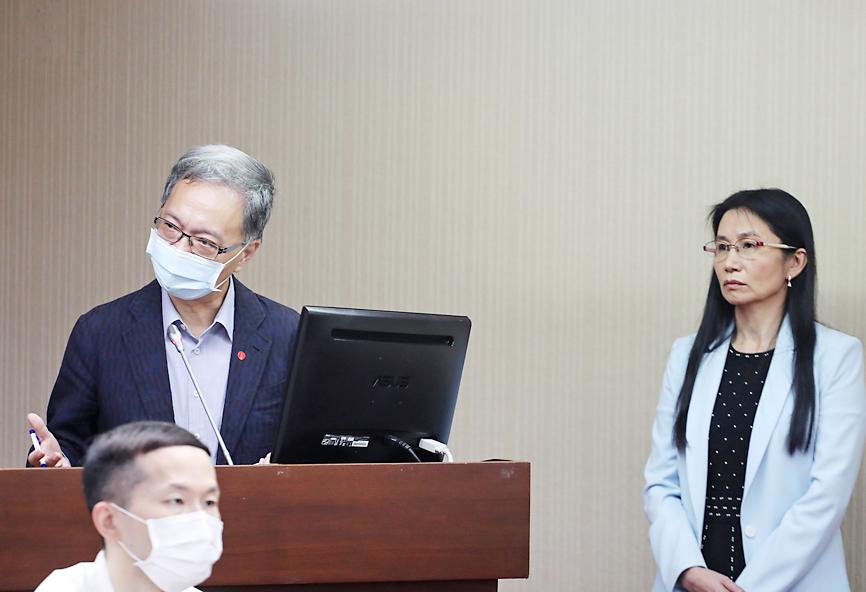
Photo: CNA
As of yesterday, more than 19,000 people had registered, close to the center’s target of 20,000.
At a meeting of the legislature’s Social Welfare and Environmental Hygiene Committee yesterday, Chinese Nationalist Party (KMT) Legislator Chiang Wan-an (蔣萬安) said that the online registration could be illegal, as it does not provide warnings in accordance with regulations on clinical trial recruitment for volunteers, the advert has not received approval from the Institutional Review Board and it likely breached other regulations.
“The trial advert must not have provisions stating that participants will receive free medical treatment or a financial subsidy, or that it is available for a limited time only to push people to sign up before the deadline,” Chiang said.
“It must not contain words, graphics, photos or illustrations to entice or force people into signing up,” he added.
In the past, the ministry would issue regulations warning people about the risks associated with clinical trials, “but now [the trials] were publicized through a press conference, which was also circulated through online platforms such as Line, Facebook and others, and only presented the potentially good points. We did not see any warnings about possible side effects and associated risks,” he added.
“The government has set a bad example, skirting around possible illegalities. In the future, can pharmaceutical firms and companies making medical vaccines do the same? That is, they can first publicize on an online platform to collect the personal data of volunteers, then claim it was not an open call for participants,” Chiang said.
Democratic Progressive Party Legislator Lin Shu-fen (林淑芬) also questioned the program.
“The trials would involve more than 20,000 people, but if something goes wrong, can the victims receive compensation, and what if the vaccine company cannot pay?” she asked. “Our government led the way in publicizing the trials, but not in shouldering the responsibility for compensation. Is this proper?”
Deputy Minister of Health and Welfare Hsueh Jui-yuan (薛瑞元) clarified that it was only a platform for registration, and not an official recruitment for clinical trial participants.
“The platform is a means for people to register, and asking them if they are willing to take part in the clinical trials, to provide their personal information. When the trial program is approved, then the official recruitment can start, and the vaccine company can select suitable volunteers,” Hsueh said.
As to whether the advert conforms to the law, it will have to be judged on a case-by-case basis, he added.

Taiwan has received more than US$70 million in royalties as of the end of last year from developing the F-16V jet as countries worldwide purchase or upgrade to this popular model, government and military officials said on Saturday. Taiwan funded the development of the F-16V jet and ended up the sole investor as other countries withdrew from the program. Now the F-16V is increasingly popular and countries must pay Taiwan a percentage in royalties when they purchase new F-16V aircraft or upgrade older F-16 models. The next five years are expected to be the peak for these royalties, with Taiwan potentially earning

STAY IN YOUR LANE: As the US and Israel attack Iran, the ministry has warned China not to overstep by including Taiwanese citizens in its evacuation orders The Ministry of Foreign Affairs (MOFA) yesterday rebuked a statement by China’s embassy in Israel that it would evacuate Taiwanese holders of Chinese travel documents from Israel amid the latter’s escalating conflict with Iran. Tensions have risen across the Middle East in the wake of US and Israeli airstrikes on Iran beginning Saturday. China subsequently issued an evacuation notice for its citizens. In a news release, the Chinese embassy in Israel said holders of “Taiwan compatriot permits (台胞證)” issued to Taiwanese nationals by Chinese authorities for travel to China — could register for evacuation to Egypt. In Taipei, the ministry yesterday said Taiwan
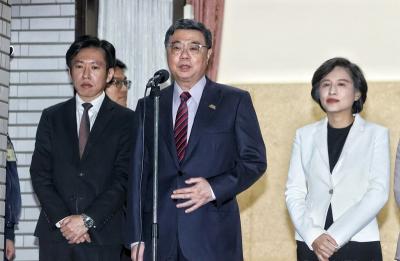
Taiwan is awaiting official notification from the US regarding the status of the Agreement on Reciprocal Trade (ART) after the US Supreme Court ruled US President Donald Trump's global tariffs unconstitutional. Speaking to reporters before a legislative hearing today, Premier Cho Jung-tai (卓榮泰) said that Taiwan's negotiation team remains focused on ensuring that the bilateral trade deal remains intact despite the legal challenge to Trump's tariff policy. "The US has pledged to notify its trade partners once the subsequent administrative and legal processes are finalized, and that certainly includes Taiwan," Cho said when asked about opposition parties’ doubts that the ART was
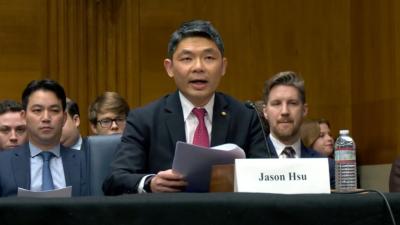
If China chose to invade Taiwan tomorrow, it would only have to sever three undersea fiber-optic cable clusters to cause a data blackout, Jason Hsu (許毓仁), a senior fellow at the Hudson Institute and former Chinese Nationalist Party (KMT) legislator, told a US security panel yesterday. In a Taiwan contingency, cable disruption would be one of the earliest preinvasion actions and the signal that escalation had begun, he said, adding that Taiwan’s current cable repair capabilities are insufficient. The US-China Economic and Security Review Commission (USCC) yesterday held a hearing on US-China Competition Under the Sea, with Hsu speaking on


 RSS
RSS