


Democratic Progressive Party (DPP) legislators Chen Ming-wen (陳明文) and Wang Mei-hui (王美惠) yesterday said they are planning to propose an amendment that would prohibit the use of party emblems with a high degree of similarity to national symbols.
The national emblem — which was adopted in 1947 and depicts a white sun in a blue sky — was derived from the Chinese Nationalist Party’s (KMT) emblem.
The continued use of the symbol by the KMT causes confusion about the separation of party and state, and conflicts with modern ideas that emerged during 30 years of democratic development in the nation, the legislators said.
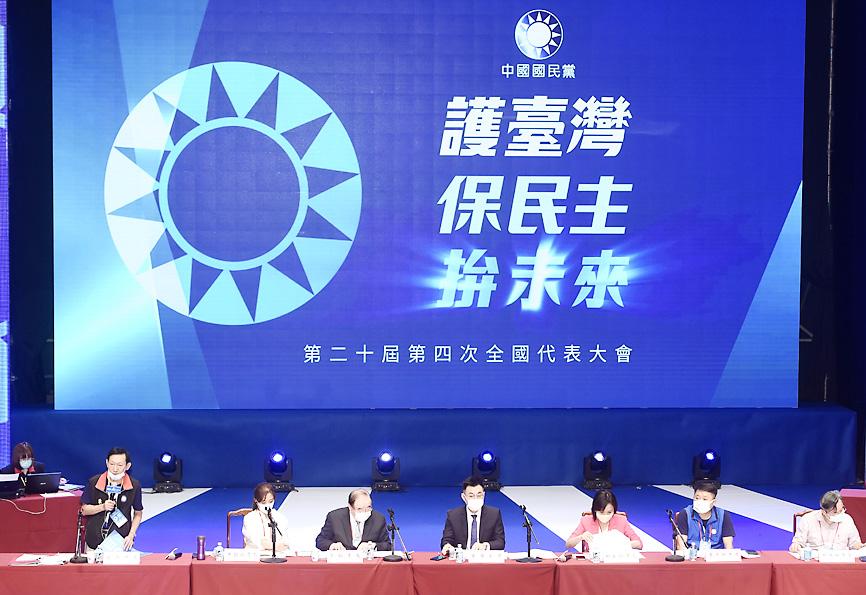
Photo: Chien Jung-fong, Taipei Times
In the KMT emblem, the sun is larger and its 12 rays touch the outer edge of the blue circle that encompasses them, but it is otherwise identical to the national emblem, they said.
“Once the amendment is passed, it will be applicable to all parties. I urge the KMT to see things not just from its own perspective. Everything it does as a political party should put the nation first,” Chen said.
“In the past, there was no distinction between the KMT and the state, but times have changed — Taiwan is no longer a one-party state,” Wang said. “This amendment is straightforward and well-intentioned. We are only aiming to avoid confusion between party and state symbols, and the KMT does not need to be so sensitive about it.”
Chen and Wang proposed amending Article 14 of the Political Parties Act (政黨法), which stipulates the rules for symbols of political parties, adding the clause that the emblems cannot be too similar to that of the nation.
The legislators said they would raise the issue in the legislature next week.
In response, the KMT yesterday accused the DPP of using its administrative majority to attack opposition parties.
“They are not just after our assets, now they want our emblem too,” the KMT said.
The symbols are similar, because the KMT established the state, it said, adding that the party’s emblem is symbolic of its reverence for the revolutionary martyrs of its past.
“The KMT established the state, and the national emblem was modeled after that of the KMT. The DPP should not have history backward,” the KMT said. “The DPP is doing a terrible job managing the nation’s internal affairs, so it is engaging in ideological warfare.”

Considering that most countries issue more than five denominations of banknotes, the central bank has decided to redesign all five denominations, the bank said as it prepares for the first major overhaul of the banknotes in more than 24 years. Central bank Governor Yang Chin-lung (楊金龍) is expected to report to the Legislative Yuan today on the bank’s operations and the redesign’s progress. The bank in a report sent to the legislature ahead of today’s meeting said it had commissioned a survey on the public’s preferences. Survey results showed that NT$100 and NT$1,000 banknotes are the most commonly used, while NT$200 and NT$2,000

The Centers for Disease Control (CDC) yesterday reported the first case of a new COVID-19 subvariant — BA.3.2 — in a 10-year-old Singaporean girl who had a fever upon arrival in Taiwan and tested positive for the disease. The girl left Taiwan on March 20 and the case did not have a direct impact on the local community, it said. The WHO added the BA.3.2 strain to its list of Variants Under Monitoring in December last year, but this was the first imported case of the COVID-19 variant in Taiwan, CDC Deputy Director-General Lin Ming-cheng (林明誠) said. The girl arrived in Taiwan on

South Korea is planning to revise its controversial electronic arrival card, a step Taiwanese officials said prompted them to hold off on planned retaliatory measures, a South Korean media report said yesterday. A Yonhap News Agency report said that the South Korean Ministry of Foreign Affairs is planning to remove the “previous departure place” and “next destination” fields from its e-arrival card system. The plan, reached after interagency consultations, is under review and aims to simplify entry procedures and align the electronic form with the paper version, a South Korean ministry official said. The fields — which appeared only on the electronic form

The Ministry of Foreign Affairs (MOFA) is suspending retaliation measures against South Korea that were set to take effect tomorrow, after Seoul said it is updating its e-arrival system, MOFA said today. The measures were to be a new round of retaliation after Taiwan on March 1 changed South Korea's designation on government-issued alien resident certificates held by South Korean nationals to "South Korea” from the "Republic of Korea," the country’s official name. The move came after months of protests to Seoul over its listing of Taiwan as "China (Taiwan)" in dropdown menus on its new online immigration entry system. MOFA last week


 RSS
RSS