


A team of National Taiwan University (NTU) researchers has developed an artificial intelligence (AI)-powered system to predict whether people with chronic obstructive pulmonary disease (COPD) would suddenly experience a worsening of their symptoms within seven days.
COPD obstructs airflow from the lungs, leading to breathing difficulties, coughing and sputum production. There is no known cure and the condition worsens over time.
Although the symptoms are usually manageable, patients can experience a sudden worsening of their symptoms, known as an acute exacerbation, one to three times per year, which could lead to respiratory failure.
The disease is the third-biggest cause of death in the world and the seventh-biggest cause of death in Taiwan.
Prior to the team’s development of the AI system, there was no method to predict whether a COPD patient would have an acute exacerbation episode, team leader Lai Fei-pei (賴飛羆) said.
Doctors can evaluate a patient’s heart and lung functions through a six-minute walk test, but the test cannot predict the chances of experiencing an episode, Lai said.
People who want to use the AI system need to wear a smartwatch and have an air quality monitor in their homes for the system to collect the information it needs to make a prediction, Lai said.
These include the patient’s heart rate, sleep quality and how many steps they walk in a day, as well as the temperature, humidity and amount of fine particulate matter smaller than 2.5 micrometers in their homes, he said.
The information is sent to the AI system, which calculates the likelihood of a patient experiencing an episode in the next seven days, he added.
If there is more than a 60 percent chance of an episode occurring, or if a patient’s heart rate averages more than 100 beats per minute, the system automatically alerts medical personnel and they contact the patient, Lai said.
The system has been used on 114 patients at NTU Hospital for one-and-a-half years, and has an accuracy rate of 92.5 percent, he said.
The team would continue to improve the system, as patients from other hospitals, such as Cardinal Tien Hospital in New Taipei City, use it, Lai said, adding that the researchers aim to bring the system to market.
The system is useful for patients and doctors, as it allows patients to monitor their situation without having to visit a hospital and it can help doctors warn patients before an episode occurs, he said.

US President Donald Trump said "it’s up to" Chinese President Xi Jinping (習近平) what China does on Taiwan, but that he would be "very unhappy" with a change in the "status quo," the New York Times said in an interview published yesterday. Xi "considers it to be a part of China, and that’s up to him what he’s going to be doing," Trump told the newspaper on Wednesday. "But I’ve expressed to him that I would be very unhappy if he did that, and I don’t think he’ll do that," he added. "I hope he doesn’t do that." Trump made the comments in

NOT AN OPENING: Trump’s violation of international law does not affect China’s consideration in attacking Taiwan; Beijing lacks capability, not precedent, an official said Taiwanese officials see the US’ capture of the president of Venezuela as a powerful deterrent to Beijing’s aggression and a timely reminder of the US’ ability to defeat militaries equipped with Chinese-made weapons. The strikes that toppled Venezuelan President Nicolas Maduro signaled to authoritarian leaders, including Chinese President Xi Jinping (習近平), US President Donald Trump’s willingness to use military might for international affairs core to US interests, one senior official in Taipei’s security circle said. That reassured Taiwan, the person said. Taipei has also dismissed the idea that Trump’s apparent violation of international law could embolden Beijing, said the official, who was not
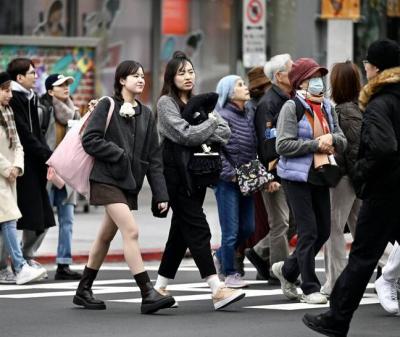
A cold surge advisory was today issued for 18 cities and counties across Taiwan, with temperatures of below 10°C forecast during the day and into tonight, the Central Weather Administration (CWA) said. New Taipei City, Taipei, Taoyuan and Hsinchu, Miaoli and Yilan counties are expected to experience sustained temperatures of 10°C or lower, the CWA said. Temperatures are likely to temporarily drop below 10°C in most other areas, except Taitung, Pingtung, Penghu and Lienchiang (Matsu) counties, CWA data showed. The cold weather is being caused by a strong continental cold air mass, combined with radiative cooling, a process in which heat escapes from

Snow this morning fell on Alishan for the first time in seven years, as a strong continental cold air mass sent temperatures plunging across Taiwan, the Central Weather Administration (CWA) said. The Alishan weather station, located at an elevation of about 2,200m in central Taiwan, recorded snowfall from 8:55am to 9:15am, when the temperature dropped to about 1°C, the CWA said. With increased moisture and low temperatures in the high-altitude Alishan area, the conditions were favorable for snow, CWA forecaster Tsai Yi-chi (蔡伊其) said. The last time snow fell at the Alishan weather station was on Jan. 10, 2018, while graupel fell there


 RSS
RSS