


The Taipei District Prosecutors’ Office yesterday indicted a woman for splashing red paint on a portrait of former president Lee Teng-hui (李登輝) at a public memorial service at the Taipei Guest House in August.
Cheng Hui-chung (鄭惠中), a veteran entertainer, was charged with interfering with a public memorial and could face a fine of up to NT$9,000 or up to six months in prison.
She was also charged with destruction of private property, which carries a fine of up to NT$15,000 or up to six months in prison, prosecutors said.
On Aug. 14, Cheng was caught hurling a balloon filled with red paint at Lee’s photograph at a public memorial service in honor of the late president, who had died on July 30.
Some of the paint also splattered nearby items, including a white pillar. She was immediately taken into custody by police.
Prosecutors said that the 68-year-old Cheng vandalized the photograph because she disagreed with Lee’s politics.
However, they said that Cheng would not be charged with breaches of the Cultural Heritage Preservation Act (文化資產保存法) because it is difficult to determine whether she intended to damage the pillar.
People charged with breaches of the act, such as vandalizing a historic building or affiliated facilities, could face a fine of up to NT$20 million and a jail sentence of up to five years.
In January last year, Cheng was detained and investigated for slapping then-minister of culture Cheng Li-chiun (鄭麗君) at a banquet for veteran entertainers.
She was charged with obstructing government administration, but that charge was dropped by prosecutors in July last year because it was considered a minor offense and the banquet was a private event.

More than half of the bamboo vipers captured in Tainan in the past few years were found in the city’s Sinhua District (新化), while other districts had smaller catches or none at all. Every year, Tainan captures about 6,000 snakes which have made their way into people’s homes. Of the six major venomous snakes in Taiwan, the cobra, the many-banded krait, the brown-spotted pit viper and the bamboo viper are the most frequently captured. The high concentration of bamboo vipers captured in Sinhua District is puzzling. Tainan Agriculture Bureau Forestry and Nature Conservation Division head Chu Chien-ming (朱健明) earlier this week said that the

NAMING SPAT: The foreign ministry called on Denmark to propose an acceptable solution to the erroneous nationality used for Taiwanese on residence permits Taiwan has revoked some privileges for Danish diplomatic staff over a Danish permit that lists “Taiwan” as “China,” Eric Huang (黃鈞耀), head of the Ministry of Foreign Affairs’ Department of European Affairs, told a news conference in Taipei yesterday. Reporters asked Huang whether the Danish government had responded to the ministry’s request that it correct the nationality on Danish residence permits of Taiwanese, which has been listed as “China” since 2024. Taiwan’s representative office in Denmark continues to communicate with the Danish government, and the ministry has revoked some privileges previously granted to Danish representatives in Taiwan and would continue to review

The first bluefin tuna of the season, brought to shore in Pingtung County and weighing 190kg, was yesterday auctioned for NT$10,600 (US$333.5) per kilogram, setting a record high for the local market. The auction was held at the fish market in Donggang Fishing Harbor, where the Siaoliouciou Island-registered fishing vessel Fu Yu Ching No. 2 delivered the “Pingtung First Tuna” it had caught for bidding. Bidding was intense, and the tuna was ultimately jointly purchased by a local restaurant and a local company for NT$10,600 per kilogram — NT$300 ,more than last year — for a total of NT$2.014 million. The 67-year-old skipper
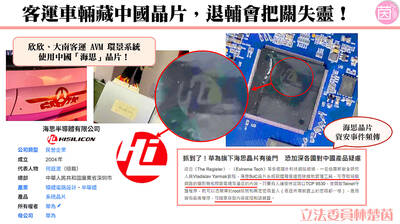
BREACH OF CONTRACT: The bus operators would seek compensation and have demanded that the manufacturer replace the chips with ones that meet regulations Two bus operators found to be using buses with China-made chips are to demand that the original manufacturers replace the systems and provide compensation for breach of contract, the Veterans Affairs Council said yesterday. Democratic Progressive Party Legislator Michelle Lin (林楚茵) yesterday said that Da Nan Bus Co and Shin-Shin Bus Co Ltd have fielded a total of 82 buses that are using Chinese chips. The bus models were made by Tron-E, while the systems provider was CYE Electronics, Lin said. Lin alleged that the buses were using chips manufactured by Huawei subsidiary HiSilicon Co, which presents a national security risk if the


 RSS
RSS