


The Chinese information warfare campaign against Taiwan can be categorized into four main components, think tank Doublethink Lab said on Saturday at the release of its annual report.
They are China’s foreign propaganda machine, its young “cybernationalists,” its content farms and Taiwanese collaborators, said National Taiwan University assistant professor Puma Shen (沈伯洋), who also heads the think tank.
Of those four components, the content farms and local collaborators present the greatest threat to Taiwan, Shen said.
Taiwanese collaborators include borough wardens and Internet celebrities, among other influential people, he said, adding that they mostly help China disseminate disinformation in exchange for money.
“These people inject small, refined fake news messages into Web sites, which makes it a more intractable problem than China’s old approach of bombarding targets with propaganda,” Shen said.
China targets its campaign at particular communities, with the same effect as a religious cult would have, he said, adding that the word-of-mouth nature of this approach is more effective in influencing people than using mainstream media.
“From our research we discovered that those who are most easily influenced are not those with strong pan-green or pan-blue political leanings, but rather those who profess to be politically neutral,” he said.
The reason for this phenomenon is that those with strong political leanings generally only listen to those with similar tendencies, and ignore misinformation that contradicts those tendencies, he said.
Shen said that research has also shown that China’s information warfare campaign is not limited to election periods, and that at any given time China is producing content extolling the virtues of its authoritarian political system and denouncing “Western-style democracy.”
“China’s content farms are particularly adept at concocting fascinating conspiracy theories that cause rifts in society,” he said.
In related news, the Executive Yuan’s Department of Cyber Security said in a report that it has handled 1,709 information security cases over the past three years, including 276 between January and July that involved unlawful intrusions into the nation’s computer systems.
Of all cases over the past three years, unlawful intrusions accounted for 723 cases, or 42 percent, attacks on Web sites accounted for 335 cases (20 percent), equipment failures were involved in 88 cases (5 percent), and denial-of-service attacks accounted for 15 cases (1 percent), it said.
The department said that it has not handled any level 4 attacks — its classification for the most severe type of cyberattack — but has handled 78 level 3 attacks, including the theft of patient information from the Taipei Department of Health’s computer system, and a separate case involving the infection of public hospital computer systems with a malicious virus.
There were 186 level 2 attacks, and the majority of cases (1,445) involved level 1 attacks, it said.
In many cases, unlawful intrusions into computer systems occurred because the systems were not set to automatically update their operating systems, which left them vulnerable to exploits, the department said.
In the case of Web site attacks, many cases occurred because site administrators had neglected to set permissions and restrict access to the site’s files, it said.
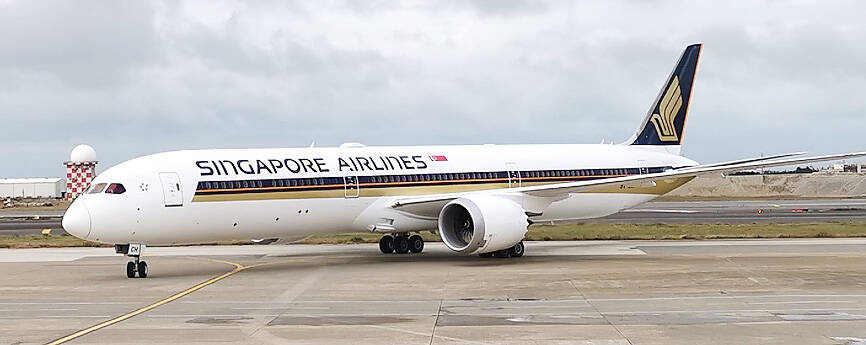
INCREASED CAPACITY: The flights on Mondays, Wednesdays, Fridays and Sundays would leave Singapore in the morning and Taipei in the afternoon Singapore Airlines is adding four supplementary flights to Taipei per week until May to meet increased tourist and business travel demand, the carrier said on Friday. The addition would raise the number of weekly flights it operates to Taipei to 18, Singapore Airlines Taiwan general manager Timothy Ouyang (歐陽漢源) said. The airline has recorded a steady rise in tourist and business travel to and from Taipei, and aims to provide more flexible travel arrangements for passengers, said Ouyang, who assumed the post in July last year. From now until Saturday next week, four additional flights would depart from Singapore on Monday, Wednesday, Friday
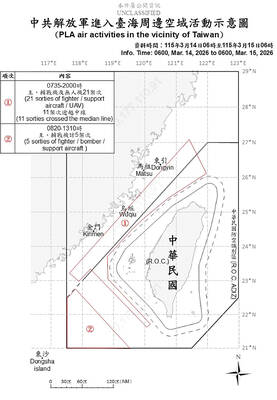
The Ministry of National Defense yesterday reported the return of large-scale Chinese air force activities after their unexplained absence for more than two weeks, which had prompted speculation regarding Beijing’s motives. China usually sends fighter jets, drones and other military aircraft around the nation on a daily basis. Interruptions to such routine are generally caused by bad weather. The Ministry of National Defense said it had detected 26 Chinese military aircraft in the Taiwan Strait over the previous 24 hours. It last reported that many aircraft on Feb. 25, when it spotted 30 aircraft, saying Beijing was carrying out another “joint combat

Taiwan successfully defended its women’s 540 kilogram title and won its first-ever men’s 640 kg title at the 2026 World Indoor Tug of War Championships in Taipei yesterday. In the women’s event, Taiwan’s eight-person squad reached the final following a round-robin preliminary round and semifinals featuring teams from Ukraine, Japan, Thailand, Vietnam, the Basque Country and South Korea. In the finals, they swept the Basque team 2-0, giving the team composed mainly of National Taiwan Normal University students and graduates its second championship in a row, and its fourth in five years. Team captain
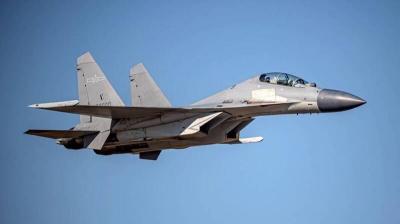
Eight Chinese naval vessels and 24 military aircraft were detected crossing the median line of the Taiwan Strait between 6am yesterday and 6am today, the Ministry of National Defense said this morning. The aircraft entered Taiwan’s northern, central, southwestern and eastern air defense identification zones, the ministry said. The armed forces responded with mission aircraft, naval vessels and shore-based missile systems to closely monitor the situation, it added. Eight naval vessels, one official ship and 36 aircraft sorties were spotted in total, the ministry said.


 RSS
RSS