


The Taiwan Railways Administration (TRA) yesterday took delivery of two of 52 commuter trains ordered from South Korea, calling them the “most beautiful local trains” it has ever had.
The EMU900 trains, painted silver and green, feature a streamlined body with soft curves, while their interiors have been carefully designed to meet commuters’ needs, TRA Director-General Chang Chen-yuan (張政源) said.
With 10 carriages, the EMU900 has 436 seats and room for 1,323 standing passengers, a 40 percent increase in passenger capacity, compared with the currently used EMU700 and EMU800 models, Chang said.
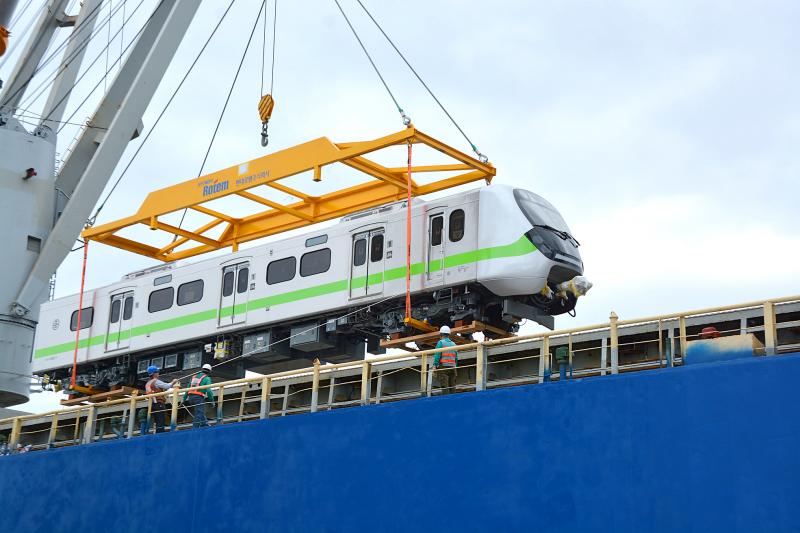
Photo: Wang Chun-chi, Taipei Times
The new trains are expected to provide better service for commuters, who account for 80 percent of the TRA’s passengers, Chang said at a ceremony at the Port of Hualien, where the trains were delivered.
They are to be tested before next year’s Lunar New Year holiday, and then put into service between Taipei and Hsinchu, the agency said.
Delivery of the 52 trains — which are being built by Hyundai Rotem and cost the TRA a total of NT$25.3 billion (US$874.92 million) — is to be completed by 2023.
Ten more are to be delivered next year, another 12 are to arrive in 2022 and the last 28 are to be delivered in 2023, Chang said.
The EMU900 offers passengers increased accessibility, he said, adding that the model doubles the number of wheelchair seats to eight per carriage, offers specially designed seats for pregnant women and provides space for bicycle riders to store their bikes, he said.
The model has been criticized for only having three restrooms, compared with the four on existing models, but the agency said that space is optimized to cater to short-haul passenger demand.
To celebrate the occasion, the TRA ran its 79-year-old DT668 locomotive to the ceremony, gaining the attention of railroad fans.
Chang Yi-fan (張貽帆), head of a student railway club at National Chiao Tung University, traveled from Hsinchu to Hualien just to capture the moment when the legendary locomotive met the next generation of transport.
“I was moved,” he said. “This is an important moment not only for railway buffs, but also for people interested in Taiwanese history and culture.”
Chang, himself a commuter, said he hopes that the new carriages provide passengers with additional room, making traveling more comfortable.

The military has spotted two Chinese warships operating in waters near Penghu County in the Taiwan Strait and sent its own naval and air forces to monitor the vessels, the Ministry of National Defense (MND) said. Beijing sends warships and warplanes into the waters and skies around Taiwan on an almost daily basis, drawing condemnation from Taipei. While the ministry offers daily updates on the locations of Chinese military aircraft, it only rarely gives details of where Chinese warships are operating, generally only when it detects aircraft carriers, as happened last week. A Chinese destroyer and a frigate entered waters to the southwest

A magnitude 6.1 earthquake struck off the coast of Yilan County at 8:39pm tonight, the Central Weather Administration (CWA) said, with no immediate reports of damage or injuries. The epicenter was 38.7km east-northeast of Yilan County Hall at a focal depth of 98.3km, the CWA’s Seismological Center said. The quake’s maximum intensity, which gauges the actual physical effect of a seismic event, was a level 4 on Taiwan’s 7-tier intensity scale, the center said. That intensity level was recorded in Yilan County’s Nanao Township (南澳), Hsinchu County’s Guansi Township (關西), Nantou County’s Hehuanshan (合歡山) and Hualien County’s Yanliao (鹽寮). An intensity of 3 was

Japanese Prime Minister Sanae Takaichi’s comment last year on Tokyo’s potential reaction to a Taiwan-China conflict has forced Beijing to rewrite its invasion plans, a retired Japanese general said. Takaichi told the Diet on Nov. 7 last year that a Chinese naval blockade or military attack on Taiwan could constitute a “survival-threatening situation” for Japan, potentially allowing Tokyo to exercise its right to collective self-defense. Former Japan Ground Self-Defense Force general Kiyofumi Ogawa said in a recent speech that the remark has been interpreted as meaning Japan could intervene in the early stages of a Taiwan Strait conflict, undermining China’s previous assumptions
Instead of focusing solely on the threat of a full-scale military invasion, the US and its allies must prepare for a potential Chinese “quarantine” of Taiwan enforced through customs inspections, Stanford University Hoover fellow Eyck Freymann said in a Foreign Affairs article published on Wednesday. China could use various “gray zone” tactics in “reconfiguring the regional and ultimately the global economic order without a war,” said Freymann, who is also a nonresident research fellow at the US Naval War College. China might seize control of Taiwan’s links to the outside world by requiring all flights and ships entering or leaving Taiwan


 RSS
RSS