


The ratio of Republic of China Air Force planes scrambled is 2.13 for each Chinese jet that has entered Taiwan’s air defense identification zone this year, Deputy Minister of National Defense Chang Che-ping (張哲平) said yesterday, as lawmakers raised concerns about increased fuel and maintenance costs amid Beijing’s belligerence.
Chang stood in for Minister of National Defense Yen De-fa (嚴德發) after Yen presented a report on improving the nation’s reserve forces and left the legislature at noon for a meeting with President Tsai Ing-wen (蔡英文).
There have been 22 instances of Chinese jets entering Taiwan’s zone since Sept. 16, Chang said, citing a counter on the ministry’s Web site.
As of Oct. 7 there had been 1,624 sorties this year by Taiwanese jets, with increased by 2,972 to reach 4,596 as of Wednesday, he said.
Air Force Chief of Staff Lieutenant General Huang Chih-wei (黃志偉) said that maintenance costs for jets as a result of increased Chinese incursions have risen by NT$470 million (US$16.26 million) compared with all of last year.
Maintenance costs for this year would rise to NT$630 million if the rate of Chinese incursions continues, he said.
When asked whether Chinese activity might increase after the US presidential election on Nov. 3, Chang said that the ministry expects the current rate of incursions and exercises in China’s southwestern airspace, as well as in other areas, to become the norm.
The ministry would use the data it collects this year to revise future budgets, he said.
Deputy Chief of the Logistics Staff Lieutenant General Chiang Cheng-kuo (蔣正國) said that a rough estimate of the maintenance budget showed an increase of NT$2 billion from last year, while fuel costs are expected to increase by NT$1 billion.
Separately, Deputy Chief of the General Staff Lieutenant General Chiu Shu-hua (邱樹華) told a meeting of the legislature’s Internal Administration Committee that Chinese drones were spotted yesterday morning near Taiwan’s southwestern zone, where the air force had planned an exercise.
Chinese incursions have increased by more than 50 percent this year from last year, a “new normal” that continues to deplete Taiwan’s military resources, Chiu said.
A US Department of State approval of a sale of three weapons systems to Taiwan with a total value of US$1.8 billion would help the military increase its strike capability, he said.
The weapons systems include 11 truck-based rocket launchers, 135 AGM-84H Standoff Land Attack Missile Expanded Response missiles and six MS-110 Recce external sensor pods.
Additional reporting by Wu Su-wei

FUKUOKA SITUATION: Japanese media reported that the pathogen is expected to be identified by the summer, while the CDC downplayed the idea that it was hMPV A “mysterious cold-like illness” reported in Japan’s Fukuoka Prefecture does not seem to be a new disease, but Japanese authorities have been asked about the situation, the Centers for Disease Control (CDC) said yesterday. The Fukuoka Prefectural Medical Association on Wednesday told a news conference that a “mystery cold” that has become a hot topic on social media is “highly likely to be caused by some kind of viral infection,” Japan’s KBC News reported. “Many people are experiencing symptoms starting with a sore throat, followed by a runny nose, phlegm and a severe cough,” KBC News reported, citing association officials. Health authorities are

Nvidia Corp CEO Jensen Huang (黃仁勳) arrived in Taiwan yesterday ahead of upcoming AI and technology events, saying he plans to meet with clients and Taiwan Semiconductor Manufacturing Co Chairman C.C. Wei (魏哲家) during his visit. After landing at Taipei Songshan Airport, Huang posed for photos with fans and handed out Yakult drinks to reporters and supporters waiting at the scene, saying he has “a lot to do” during the trip. Asked about reports that Nvidia’s planned headquarters site in Taipei’s Beitou Shilin Technology Park could break ground on May 27, Huang said that if the company holds an event, he would
Carrefour Taiwan is to begin using a new name from the start of July, but it cannot divulge the name until then, the chairman of the supermarket chain's parent company said today. President Chain Store Co chairman Lo Chih-hsien (羅智先) was asked by reporters after a shareholders' meeting to confirm whether the company has settled on a new name for the supermarket brand. In March, the government-registered name of two Carrefour Taiwan branches was quietly changed to "Le Chia Kang" (樂家康) in Chinese, raising speculation that has been selected as the name. Lo said that because of local regulations and contractual obligations, the
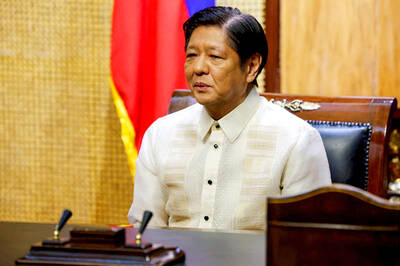
The Philippines would likely be involved in any conflict over Taiwan due to its proximity to the democracy claimed by China, President Ferdinand Marcos Jr said, reiterating a stance that risks angering Beijing. “In the Philippines, we do not have a choice because Taiwan is so close to the Philippines and we have almost 200,000 Filipino nationals living and working in Taiwan,” Marcos said in an interview with Japanese media in Manila on Monday. The Philippine leader’s comments come ahead of a state visit to Japan next week, where he is to meet with Japanese Prime Minister Sanae Takaichi to discuss security


 RSS
RSS