


New Power Party (NPP) Legislator Chiu Hsien-chih (邱顯智) yesterday called for an independent investigation into allegations that police used excessive force during a protest in Taipei on Friday.
The Railway Bureau on Tuesday last week began tearing down the three remaining homes that stood in the way of a planned railway relocation project.
Having been unsuccessful in their protests in Tainan, a group of students on Friday traveled to Taipei to protest in front of the Ministry of Transportation and Communications.
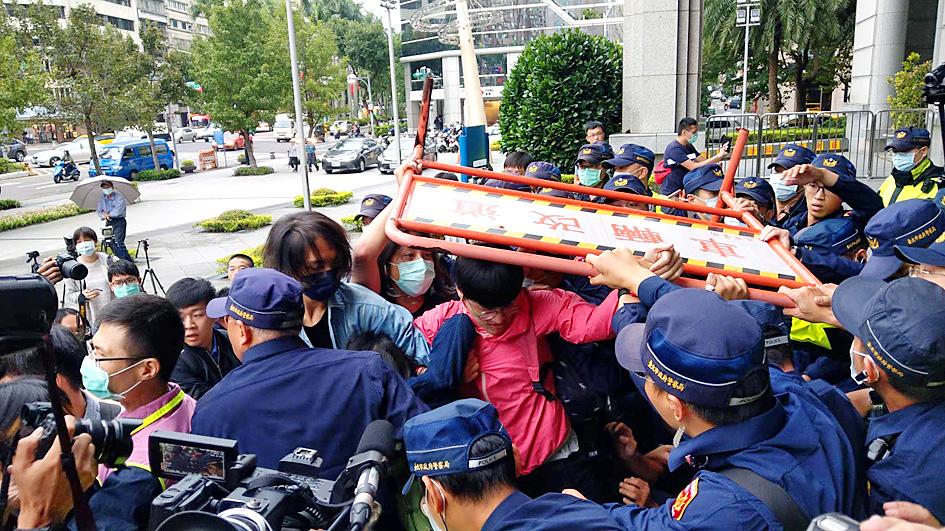
Photo: Cheng Wei-chi, Taipei Times
However, after the protest turned violent, police began restraining people, including a journalist from an online media company, Chiu said, adding that there were allegations that police used excessive force as they held people down on the ground while restraining them.
During a meeting of the legislature’s Judiciary and Organic Laws and Statutes Committee yesterday, at which Control Yuan Secretary-General Chu Fu-mei (朱富美) was invited to speak, Chiu and NPP Legislator Chen Jiau-hua (陳椒華) brought up the allegations and called for an independent investigation by the Control Yuan’s National Human Rights Committee.
In the second national report on investigations regarding the International Covenant on Civil and Political Rights and the International Covenant on Economic Social and Cultural Rights, there were eight issues related to forced evictions and relocation, housing justice and land expropriation, Chiu said.
The National Human Rights Committee had on Aug. 1 discussed whether to investigate the railway relocation project, Chiu added.
Chu said that following an investigation in 2013, the committee asked the Tainan City Government to improve communication with residents and report on its progress every six months.
However, the investigation was never concluded, she said.
Chiu asked Chu whether she agreed with the argument by the Taipei Police Department’s Zhongzheng First Precinct that officers were empowered to use force to restrain protesters in accordance with Article 19 of the Police Power Exercise Act (警察職權行使法).
The article stipulates: “The police may bring a person under control if he/she ... [is] being insane or drunk to the degree that makes restraint necessary in order to avert a situation that may endanger his/her life or prevent danger to the life or health of another person.”
Chu said there was “room for discussion on the issue” and that she would bring up the issue with the committee.
Chen said there were also concerns that during the protest, after a scuffle broke out between police and protesters, two male officers allegedly forced a female student to the ground.
“Is that not a clear violation of human rights and the principle of proportionality?” she asked.
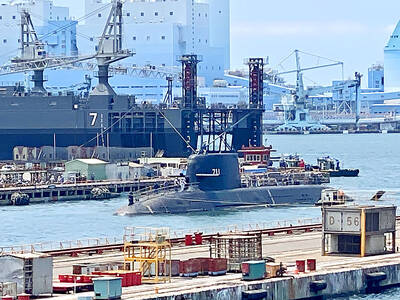
AGING: While Japan has 22 submarines, Taiwan only operates four, two of which were commissioned by the US in 1945 and 1946, and transferred to Taiwan in 1973 Taiwan would need at least 12 submarines to reach modern fleet capabilities, CSBC Corp, Taiwan chairman Chen Cheng-hung (陳政宏) said in an interview broadcast on Friday, citing a US assessment. CSBC is testing the nation’s first indigenous defense submarine, the Hai Kun (海鯤, Narwhal), which is scheduled to be delivered to the navy next month or in July. The Hai Kun has completed torpedo-firing tests and is scheduled to undergo overnight sea trials, Chen said on an SET TV military affairs program. Taiwan would require at least 12 submarines to establish a modern submarine force after assessing the nation’s operational environment and defense

Yangmingshan National Park authorities yesterday urged visitors to respect public spaces and obey the law after a couple was caught on a camera livestream having sex at the park’s Qingtiangang (擎天崗) earlier in the day. The Shilin Police Precinct in Taipei said it has identified a suspect and his vehicle registration number, and would summon him for questioning. The case would be handled in accordance with public indecency charges, it added. The couple entered the park at about 11pm on Thursday and began fooling around by 1am yesterday, the police said, adding that the two were unaware of the park’s all-day live
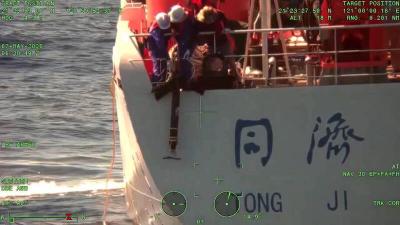
The coast guard today said that it had disrupted "illegal" operations by a Chinese research ship in waters close to the nation and driven it away, part of what Taipei sees a provocative pattern of China's stepped up maritime activities. The coast guard said that it on Thursday last week detected the Chinese ship Tongji (同濟號), which was commissioned only last year, 29 nautical miles (54km) southeast of the southern tip of Taiwan, although just outside restricted waters. The ship was observed lowering ropes into the water, suspected to be the deployment of scientific instruments for "illegal" survey operations, and the coast

A former soldier and an active-duty army officer were yesterday indicted for allegedly selling classified military training materials to a Chinese intelligence operative for a total of NT$79,440. The Taipei District Prosecutors’ Office indicted Chen Tai-yin (陳泰尹) and Lee Chun-ta (李俊達) for contravening the National Security Act (國家安全法) and the Anti-Corruption Act (貪污治罪條例). Chen left the military in September 2013 after serving alongside then-staff sergeant Lee, now an army lieutenant, at the 21st Artillery Command of the army’s Sixth Corps from 2011 to 2013, according to the indictment. Chen met a Chinese intelligence operative identified as “Wang” (王) through a friend in November


 RSS
RSS