


Surprise nighttime inspections of six financial institutions found that all of them appeared to be engaged in one or more allegedly unlawful activities, Taipei Department of Labor Commissioner Chen Hsin-yu (陳信瑜) said yesterday.
Beginning in May, the department received several petitions from Taipei City Councilor Hsu Li-hsin (徐立信) and the Taiwan Federation of Financial Unions, reporting that bank employees have been working too much overtime trying to handle applications for COVID-19 relief loans and were not getting paid for it, Chen said.
Applications for the government’s COVID-19 pandemic relief loan program for Taiwanese workers aged 20 or older opened on April 30, with each applicant able to apply for a maximum of NT$100,000 (US$3,404) per person.
The Ministry of Labor has stipulated that companies handling work associated with the loan program can be regarded as working under an “unexpected event” situation as stipulated in the Labor Standards Act (勞動基準法), meaning that employees would be allowed to extend their working hours or work on holidays if needed.
The department decided to conduct unannounced inspections at night at six randomly selected financial institutions that were offering the relief loans to check on employees’ working conditions, Chen said.
She said that she had personally led the spot inspections of state-owned Bank of Taiwan, Taipei Fubon Commercial Bank, KGI Bank, Yuanta Commercial Bank, Standard Chartered Bank Taiwan and the Small and Medium Enterprise Credit Guarantee Fund of Taiwan.
All six have allegedly contravened the Labor Standards Act through such actions as not paying overtime according to the legally prescribed calculation method, not giving enough days off and not giving the correct payment for working on rest days, the department said.
Other alleged contraventions include not reporting the overtime situation to the labor union or the department within the required timeframe and inaccurate attendance records, it added.
“The inspections found some bank employees worked 61.5 hours of overtime in one month,” Chen said.
Bank managers should comply with occupational safety and health regulations to prevent employees dying from overwork, Chen said, as she encouraged employees to collect proof of unlawful behavior by their employers and report them to the department.
Department official Chen Kun-hong (陳昆鴻) said the six companies would be allowed to make statements to respond to the allegations that they had contravened the labor act.
However, if the allegations are confirmed, they could be fined between NT$20,000 and NT$1 million, Chen Kun-hong said.
There are more than 30 financial institutions handling the COVID-19 relief loans, and the department would continue to conduct inspections of their working conditions, although those who have been reported to the department for alleged breaches would be checked first, Chen Kun-hong said.
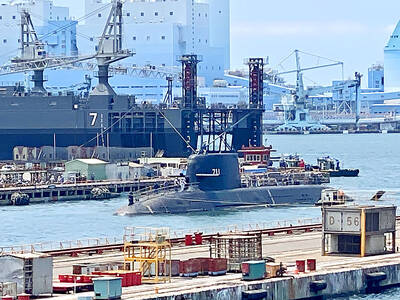
AGING: While Japan has 22 submarines, Taiwan only operates four, two of which were commissioned by the US in 1945 and 1946, and transferred to Taiwan in 1973 Taiwan would need at least 12 submarines to reach modern fleet capabilities, CSBC Corp, Taiwan chairman Chen Cheng-hung (陳政宏) said in an interview broadcast on Friday, citing a US assessment. CSBC is testing the nation’s first indigenous defense submarine, the Hai Kun (海鯤, Narwhal), which is scheduled to be delivered to the navy next month or in July. The Hai Kun has completed torpedo-firing tests and is scheduled to undergo overnight sea trials, Chen said on an SET TV military affairs program. Taiwan would require at least 12 submarines to establish a modern submarine force after assessing the nation’s operational environment and defense
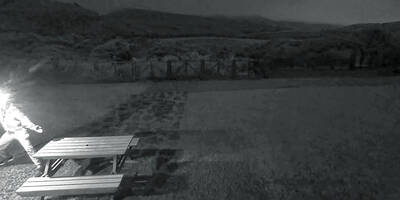
Yangmingshan National Park authorities yesterday urged visitors to respect public spaces and obey the law after a couple was caught on a camera livestream having sex at the park’s Qingtiangang (擎天崗) earlier in the day. The Shilin Police Precinct in Taipei said it has identified a suspect and his vehicle registration number, and would summon him for questioning. The case would be handled in accordance with public indecency charges, it added. The couple entered the park at about 11pm on Thursday and began fooling around by 1am yesterday, the police said, adding that the two were unaware of the park’s all-day live
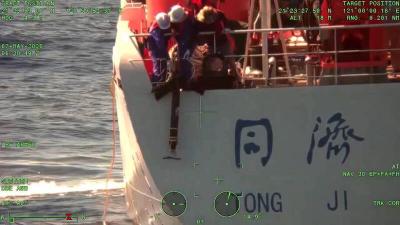
The coast guard today said that it had disrupted "illegal" operations by a Chinese research ship in waters close to the nation and driven it away, part of what Taipei sees a provocative pattern of China's stepped up maritime activities. The coast guard said that it on Thursday last week detected the Chinese ship Tongji (同濟號), which was commissioned only last year, 29 nautical miles (54km) southeast of the southern tip of Taiwan, although just outside restricted waters. The ship was observed lowering ropes into the water, suspected to be the deployment of scientific instruments for "illegal" survey operations, and the coast

A former soldier and an active-duty army officer were yesterday indicted for allegedly selling classified military training materials to a Chinese intelligence operative for a total of NT$79,440. The Taipei District Prosecutors’ Office indicted Chen Tai-yin (陳泰尹) and Lee Chun-ta (李俊達) for contravening the National Security Act (國家安全法) and the Anti-Corruption Act (貪污治罪條例). Chen left the military in September 2013 after serving alongside then-staff sergeant Lee, now an army lieutenant, at the 21st Artillery Command of the army’s Sixth Corps from 2011 to 2013, according to the indictment. Chen met a Chinese intelligence operative identified as “Wang” (王) through a friend in November


 RSS
RSS