


The Taipei District Court yesterday sentenced six activists linked to the 2014 Sunflower movement to 30 days in jail for spray-painting graffiti on a side of the National Police Agency’s (NPA) headquarters in Taipei in 2018, but their sentences can be commuted to fines.
The court convicted the six of “insulting and defaming public agencies” and “destruction, abandonment and damage of property,” including Wu Jun-yen (吳濬彥), deputy head of the Democratic Progressive Party’s Yilan County chapter.
Wu told reporters that he and his codefendants would appeal their convictions.
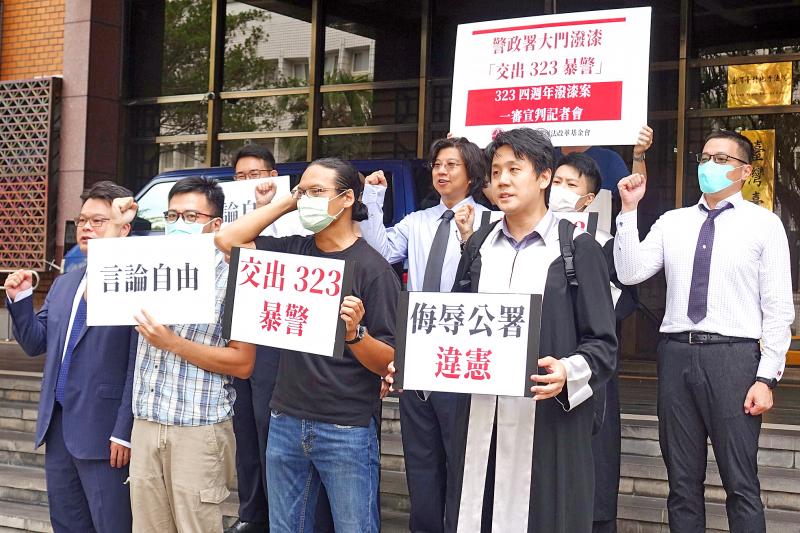
Photo: Wang Yi-sung, Taipei Times
“The charge of insulting and defaming public agencies violates the Constitution’s guarantee on freedom of expression,” he said.
Prosecutors said that Wu, Kao Juo-yu (高若有), two youth activists surnamed Chen (陳) and Chuang (莊), and two other males surnamed Chang (張) on March 24, 2018, had used red paint to write “323 Four-Year Anniversary” (323四週年) on one wall, as well as throwing white masks inside.
Wu said the slogan marked the anniversary of the March 23, 2014, occupation of Executive Yuan compound, which is next to the NPA’s headquarters, by protesters whose occupation was ended the next day by riot-gear-clad police wielding batons against the demonstrators.
Police officers apprehended Kao outside the NPA’s building, and he admitted he was part of a group of six protesting the alleged cover-up by the agency and the judiciary of the violence used by police to end the occupation of the Executive Yuan.
“We took action in 2018, because it had been four years, but we had still received no response to requests that several police officers who viciously beat protesters on March 23 and 24, as documented by photographs and videos, be prosecuted,” Wu said.
“The government and NPA officials are still covering up the whole thing, and no truth has come from our demand for investigation and for prosecution,” he said.
“We feel this ruling is very unreasonable, so we will appeal. Legal experts have said that the ‘insulting and defaming public agencies’ charge is unconstitutional as it violates citizens’ rights to freedom of expression. It seems this offense can be used against any person who disagrees with government policies and choose to express their dissenting views,” he added.

The Centers for Disease Control (CDC) yesterday reported the first case of a new COVID-19 subvariant — BA.3.2 — in a 10-year-old Singaporean girl who had a fever upon arrival in Taiwan and tested positive for the disease. The girl left Taiwan on March 20 and the case did not have a direct impact on the local community, it said. The WHO added the BA.3.2 strain to its list of Variants Under Monitoring in December last year, but this was the first imported case of the COVID-19 variant in Taiwan, CDC Deputy Director-General Lin Ming-cheng (林明誠) said. The girl arrived in Taiwan on

South Korea is planning to revise its controversial electronic arrival card, a step Taiwanese officials said prompted them to hold off on planned retaliatory measures, a South Korean media report said yesterday. A Yonhap News Agency report said that the South Korean Ministry of Foreign Affairs is planning to remove the “previous departure place” and “next destination” fields from its e-arrival card system. The plan, reached after interagency consultations, is under review and aims to simplify entry procedures and align the electronic form with the paper version, a South Korean ministry official said. The fields — which appeared only on the electronic form

The Ministry of Foreign Affairs (MOFA) is suspending retaliation measures against South Korea that were set to take effect tomorrow, after Seoul said it is updating its e-arrival system, MOFA said today. The measures were to be a new round of retaliation after Taiwan on March 1 changed South Korea's designation on government-issued alien resident certificates held by South Korean nationals to "South Korea” from the "Republic of Korea," the country’s official name. The move came after months of protests to Seoul over its listing of Taiwan as "China (Taiwan)" in dropdown menus on its new online immigration entry system. MOFA last week

A bipartisan group of US senators has introduced a bill to enhance cooperation with Taiwan on drone development and to reduce reliance on supply chains linked to China. The proposed Blue Skies for Taiwan Act of 2026 was introduced by Republican US senators Ted Cruz and John Curtis, and Democratic US senators Jeff Merkley and Andy Kim. The legislation seeks to ease constraints on Taiwan-US cooperation in uncrewed aerial systems (UAS), including dependence on China-sourced components, limited access to capital and regulatory barriers under US export controls, a news release issued by Cruz on Wednesday said. The bill would establish a "Blue UAS


 RSS
RSS