


Lawmakers and environmentalists yesterday called on the government to tighten rules on minimum green power requirements for large corporations that use a lot of electricity.
The Ministry of Economic Affairs on Aug. 26 announced draft regulations governing electricity consumption, with firms required to install renewable energy facilities if they exceed the limits.
Taiwan Renewable Energy Alliance director Kao Ju-ping (高如萍) said that the proposed rules would waive government agencies’ responsibility to lead by example by installing sources of renewable energy.
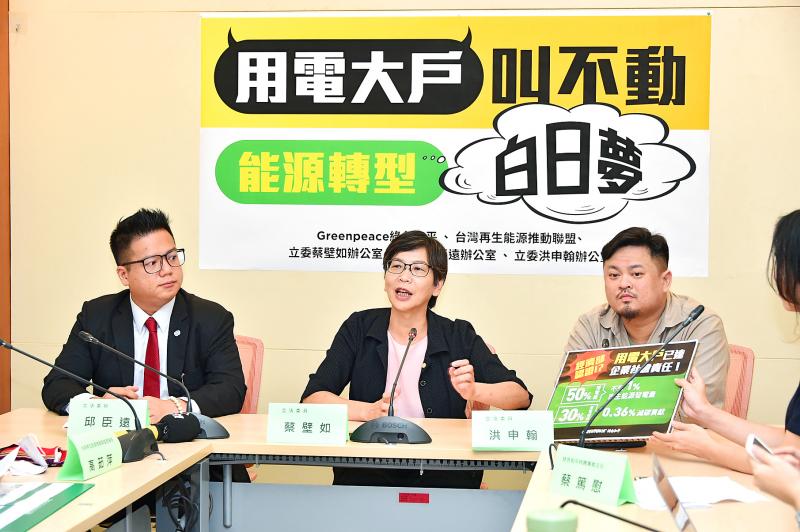
Photo: Tu Chien-jung, Taipei Times
Kao disagreed with the Bureau of Energy, which said that Article 12 of the Renewable Energy Development Act (再生能源發展條例) covered government agencies, so they did not need to be covered by the proposed regulations.
Article 12 stipulates that if green energy facilities are feasible, government agencies should prioritize them when constructing new buildings, expanding or renovating existing facilities and public buildings, and engaging in public construction projects.
“The article pales in comparison to the draft act,” Kao said.
Greenpeace Taiwan energy project campaign specialist Alynne Tsai (蔡篤慰) said that the bill should aim to reduce carbon emissions — using 2010 as a baseline — by 45 percent by 2030.
It is ludicrous that the ministry labels firms that use half of the nation’s power supply and produce 30 percent of the nation’s carbon emissions as “socially responsible” when, according to the bill, they would only have to generate less than 1 percent of the renewable energy on the national power grid, which equates to a 0.36 percent reduction in carbon emissions, Tsai said.
Heavy power consumers should aim to have 20 percent of their power consumption from renewable sources, Tsai said.
Taiwan People’s Party Legislator Tsai Pi-ru (蔡璧如) said that the draft act narrows eligible corporations from 5,400 to 506, as it identifies heavy power consumers as entities that have at least 5,000 kilowatts (kW) of capacity.
However, the Energy Administration Act (能源管理法), as well as local ordinances in Tainan, Taichung and other places, recognize heavy power consumpers as those that have at least 800kW, Tsai Pi-ru said.
The Executive Yuan lacks the resolve to promote green energy, she said, adding that even 10 percent would be too low a requirement for their renewable energy production.
“The government must stand its ground and call these corporations to account,” Tsai Pi-ru said.
Democratic Progressive Party Legislator Hung Sun-han (洪申翰) said that there was room for improvement, such as gradually expanding the list of corporations that are subject to the regulations and cutting the buffer time from five years to three years.
The first wave of heavy power consumers should install renewable energy sources by 2023, Hung said, adding that the ministry should mull how to encourage them to meet their obligations.
It should also consider a more flexible method to purchase green power generated by them, he said.
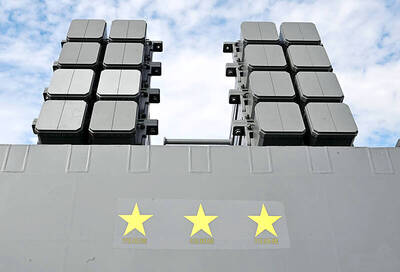
UPGRADE: The Kang Ding-class frigate is replacing its Chaparall missiles with Tien Chien II and Hua Yang VLS, which would provide it with long-range, 360° air defense Taiwan plans to produce 1,200 to 1,376 Hai Chien II missiles (海劍二, Sea Sword II) — also known as TC-2N — to serve as the standard air defense system of the navy’s surface combatant fleet, a source said yesterday. Last week, the Hai Chien II, the naval version of the Tien Kung II missile (天劍二, Sky Sword II), completed a live-fire test in waters off the National Chungshan Institute of Science and Technology’s Jiupeng facility (九鵬) in Pingtung County’s Manjhou Township (滿州). The MIM72 Chaparral and other dated air defense missiles that currently arm Taiwanese ships have inadequate range to combat Chinese

REASONS FOR TRAVEL: An assistant professor said that proposed amendments to penalize drivers if they used drugs overseas would not deter people from traveling People who operate a motor vehicle under the influence of marijuana would have their driver’s license revoked, even if they used the substance while overseas, the Ministry of Transportation and Communications said yesterday, citing proposed amendments to the Road Traffic Management and Penalty Act (道路交通管理處罰條例). The amendments would also authorize the government to revoke the licenses of people determined to have used Category 1 or Category 2 narcotics, even if they were not operating a vehicle while under the influence of drugs, as well as ban them from taking the license test for three years, the ministry said. People aged 18 or
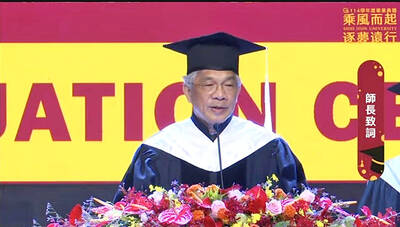
Shih Hsin University President Chen Ching-he (陳清河) yesterday issued a public apology for comments made in his commencement speech last week, stating that he has asked the school to suspend his duties and halt his wages for two months as a show of contrition. At the commencement ceremony on May 30, Chen said, “If you don’t manage your time well, or your own emotions, or your health, then I am telling every one of you — put a quick end to ‘you,’ because the world has no need for ‘you.’” The comments have sparked significant controversy online, and Chen through an open
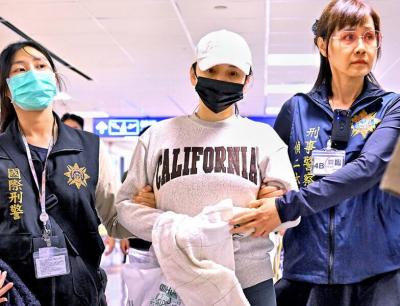
Johanne Liou (劉喬安), a Taiwanese woman who shot to unwanted fame during the Sunflower movement protests in 2014, returned to Taiwan last night after being deported from the US. She is to stand trial in Taiwan for charges involving embezzlement, fraud and drug crimes. The Criminal Investigation Bureau (CIB) said it took her into custody at Taiwan Taoyuan International Airport and would first question her before transferring her to the New Taipei District Prosecutors’ Office. She was arrested upon disembarking a flight from San Francisco that landed shortly before 7pm. Liou absconded to the US in 2019 after jumping bail


 RSS
RSS