


A Brazilian artist who came to Taiwan to study after falling in love with the nation’s movies and music has written a comic book depicting a love story between a soccer player and a betel nut sales girl.
The Betel Nut Beauty (檳榔美少女) is Lucas Paixao’s first serialized work and his first publication, he said.
Paixao first came to Taiwan in 2014 as an exchange student at Taipei National University of the Arts’ School of Fine Arts, he said.
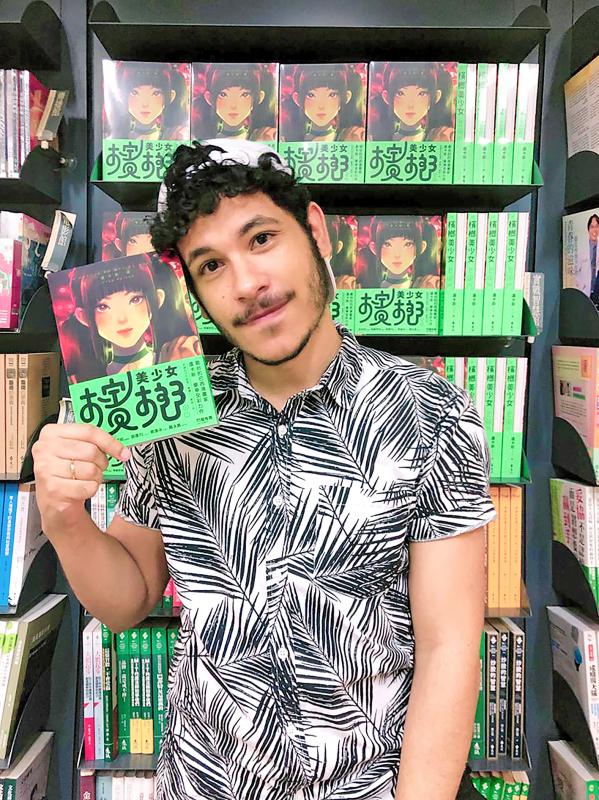
Photo courtesy of Yuan-Liou Publishing via CNA
The series showcases his view of unique aspects of Taiwan’s culture, as well as his deep love for comics, critics have said.
Paixao, who was born in Salvador, Brazil, became a fan of Taiwanese all-girl pop group S.H.E when he was 12 years old, which motivated him to learn Mandarin and sparked his interest in Taiwanese culture, especially films and TV dramas.
After graduating from university in Brazil, Paixao worked as a graphic designer, but it left him feeling “empty,” he said.
At 24, he decided to move back to Taiwan, and applied to a graduate studies program at the Taipei National University of the Arts, but while studying in Taiwan, he was still unsure about his future, he said.
“It was at this time that I saw a poster advertising a comic book artists’ competition,” he said.
From a young age, Paixao enjoyed drawing comics, but never thought of his hobby as a career option until he saw that poster, he said.
His decision to focus on betel nut sales girls came after hearing the expression “betel nut beauty” in the 2007 film Help Me Eros (幫幫我愛神), he said.
“At first I thought this was an occupation that film producers had made up,” Paixao said, adding that he never imagined that he would encounter so many real “betel nut beauties” after coming to Taiwan.
He slowly came to understand all of the inherent contradictions and intricacies in the occupation, he said.
When he first began to work on the comic, many people questioned the subject matter, telling him that a soccer star would never fall in love with a betel nut sales girl, who works an occupation that they described as uncouth, he said.
The reservations only strengthened his resolve to continue the series, he said.
While preparing to work on the comic, Paixao attempted to interview betel nut sales girls at a shop near his home, but they refused to speak with him, he said.
Nevertheless, the experience proved valuable to his understanding of the industry, he added.
“That experience helped me realize the extent to which betel nut sales girls go to protect themselves, and also the mysterious nature of this industry,” Paixao said.
The first issue in the series in 2016 won an award in the potential category of the Comico competition.
He finished the series at the end of 2017.
Yuan-Liou Publishing on Thursday last week published the series as a collection, which includes improvements to the work, he said.

Actor Darren Wang (王大陸) was sentenced to six months in prison, commutable to a fine, by the New Taipei District Court today for contravening the Personal Data Protection Act (個人資料保護法) in a case linked to an alleged draft-dodging scheme. Wang allegedly paid NT$3.6 million (US$114,380) to an illegal group to help him evade mandatory military service through falsified medical documents, prosecutors said. He transferred the funds to Chen Chih-ming (陳志明), the alleged mastermind of a draft-evasion ring, although he lost contact with him as he was already in detention on fraud charges, they said. Chen is accused of helping a

UNREASONABLE SURVEILLANCE: A camera targeted on an road by a neighbor captured a man’s habitual unsignaled turn into home, netting him dozens of tickets The Taichung High Administrative Court has canceled all 45 tickets given to a man for failing to use a turn signal while driving, as it considered long-term surveillance of his privacy more problematic than the traffic violations. The man, surnamed Tseng (曾), lives in Changhua County and was reported 45 times within a month for failing to signal while driving when he turned into the alley where his residence is. The reports were filed by his neighbor, who set up security cameras that constantly monitored not only the alley but also the door and yard of Tseng’s house. The surveillance occurred from July

SECURITY: Starlink owner Elon Musk has taken pro-Beijing positions, and allowing pro-China companies to control Taiwan’s critical infrastructure is risky, a legislator said Starlink was reluctant to offer services in Taiwan because of the nation’s extremely high penetration rates in 4G and 5G services, the Ministry of Digital Affairs said yesterday. The ministry made the comments at a meeting of the legislature’s Transportation Committee, which reviewed amendments to Article 36 of the Telecommunications Management Act (電信管理法). Article 36 bans foreigners from holding more than 49 percent of shares in public telecommunications networks, while shares foreigners directly and indirectly hold are also capped at 60 percent of the total, unless specified otherwise by law. The amendments, sponsored by Chinese Nationalist Party (KMT) Legislator Ko

‘SAME OLD TRICK’: Even if Beijing resumes individual travel to Taiwan, it would only benefit Chinese tourism companies, the Economic Democracy Union convener said China’s 10 new “incentives” are “sugar-coated poison,” an official said yesterday, adding that Taiwanese businesses see them clearly for what they are, but that Beijing would inevitably find some local collaborators to try to drums up support. The official, speaking on condition of anonymity, made the remark ahead of a news conference the General Chamber of Commerce is to hold today. The event, titled “Industry Perspectives on China’s Recent Pro-Taiwan Policies,” is expected to include representatives from industry associations — such as those in travel, hotels, food and agriculture — to request the government cooperate with China’s new measures, people familiar with


 RSS
RSS