


Local governments can independently set mandatory mask-wearing rules for eight types of crowded or enclosed spaces, the Central Epidemic Command Center (CECC) said yesterday, as it reported a case of a Philippine worker who tested positive after returning to the Philippines from Taiwan.
Since the center loosened mandatory COVID-19 prevention rules and started promoting the “new disease prevention lifestyle” on June 7, Minister of Health and Welfare Chen Shih-chung (陳時中), who also heads the CECC, said he has increasingly seen people letting their guard down.
Chen said that the center encourages people to practice social distancing or wear a mask in eight types of crowded or enclosed spaces — healthcare and long-term care facilities, public transportation, marketplaces, education sites, show or competition venues, religious venues, recreational sites, and at large events.
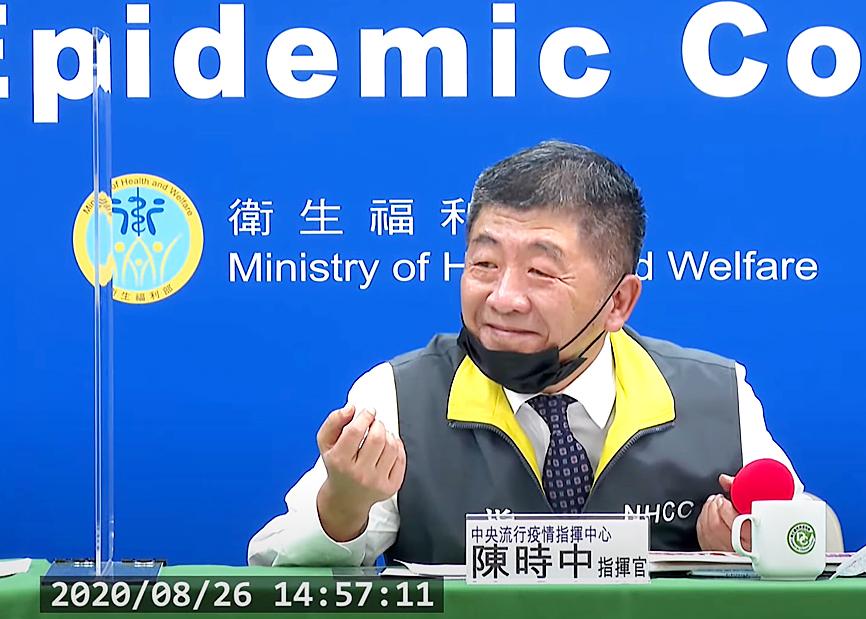
Photo copied by Wu Liang-yi, Taipei Times
Local governments can set mandatory mask-wearing rules at these sites if they deem it necessary, and set penalties for people who do not follow the rules, Chen said, adding that local governments are required to inform the CECC about their rules before implementing them.
If the domestic COVID-19 situation worsens or domestic cases of unknown infection sources are reported in certain cities, counties or areas, the CECC might also announce location-specific mask-wearing rules, he said.
“We are still in the phase of ‘persuading and encouraging’ people to wear a mask, but we respect the local governments’ decisions, and they can make it compulsory if they need to,” Chen said.
The CECC has been informed by the Philippine authorities that a Filipino woman tested positive for COVID-19 upon arrival in Manila last week, he said.
The woman is in her 30s and had been working in Taiwan since Feb. 27, Chen said, adding that she returned home on Wednesday last week.
The CECC said that the woman has been asymptomatic, and 21 people who have had close contact with her in Taiwan, including coworkers and her roommate, have been given polymerase chain reaction (PCR) tests and antibody tests.
Centers for Disease Control (CDC) Deputy Director-General Chuang Jen-hsiang (莊人祥), who doubles as the CECC spokesman, said that two PCR test results have so far come back negative, while the others are still being examined, adding that the center would ask the Philippine authorities for more detailed information on the case.
Asked to comment on cases of travelers from Taiwan testing positive in other countries, Chuang said that some of the results were unclear, referring to people who have tested negative and positive when different test kits were used.
However, the CECC’s main concern is the impact on local communities, Chuang said, adding that while symptoms of SARS were clear and allowed for cases being quickly identified and isolated, people with COVID-19 often do not show symptoms and it is unclear whether such cases can spread the virus.
It is therefore important for people to wear masks to protect themselves, he said.
The policy of conducting PCR tests on all travelers arriving from the Philippines has been in place since July 26, and starting from Aug. 12, arrivals from the country are required to stay at centralized quarantine facilities after entering Taiwan.
Asked if the policy would continue, Chuang said that 557 travelers from the Philippines have been tested since the policy was implemented, with 51 people showing symptoms and 11 being confirmed with COVID-19.
Among the 506 people tested without symptoms, two received positive test results, he added.
As the COVID-19 situation in South Korea has been rapidly worsening in the past two weeks, the CECC has removed South Korea from the list of “medium-low infection risk countries or areas,” from which short-term business travelers can apply for shortened quarantine periods, Chen said, adding that Sri Lanka, Nauru, Timor-Leste and Mauritius have been added to the list of “low infection risk countries or areas.”

Actor Darren Wang (王大陸) was sentenced to six months in prison, commutable to a fine, by the New Taipei District Court today for contravening the Personal Data Protection Act (個人資料保護法) in a case linked to an alleged draft-dodging scheme. Wang allegedly paid NT$3.6 million (US$114,380) to an illegal group to help him evade mandatory military service through falsified medical documents, prosecutors said. He transferred the funds to Chen Chih-ming (陳志明), the alleged mastermind of a draft-evasion ring, although he lost contact with him as he was already in detention on fraud charges, they said. Chen is accused of helping a

SECURITY: Starlink owner Elon Musk has taken pro-Beijing positions, and allowing pro-China companies to control Taiwan’s critical infrastructure is risky, a legislator said Starlink was reluctant to offer services in Taiwan because of the nation’s extremely high penetration rates in 4G and 5G services, the Ministry of Digital Affairs said yesterday. The ministry made the comments at a meeting of the legislature’s Transportation Committee, which reviewed amendments to Article 36 of the Telecommunications Management Act (電信管理法). Article 36 bans foreigners from holding more than 49 percent of shares in public telecommunications networks, while shares foreigners directly and indirectly hold are also capped at 60 percent of the total, unless specified otherwise by law. The amendments, sponsored by Chinese Nationalist Party (KMT) Legislator Ko
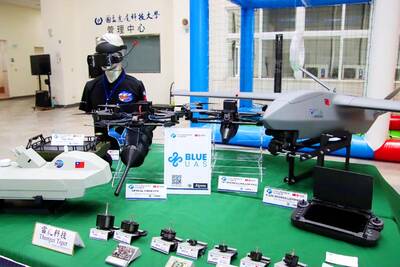
NON-RED SUPPLY: Boosting the nation’s drone industry is becoming increasingly urgent as China’s UAV dominance could become an issue in a crisis, an analyst said Taiwan’s drone exports to Europe grew 41.7-fold from 2024 to last year, with demand from Ukraine’s fight against Russian aggression the most likely driver of growth, a study showed. The Institute for Democracy, Society and Emerging Technology (DSET) in a statement on Wednesday said it found that many of Taiwan’s uncrewed aerial vehicle (UAV) sales were from Poland and the Czech Republic. These countries likely transferred the drones to Ukraine to aid it in its fight against the Russian invasion that started in 2022, it said. Despite the gains, Taiwan is not the dominant drone exporter to these markets, ranking second and fourth

The eastern extension of the Taipei MRT Red Line could begin operations as early as late June, the Taipei Department of Rapid Transit Systems said yesterday. Taipei Rapid Transit Corp said it is considering offering one month of free rides on the new section to mark its opening. Construction progress on the 1.4km extension, which is to run from the current terminal Xiangshan Station to a new eastern terminal, Guangci/Fengtian Temple Station, was 90.6 percent complete by the end of last month, the department said in a report to the Taipei City Council's Transportation Committee. While construction began in October 2016 with an


 RSS
RSS