

People should not focus entirely on having zero new confirmed COVID-19 cases in Taiwan, but neglect overall control over the disease situation, Central Epidemic Command Center (CECC) specialist advisory panel convener Chang Shan-chwen (張上淳) said yesterday.
Chang made the remark at a forum in Taipei discussing the steps Taiwan should take in the post-pandemic era, organized by the Chinese-language magazine Global Views Monthly.
Chang, Centers for Disease Control (CDC) Director-General Chou Jih-haw (周志浩), and Stanford University’s Center for Policy, Outcomes and Prevention director C. Jason Wang (王智弘) each made a presentation, followed by a panel discussion with Chang, Wang and Buddhist Tzu Chi University president Ingrid Y. Liu (劉怡均).

Photo: Chien Hui-ju, Taipei Times
“As people say: ‘No pain, no gain.’ We have suffered pain and have gained,” Chou said, adding that Taiwan had learned much from the SARS outbreak in 2003 and improved its disease prevention measures.
That included amending regulations to set up a more efficient and centralized disease control command system, enhancing infection controls at healthcare facilities and setting up a mask rationing policy, he said.
Taiwan acted fast to effectively block the virus through these mechanisms, as well as the use of smart technology, he added.
“However, the global COVID-19 situation is still severe, so the CECC is being very careful in easing border controls,” Chou said.
Until effective vaccines and drugs are developed, wearing a mask, washing hands frequently and practicing the “new disease prevention lifestyle” remain very important, he said, adding that the government also needs to consider its long-term investment strategy in the public health and healthcare sectors.
Chang said the CECC and advisory specialists acted rapidly and frequently discussed response measures from the early days of the pandemic.
They were prepared for possible local outbreaks, but the nation kept the disease situation under control much better than they had expected, he said.
He is thankful to healthcare workers who had to keep up with the rapidly changing policies, as well as for the cooperation of people and the private sector, Chang added.
About 1 million new confirmed cases were reported around the world in only four days, Chang said.
While Taiwan is relatively safe, it faces the challenge of how to interact with other nations for economic development while preventing the risk of a local outbreak, he said.
“If people always want to see zero new cases, then the government will not dare to ease [disease prevention] policies, but this might have a negative effect on the economy,” he said.
“We should not always have zero tolerance to new infections, or else the government cannot make any changes,” he added.
Posing a hypothetical question, Chang asked whether a doctor should be more focused on the overall well-being of a patient or getting perfect data values, and said that people should not be so concerned by a few new COVID-19 cases, which might indicate local infection, and cast doubt on the government’s overall disease prevention policy.
Asked about a Belgian COVID-19 patient who had been in Taiwan since May and tested positive last week, Chang said: “Theoretically, the possibility of him having contracted it in Taiwan is higher, but whether there are exceptions, we still need more information to tell.”
If disease prevention measures were to fail just because the nation does not conduct COVID-19 tests on all travelers within 14 days of their arrival in Taiwan, then the nation would have already lost control of the disease situation, he said.
Saying “never let a good crisis go to waste,” Wang added Taiwan has already shown the world that a democratic nation can effectively prevent a COVID-19 outbreak.
The nation should emerge from the crisis and become stronger, he said.
Wang proposed changing the slogan “Taiwan can help” to “Taiwan can lead,” and urged the nation to seize the opportunity to share its biotechnological innovations with the world, or even take the lead in developing new disease prevention technology.
A video of Taiwanese-American HIV/AIDS researcher David Ho’s (何大一) interview with Global Views Monthly was also screened at the forum, in which Ho said that people must realize that “if you don’t have public health, you’re not going to have economic health.”
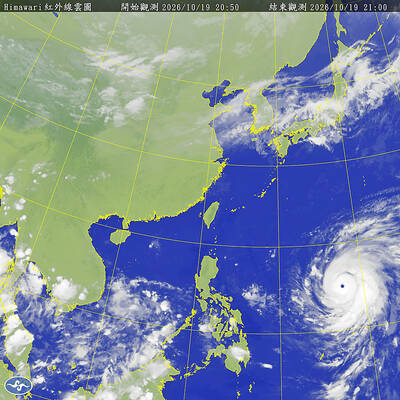
Typhoon Champi is forecast to turn northward earlier than previously expected, sparing Taiwan a direct hit but still bringing heavy rain to the north of the country on Friday and Saturday, the Central Weather Administration (CWA) said yesterday. Typhoon Champi had strengthened and increased in size over the past 12 hours, and as of yesterday afternoon, was packing sustained winds of 198kph near its center, CWA forecaster Cheng Chieh-jen (鄭傑仁) said. However, due to the weakening of a Pacific high-pressure system the storm is now expected to turn northward earlier than initially forecast, likely around Japan’s Ishigaki Island, Cheng said. As Champi brushes
A Chinese People's Liberation Army (PLA) Navy aircraft carrier group was being monitored after entering the western Pacific, the Ministry of National Defense said today, after Beijing yesterday criticized Taiwan for using a water cannon against a Chinese fishing boat near the Pratas Islands (Dongsha Islands, 東沙群島). A Chinese naval task group led by the aircraft carrier Liaoning (遼寧) yesterday sailed to the western Pacific for training, Chinese state-run Xinhua news agency quoted the PLA Navy as saying. “The drill is part of the annual routine training plan aimed at testing and improving the troops’ combat readiness and enhancing their ability to
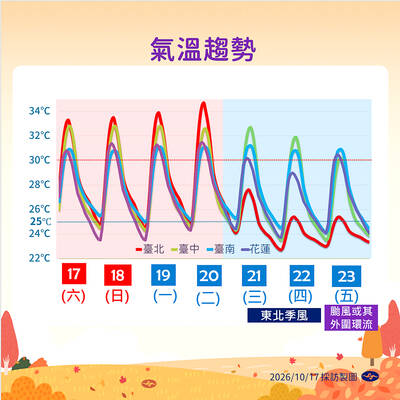
TYPHOON WATCH Champi closes to east Typhoon Champi could continue to strengthen and approach waters off eastern Taiwan by Thursday, with some forecast models suggesting it could move west and cross the nation, the Central Weather Administration (CWA) said yesterday. As of 2pm yesterday, Champi was 2,980km east-southeast of Oluanpi (鵝鑾鼻), Taiwan’s southernmost tip, and moving west at 22kph. It had maximum sustained winds of 162kph and a storm radius of 180km, CWA data showed. CWA forecaster Chang Cheng-chuan (張承傳) said Champi could intensify as it moves west before turning west-northwest toward Taiwan. The storm is expected to reach waters off eastern
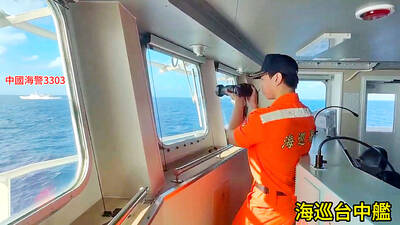
Taiwan said yesterday it had driven away 16 Chinese coast guard, research and fishing vessels involved in simultaneous “maritime harassment” operations. An “unusually large” number of Chinese vessels took part in the coordinated operations around Taiwan proper and Taiwan-controlled Pratas Islands (Dongsha Islands, 東沙群島), the Taiwanese coast guard said in a statement. The Chinese vessels, including four fishing boats, carried out “simultaneous operations at multiple locations and engaged in hybrid warfare,” the statement said. The locations were off Taiwan’s eastern, southern and southwestern coastlines, and around Pratas. Some of the Chinese vessels entered Taiwan’s restricted


 RSS
RSS