

The government’s real-name mask purchasing system is to be continued until at least the end of the year, the Central Epidemic Command Center (CECC) said yesterday, as it reported a new imported COVID-19 case from the Philippines.
The center would continue to requisition mask production to ensure people can buy masks using the real-name system until the end of December, said Centers for Disease Control (CDC) Deputy Director-General Chuang Jen-hsiang (莊人祥), the CECC’s spokesman.
While the CECC requisitions about 8 million masks per day to ensure there are enough for the real-name system, more than 10 million masks are produced per day for sale domestically or overseas, so people can also purchase masks from various retailers, he told the CECC’s daily news conference, after being asked about former vice president Chen Chien-jen’s (陳建仁) suggestion that each household have a mask reserve to last them three months.
Photo: CNA
Given that the COVID-19 pandemic is raging worldwide, Taiwan could face the challenges of low herd immunity, an increase in imported cases as border controls are gradually eased, the lack of a vaccine and the possibility of COVID-19 cases being mistaken for the flu during flu season, said Chen, an epidemiologist and public health expert, adding that having a mask reserve was a practical suggestion.
Chuang said a Filipina in her 20s who has an Alien Resident Certificate arrived at Taiwan Taoyuan International Airport on Friday to visit her family and was given a COVID-19 test at the airport upon arrival, as all Filipinos must now do as of Wednesday last week.
As the woman did not have any COVID-19 symptoms upon arrival, she was taken to a hotel to undergo quarantine.
However, on Saturday she developed a mild fever and was tested again, and the test result received yesterday was positive, raising the total number of confirmed cases in Taiwan to 465, Chuang said.
The local health bureau initiated contact tracing after the positive test result was received, and as of 5pm, the 26 people who had direct contact with the woman have been identified, the CECC said.
They include 12 passengers who sat close to her on the flight to Taiwan and one family member — who have been placed under home isolation — and 11 crew members who have been asked to self-monitor, as well as two passengers from the flight who only transited Taiwan, the CECC said.
As for the case of a Belgian engineer who entered Taiwan on May 3 and was quarantined until May 17, but tested positive last week in two polymerase chain reaction (PCR) tests, Chuang said the man underwent the tests as a requirement for returning home, but had not reported any symptoms while in Taiwan.
However, he had experienced a loss of smell and taste in March while still in Belgium, so the PCR tests might have detected small fragments of inactive viral RNA, Chuang said.
Chung said 310 people who had close contact with the Belgian during his stay have been given a PCR test, and 109 tested negative as of 5pm yesterday.
They would be asked to take a COVID-19 antibody test as well, he said.
The CECC cannot rule out that the man contracted SARS-COV-2 in Taiwan, a determination that would be made by experts based up the results of the contact investigations, he added.
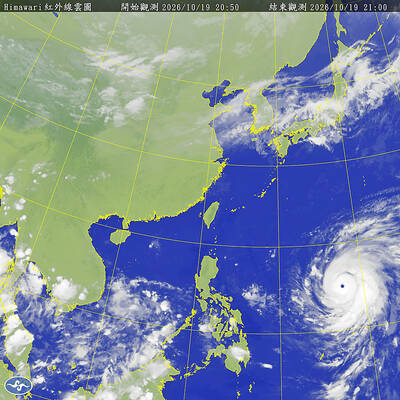
Typhoon Champi is forecast to turn northward earlier than previously expected, sparing Taiwan a direct hit but still bringing heavy rain to the north of the country on Friday and Saturday, the Central Weather Administration (CWA) said yesterday. Typhoon Champi had strengthened and increased in size over the past 12 hours, and as of yesterday afternoon, was packing sustained winds of 198kph near its center, CWA forecaster Cheng Chieh-jen (鄭傑仁) said. However, due to the weakening of a Pacific high-pressure system the storm is now expected to turn northward earlier than initially forecast, likely around Japan’s Ishigaki Island, Cheng said. As Champi brushes
A Chinese People's Liberation Army (PLA) Navy aircraft carrier group was being monitored after entering the western Pacific, the Ministry of National Defense said today, after Beijing yesterday criticized Taiwan for using a water cannon against a Chinese fishing boat near the Pratas Islands (Dongsha Islands, 東沙群島). A Chinese naval task group led by the aircraft carrier Liaoning (遼寧) yesterday sailed to the western Pacific for training, Chinese state-run Xinhua news agency quoted the PLA Navy as saying. “The drill is part of the annual routine training plan aimed at testing and improving the troops’ combat readiness and enhancing their ability to
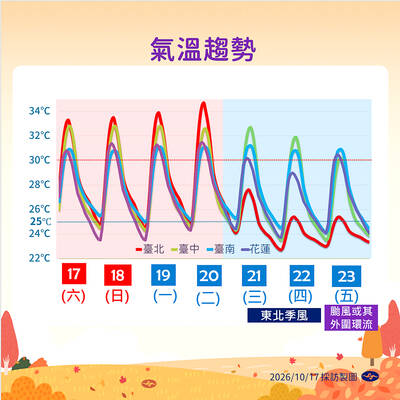
TYPHOON WATCH Champi closes to east Typhoon Champi could continue to strengthen and approach waters off eastern Taiwan by Thursday, with some forecast models suggesting it could move west and cross the nation, the Central Weather Administration (CWA) said yesterday. As of 2pm yesterday, Champi was 2,980km east-southeast of Oluanpi (鵝鑾鼻), Taiwan’s southernmost tip, and moving west at 22kph. It had maximum sustained winds of 162kph and a storm radius of 180km, CWA data showed. CWA forecaster Chang Cheng-chuan (張承傳) said Champi could intensify as it moves west before turning west-northwest toward Taiwan. The storm is expected to reach waters off eastern
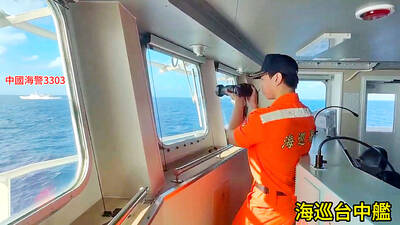
Taiwan said yesterday it had driven away 16 Chinese coast guard, research and fishing vessels involved in simultaneous “maritime harassment” operations. An “unusually large” number of Chinese vessels took part in the coordinated operations around Taiwan proper and Taiwan-controlled Pratas Islands (Dongsha Islands, 東沙群島), the Taiwanese coast guard said in a statement. The Chinese vessels, including four fishing boats, carried out “simultaneous operations at multiple locations and engaged in hybrid warfare,” the statement said. The locations were off Taiwan’s eastern, southern and southwestern coastlines, and around Pratas. Some of the Chinese vessels entered Taiwan’s restricted


 RSS
RSS