


National Taiwan University public health experts yesterday said that all foreign students and workers should undergo a centralized quarantine upon arrival in Taiwan, as well as being tested for COVID-19 upon arrival and departure.
The Central Epidemic Command Center on Monday reported a case of a Thai worker who tested positive for COVID-19 after returning to Thailand from Taiwan last week, saying that it could not rule out the possibility that it was a locally acquired case.
National Taiwan University College of Public Health dean Chan Chang-chuan (詹長權) said that following last month’s case of a student testing positive for COVID-19 in Japan after returning from Taiwan and the new case in Thailand, many people are worried about asymptomatic carriers in local communities in Taiwan.
“The cases imply that there is a remaining threat of potential asymptomatic carriers in local communities,” Chan said. “They also tell us that foreign students and workers should undergo a mandatory centralized quarantine, as it would be difficult to do contact tracing if a positive case is confirmed among them.”
“We also believe that foreign students and workers should be tested for COVID-19 upon arrival and on their departure from Taiwan,” he said. “Digital contact tracing for these foreign students and workers, who might not have smartphones, should also be improved.”
The center and the Ministry of Labor should have a comprehensive disease prevention plan for migrant workers, including conducting mass testing on all workers at the factory where the Thai patient worked and all their close contacts, as well as moving migrant workers to individual dormitory rooms, and separate the flow of workers in the factory and the dormitory, Chan said.
Other preventive measures should include testing of all foreign workers when they enter and leave Taiwan, conducting safety and hygiene inspections of foreign workers’ working and living environments, and conducting COVID-19 antibody tests on all foreign workers, he said.
College vice dean Tony Chen (陳秀熙) said that data on clustered infections on cruise ships showed the exceptionally high risk of COVID-19 spreading in high-density environments, and the limitations of reverse transcription polymerase chain reaction tests in detecting pre-symptomatic and asymptomatic carriers.
In addition to contact tracing and COVID-19 testing, antibody testing should also be used for members of highly clustered groups, such as migrant workers, to find potential asymptomatic carriers that could become the source of additional local infections, Chen said.
As the influenza season occurs between autumn and spring, both diseases have very similar symptoms and many experts have predicted that the COVID-19 pandemic could get worse in the winter, the government should develop kits that can test for both influenza and COVID-19, Chan said.
He also urged the government to join international research teams developing COVID-19 vaccines as soon as possible, or the nation could face problems such as not having priority in purchasing a vaccine once it goes on sale or domestically produced vaccines being unable to obtain international verification.

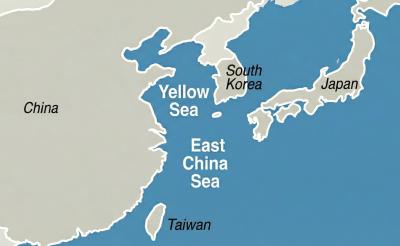
China has reserved offshore airspace in the Yellow Sea and East China Sea from March 27 to May 6, issuing alerts usually used to warn of military exercises, although no such exercises have been announced, the Wall Street Journal (WSJ) reported yesterday. Reserving such a large area for 40 days without explanation is an “unusual step,” as military exercises normally only last a few days, the paper said. These alerts, known as Notice to Air Missions (Notams), “are intended to inform pilots and aviation authorities of temporary airspace hazards or restrictions,” the article said. The airspace reserved in the alert is
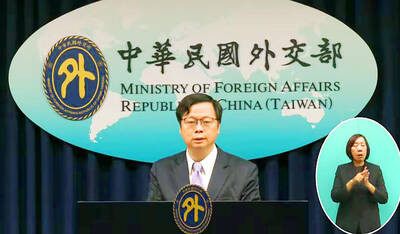
NAMING SPAT: The foreign ministry called on Denmark to propose an acceptable solution to the erroneous nationality used for Taiwanese on residence permits Taiwan has revoked some privileges for Danish diplomatic staff over a Danish permit that lists “Taiwan” as “China,” Eric Huang (黃鈞耀), head of the Ministry of Foreign Affairs’ Department of European Affairs, told a news conference in Taipei yesterday. Reporters asked Huang whether the Danish government had responded to the ministry’s request that it correct the nationality on Danish residence permits of Taiwanese, which has been listed as “China” since 2024. Taiwan’s representative office in Denmark continues to communicate with the Danish government, and the ministry has revoked some privileges previously granted to Danish representatives in Taiwan and would continue to review
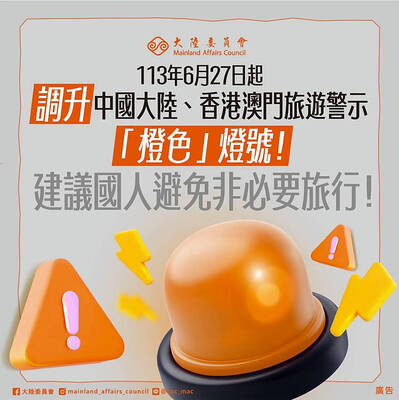
More than 6,000 Taiwanese students have participated in exchange programs in China over the past two years, despite the Mainland Affairs Council’s (MAC) “orange light” travel advisory, government records showed. The MAC’s publicly available registry showed that Taiwanese college and university students who went on exchange programs across the Strait numbered 3,592 and 2,966 people respectively. The National Immigration Agency data revealed that 2,296 and 2,551 Chinese students visited Taiwan for study in the same two years. A review of the Web sites of publicly-run universities and colleges showed that Taiwanese higher education institutions continued to recruit students for Chinese educational programs without

A bipartisan group of US senators has introduced a bill to enhance cooperation with Taiwan on drone development and to reduce reliance on supply chains linked to China. The proposed Blue Skies for Taiwan Act of 2026 was introduced by Republican US senators Ted Cruz and John Curtis, and Democratic US senators Jeff Merkley and Andy Kim. The legislation seeks to ease constraints on Taiwan-US cooperation in uncrewed aerial systems (UAS), including dependence on China-sourced components, limited access to capital and regulatory barriers under US export controls, a news release issued by Cruz on Wednesday said. The bill would establish a "Blue UAS


 RSS
RSS