


Taipei Times: Why do you believe Taiwan must push for a jury system?
Jerry Cheng (鄭文龍): Having been a lawyer for 27 years, I am quite familiar with courtroom operations in Taiwan, and being one of the few in the nation who have closely observed proceedings in other countries, my assessment is that Taiwan’s judiciary would fare poorly if we were to rank it against other countries.
For example, 13 years ago I was in Indonesia watching a case. At that time there was satellite news gathering broadcasting inside the courtroom, in addition to screens set up outside the court. In that regard, the transparency of Taiwan’s judiciary lags far behind.
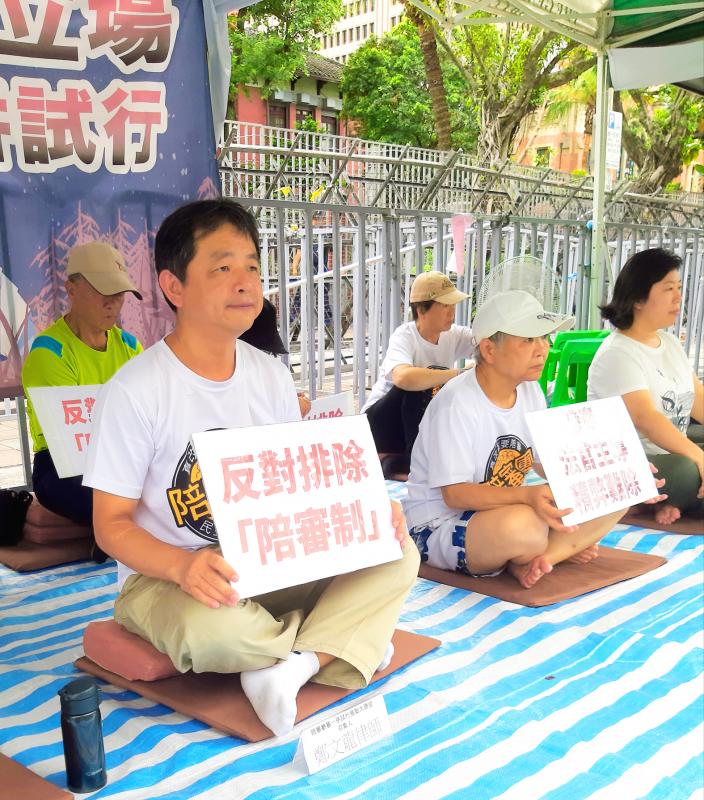
Photo: Huang Tai-lin, Taipei Times
Of the courtrooms I have observed in many countries, do you know which country’s judges are the most scathing? Taiwan. The judges in Taiwan can arbitrarily castigate others — and it is quite common — the defendants, even the witnesses, the lawyers and sometimes the prosecutors.
Another example of the absurdity of Taiwan’s judiciary is that it has five high courts, all of which are not open to the public. As a foreign national, I was able to gain entry to high courts in the US, the UK, Egypt and Peru, for example, but not in Taiwan, where trials are still held behind closed doors.
Yet most judges, prosecutors and lawyers think the current approach works. This in turn explains why 80 percent of respondents to a poll said they were dissatisfied with the judiciary.
After giving the matter a thorough look, I have reached the conclusion that the core of the issue lies in that Taiwan’s trial system is akin to Middle Age practice. Hence, in 2009, I started advocating trial-by-jury with the hope of reforming the nation’s trial system.
The current unrefined trial system has resulted in three judicial maladies: judges prone to receiving bribes, judges inclined to becoming political pawns, and judges who we have dubbed “dinosaurs,” handing out rulings that are out of touch with society.
While it is no panacea, I believe a jury system could be a solution to most of the problems.
First, in a trial-by-jury system, the chances of bribing jurors are low, given the selection mechanism. Second, jurors answer to no one, unlike judges who comply to higher-ups’ directives. Third, a jury of citizens made up of nine or 12 people is drawn from the general public, having diverse backgrounds with plenty of social experience. Collectively they could aggregate knowledge, perspectives to deliver what we call “diverse wisdom” [in reaching a fair and judicious verdicts].
There are 52 countries that employ the jury system, including the UK, where it has been in use for 1,000 years, and the US, which has had it for 400 years. In other words, it is a stable and reliable system.
TT: Having observed many countries’ judicial practices, including in Taiwan’s neighboring countries, with Japan adopting a lay judge model while South Korea has a jury system, why do you think a jury system is a better fit for Taiwan than a lay assessor model?
Cheng: The lay judge model cannot solve the three judicial maladies.
In a lay judge model, professional judges are still in command of the process, and one among them could still possibly be receiving bribes and seeking to influence the direction of lay votes, or they could still heed higher-ups’ instructions, and young judges still dominate trials.
Japan has had the lay judge model for 11 years and the results of a survey conducted on its 10th year suggested it is a failed system.
A poll conducted by Kyodo News showed that of those who had served as lay judges, 39 percent said that they felt they had been influenced by professional judges.
This is a common failing of the lay judge model, because in the mixed body of lay and professional judges, the latter feel they are superior, so they are bound to dominate the trial, whereas the lay judges, susceptible to so-called authority bias, tend to yield to the opinion of an authority figure.
One of the reasons prompting Japan to undergo judicial reform in the first place was because the Japanese found their judges to be “deformed” amid a conviction rate of more than 99 percent, so they needed citizen participation to dilute the high percentage of wrongful convictions.
However, after the employment of the lay judge system, the issue has not been solved. Japan also found that when the system was introduced, there was eagerness from members of the public to take part, but the willingness to participate decreased after 10 years when people realized that they were mostly just “wall flowers,” so to speak.
So, this brings us to the question: Why are we not adopting a trial system that has proven to be mature and stable, but one that has been shown to be a failure?
Look at Hong Kong. It adopted the jury system in 1845, but Article 46 of [Beijing’s recent] national security legislation removes the jury system, because the existence of juries means that authorities cannot employ heavy-handed means and beleaguer political opponents.
In other words, a jury is an instrument of protection for the people. The more authoritative a country is, or the more hierarchical a society is, the more resistant it is to a jury system.
Taiwan is a fit for a jury system, as such a system requires a society that is open and values equality.
The nation’s democratization over the past three decades means we have chosen a political system that embodies the democratic ethos of “believing the people,” and yet the government is opting for a trial model that says otherwise, which is quite odd.
TT: Some have called into question the competency of legal knowledge among Taiwanese. Your thoughts? Also, jurors can only hear testimonies, while lay judges can question the defendants and witnesses. Would the latter not allow for wider citizen engagement than the former?
Cheng: The fact that 52 countries stick to the jury system is evidence that citizens and judges need to work independently on a division of labor basis.
Both are important in their respective functions, but you cannot mix them or else the function will be obscured.
To put it in an analogy, a juror is like a clear glass of water for drinking while a judge is ink for writing. Each has distinct functions. When you mix the two, the water can no longer be drunk and the ink cannot be used to write.
The presence of a judge would hinder citizen jurors from reaching “diverse wisdom” in a fair and objective manner, as they would illicit the so-called authority bias.
A mixed body of lay and trained judges likewise obscures the function of the judge, which is to preserve order. A judge’s impartiality is hindered when they also lead the trial.
Judges can provide guidance if they do so openly and under the scrutiny of prosecutors and lawyers, but when they are placed together with the jurors, their “guidance” becomes interference.
Generally speaking, it is not a good idea for jurors to ask questions. Interrogation is a trained skill. In a scrupulous trial system, only judges, prosecutors and lawyers who have undergone professional training are capable of asking questions. The function of jurors is to hear the case and use diverse wisdom.
The design of the jury system does not require jurors to possess legal knowledge, but their common sense, social experience and perspective of right and wrong to determine facts.
In short, a lay judge model confounds the functions of citizens and judges in trials.
TT: Be it a jury system or a lay judge model, do you think the nation’s judiciary is ready for public participation in trials?
Cheng: I do not think the judiciary is ready, but I believe the caliber of the people is sufficient.
If Taiwan adopts a lay judge model, it would be a laughing stock, especially in China, which, having run a lay assessor system for decades, would see it as Taiwan following its lead.
Taiwan makes its mark in the world because of its freedom and democracy. Implementation of a jury system could set Taiwan apart from undemocratic, unfree China.
If Taiwan adopts a lay judge model, it would not only show its regression and ignorance, but also put it at a disadvantage in the international community by failing to make a distinction between Taiwan and China.


UPGRADE: The Kang Ding-class frigate is replacing its Chaparall missiles with Tien Chien II and Hua Yang VLS, which would provide it with long-range, 360° air defense Taiwan plans to produce 1,200 to 1,376 Hai Chien II missiles (海劍二, Sea Sword II) — also known as TC-2N — to serve as the standard air defense system of the navy’s surface combatant fleet, a source said yesterday. Last week, the Hai Chien II, the naval version of the Tien Kung II missile (天劍二, Sky Sword II), completed a live-fire test in waters off the National Chungshan Institute of Science and Technology’s Jiupeng facility (九鵬) in Pingtung County’s Manjhou Township (滿州). The MIM72 Chaparral and other dated air defense missiles that currently arm Taiwanese ships have inadequate range to combat Chinese

REASONS FOR TRAVEL: An assistant professor said that proposed amendments to penalize drivers if they used drugs overseas would not deter people from traveling People who operate a motor vehicle under the influence of marijuana would have their driver’s license revoked, even if they used the substance while overseas, the Ministry of Transportation and Communications said yesterday, citing proposed amendments to the Road Traffic Management and Penalty Act (道路交通管理處罰條例). The amendments would also authorize the government to revoke the licenses of people determined to have used Category 1 or Category 2 narcotics, even if they were not operating a vehicle while under the influence of drugs, as well as ban them from taking the license test for three years, the ministry said. People aged 18 or

Johanne Liou (劉喬安), a Taiwanese woman who shot to unwanted fame during the Sunflower movement protests in 2014, returned to Taiwan last night after being deported from the US. She is to stand trial in Taiwan for charges involving embezzlement, fraud and drug crimes. The Criminal Investigation Bureau (CIB) said it took her into custody at Taiwan Taoyuan International Airport and would first question her before transferring her to the New Taipei District Prosecutors’ Office. She was arrested upon disembarking a flight from San Francisco that landed shortly before 7pm. Liou absconded to the US in 2019 after jumping bail
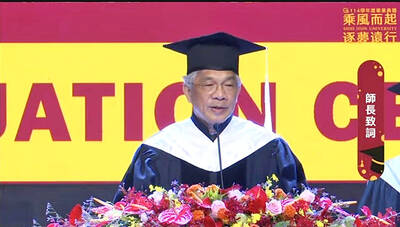
Shih Hsin University President Chen Ching-he (陳清河) yesterday issued a public apology for comments made in his commencement speech last week, stating that he has asked the school to suspend his duties and halt his wages for two months as a show of contrition. At the commencement ceremony on May 30, Chen said, “If you don’t manage your time well, or your own emotions, or your health, then I am telling every one of you — put a quick end to ‘you,’ because the world has no need for ‘you.’” The comments have sparked significant controversy online, and Chen through an open


 RSS
RSS