


The Chinese Nationalist Party (KMT) yesterday called on the central government to expand its COVID-19 relief package to help the travel industry, which has been hit hard by the pandemic.
From January to March, 19 travel agencies dissolved or suspended operations, KMT Culture and Communications Committee director-general Alicia Wang (王育敏) said, citing Tourism Bureau statistics.
Data released by the Travel Quality Assurance Association also showed that 12 travel agencies applied for dissolution from April to last month, she said.

Photo: CNA
Many more travel agencies are struggling, she said, urging the Ministry of Transportation and Communications to provide them with more support.
Wang attributed the problem to a sharp drop in outbound tourism, with Tourism Bureau data showing that the number of people traveling abroad plunged 87 percent to 733,207 from February to May, from 5,743,807 a year earlier.
The COVID-19 pandemic has had a “tsunami-like impact” on travel agencies, she said.
Wang urged the central government and the Ministry of Transportation and Communications to roll out the next phase of COVID-19 relief measures as soon as possible.
She also urged the government to consider forming so-called “travel bubbles” with other nations, such as New Zealand, which has the novel coronavirus under control, adding that they would open up opportunities for local travel agencies and reduce their need for government relief.
With domestic travel picking up, the government should also consider ways to spread out tourists, Wang said.
Reports that some travel agencies are considering downsizing or cutting salaries might be an indicator of a imminent wave of company closures, the KMT said, adding that bankruptcies, layoffs and furloughs would weigh on the domestic labor market.
The ministry is not expected to unveil its next phase of relief measures until the end of the month and details of the plan remain unclear, leaving people to question whether the new measures would be enough to help travel companies, it said.
The bureau said in a statement yesterday that Minister of Transportation and Communications Lin Chia-lung (林佳龍) had met with industry representatives to listen to their needs.
Travel companies serving inbound and outbound travelers would be the a major focus of the ministry’s next phase of relief measures, which would be implemented soon after it is approved by the Executive Yuan, it said.
Whether the bureau would extend its domestic travel subsidy program past October is to be considered on a rolling basis, depending on the execution of the budget, it said.

LOUD AND PROUD Taiwan might have taken a drubbing against Australia and Japan, but you might not know it from the enthusiasm and numbers of the fans Taiwan might not be expected to win the World Baseball Classic (WBC) but their fans are making their presence felt in Tokyo, with tens of thousands decked out in the team’s blue, blowing horns and singing songs. Taiwanese fans have packed out the Tokyo Dome for all three of their games so far and even threatened to drown out home team supporters when their team played Japan on Friday. They blew trumpets, chanted for their favorite players and had their own cheerleading squad who dance on a stage during the game. The team struggled to match that exuberance on the field, with
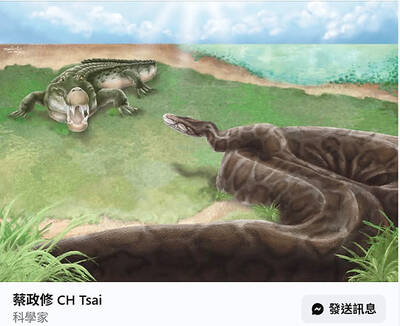
Taiwanese paleontologists have discovered fossil evidence that pythons up to 4m long inhabited Taiwan during the Pleistocene epoch, reporting their findings in the international scientific journal Historical Biology. National Taiwan University (NTU) Institute of Ecology and Evolutionary Biology associate professor Tsai Cheng-hsiu (蔡政修) led the team that discovered the largest snake fossil ever found in Taiwan. The single trunk vertebra was discovered in Tainan at the Chiting Formation, dated to between 400,000 and 800,000 years ago in the Middle Pleistocene, the paper said. The area also produced Taiwan’s first avian fossil, as well as crocodile, mammoth, saber-toothed cat and rhinoceros fossils, it said. Discoveries

Taiwanese paleontologists have discovered fossil evidence that pythons up to 4m long inhabited Taiwan during the Pleistocene epoch, reporting their findings in the international scientific journal Historical Biology. National Taiwan University (NTU) Institute of Ecology and Evolutionary Biology associate professor Tsai Cheng-hsiu (蔡政修) led the team that discovered the largest snake fossil ever found in Taiwan. A single trunk vertebra was discovered in Tainan at the Chiting Formation, dated to between 800,000 to 400,000 years ago in the Middle Pleistocene, the paper said. The area also produced Taiwan’s first avian fossil, as well as crocodile, mammoth, sabre-toothed cat and rhinoceros fossils, it said. Discoveries

Whether Japan would help defend Taiwan in case of a cross-strait conflict would depend on the US and the extent to which Japan would be allowed to act under the US-Japan Security Treaty, former Japanese minister of defense Satoshi Morimoto said. As China has not given up on the idea of invading Taiwan by force, to what extent Japan could support US military action would hinge on Washington’s intention and its negotiation with Tokyo, Morimoto said in an interview with the Liberty Times (sister paper of the Taipei Times) yesterday. There has to be sufficient mutual recognition of how Japan could provide


 RSS
RSS