


An Executive Yuan task force is reviewing templates for name and logo changes for the nation’s passport and China Airlines Ltd (CAL, 中華航空), following calls to remove the word “China” after several countries refused medical donations from Taiwan after mistaking it for China.
A CAL plane delivering medical supplies to Luxembourg on April 9 was mistaken for the Chinese carrier Air China Ltd (中國國際航空).
The Executive Yuan is awaiting the finalized versions from the Ministry of Foreign Affairs and the Ministry of Transportation and Communications (MOTC), Cabinet spokesman Ting Yi-ming (丁怡銘) said.
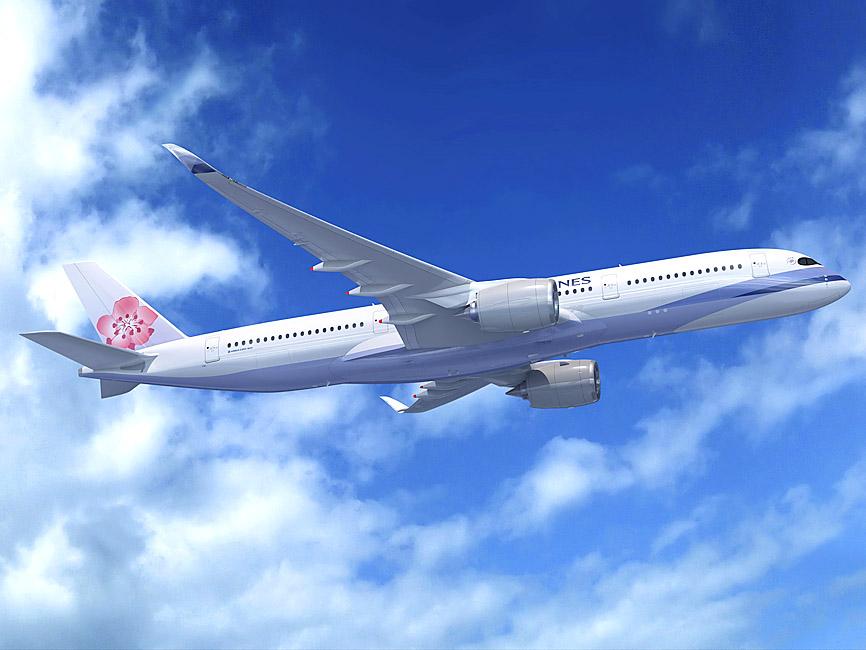
Photo: Cheng Wei-chi, Taipei Times
Premier Su Tseng-chang (蘇貞昌) would review all versions and reach a decision before forwarding it to the Legislative Yuan, a source in the Executive Yuan said.
Democratic Progressive Party (DPP) Legislator Chen Ting-fei (陳亭妃) said that calls to change the name of the airline and the design of the passport cover have received popular support, and that the Legislative Yuan would handle the issue in its extraordinary session.
The DPP caucus has separately proposed a bill calling on the legislature to decide on the matter, for the MOTC to look into measures to further highlight CAL’s country of origin, and to propose medium and long-term measures to prevent the company from being mistaken for Air China.
The DPP said that the MOTC’s measures should protect Taiwanese interests and reinforce the international identifiability of China Airlines as a Taiwanese company by, for example, adding “Taiwan” to its official name, or incorporating a map of Taiwan into its logo.
The New Power Party (NPP) caucus has also submitted a bill suggesting that the MOTC in the short term make the word “China” less prominent or remove it from the company’s name, and add the word “Taiwan” or the form of the island of Taiwan on the bodies of aircraft flying on routes that would not require the renegotiation of flight paths.
As for the passport cover — which Taiwanese travelers have said has led them to be misidentified as Chinese — the DPP said the MOTC should look into measures that would help identify the passport holder as “Taiwanese.”

LOUD AND PROUD Taiwan might have taken a drubbing against Australia and Japan, but you might not know it from the enthusiasm and numbers of the fans Taiwan might not be expected to win the World Baseball Classic (WBC) but their fans are making their presence felt in Tokyo, with tens of thousands decked out in the team’s blue, blowing horns and singing songs. Taiwanese fans have packed out the Tokyo Dome for all three of their games so far and even threatened to drown out home team supporters when their team played Japan on Friday. They blew trumpets, chanted for their favorite players and had their own cheerleading squad who dance on a stage during the game. The team struggled to match that exuberance on the field, with
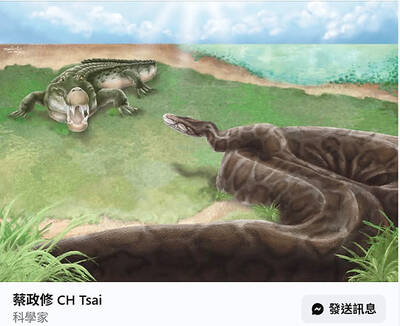
Taiwanese paleontologists have discovered fossil evidence that pythons up to 4m long inhabited Taiwan during the Pleistocene epoch, reporting their findings in the international scientific journal Historical Biology. National Taiwan University (NTU) Institute of Ecology and Evolutionary Biology associate professor Tsai Cheng-hsiu (蔡政修) led the team that discovered the largest snake fossil ever found in Taiwan. The single trunk vertebra was discovered in Tainan at the Chiting Formation, dated to between 400,000 and 800,000 years ago in the Middle Pleistocene, the paper said. The area also produced Taiwan’s first avian fossil, as well as crocodile, mammoth, saber-toothed cat and rhinoceros fossils, it said. Discoveries

Taiwanese paleontologists have discovered fossil evidence that pythons up to 4m long inhabited Taiwan during the Pleistocene epoch, reporting their findings in the international scientific journal Historical Biology. National Taiwan University (NTU) Institute of Ecology and Evolutionary Biology associate professor Tsai Cheng-hsiu (蔡政修) led the team that discovered the largest snake fossil ever found in Taiwan. A single trunk vertebra was discovered in Tainan at the Chiting Formation, dated to between 800,000 to 400,000 years ago in the Middle Pleistocene, the paper said. The area also produced Taiwan’s first avian fossil, as well as crocodile, mammoth, sabre-toothed cat and rhinoceros fossils, it said. Discoveries

Whether Japan would help defend Taiwan in case of a cross-strait conflict would depend on the US and the extent to which Japan would be allowed to act under the US-Japan Security Treaty, former Japanese minister of defense Satoshi Morimoto said. As China has not given up on the idea of invading Taiwan by force, to what extent Japan could support US military action would hinge on Washington’s intention and its negotiation with Tokyo, Morimoto said in an interview with the Liberty Times (sister paper of the Taipei Times) yesterday. There has to be sufficient mutual recognition of how Japan could provide


 RSS
RSS