


The Legislative Yuan has established friendship associations with lawmakers in Latin America and Africa as part of the nation’s efforts to bolster ties with diplomatic allies and nations friendly to Taiwan.
The two associations have been set up to promote deeper exchanges between Taiwanese lawmakers and their counterparts Latin America and Africa, Democratic Progressive Party Legislator Chiu Chih-wei (邱志偉), who spearheaded the initiative, said at the inaugural meeting in Taipei yesterday.
A cross-party effort, the Taiwan-Central and South American and Caribbean Countries Parliamentary Friendship Association has 30 Taiwanese legislative members, while the Taiwan-African Countries Parliamentary Friendship Association has 46, Chiu said, adding that the goal is to have more than half of the Legislative Yuan join both groups.

Photo: Lu Yi-hsuan, Taipei Times
Despite the distance that separates Taiwan from allies and friends in Latin America and Africa, the bond between Taiwan and those nations is strong, as they share the same values, such as democracy, freedom and hospitality, he said.
The inauguration is only the beginning, as plenty of work still needs to be done, he added.
A time frame for responsibilities would be drawn up to enhance bilateral relations between Taiwan and each of these nations in a practical manner, he said.
“We value every nation,” Chiu said.
Lauding the founding of the associations, Nicaraguan Ambassador William Manuel Tapia Aleman, who is the dean of the foreign diplomatic corps in Taiwan, said he believed the associations would benefit Taiwan’s foreign relations.
Taiwan has made major contributions in the international arena amid the COVID-19 pandemic, Tapia said, citing Taiwan’s provision of disease prevention aid to Nicaragua, the first nation in the world to do so.
Taiwan has done a “wonderful job” in providing disease prevention assistance, he said, adding that ambassadors and representatives from other nations probably share the sentiment.
The establishment of the associations is a starting point for a new round of international networking, he said, adding that he hoped Taiwanese missions can visit more regions and nations after the pandemic is over.
Except for Honduras, all the ambassadors of Taiwan’s allies in Central and South America attended the inauguration: Tapia, Saint Kitts and Nevis Ambassador Jasmine Elise Huggins, Paraguayan Ambassador Marcial Bobadilla Guillen, Haitian Ambassador Rachel Coupaud, Belizean Ambassador Diane C. Haylock, Saint Lucia Ambassador Edwin Laurent, Guatemalan Ambassador Willy Alberto Gomez Tirado, and Saint Vincent and the Grenadines Ambassador Andrea Clare Bowman.
Attendees from Africa were Lindiwe Kunene, an official from the Embassy of the Kingdom of Eswatini, as well as South African Representative to Taiwan Robert Seraki Matsebe.
DPP legislators Hsu Chih-chieh (許智傑) and Tsai Shih-ying (蔡適應) were also present, while Vice Minister of Foreign Affairs Miguel Tsao (曹立傑) delivered an address.
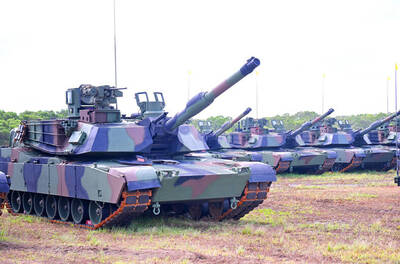
The manufacture of the remaining 28 M1A2T Abrams tanks Taiwan purchased from the US has recently been completed, and they are expected to be delivered within the next one to two months, a source said yesterday. The Ministry of National Defense is arranging cargo ships to transport the tanks to Taiwan as soon as possible, said the source, who is familiar with the matter. The estimated arrival time ranges from late this month to early next month, the source said. The 28 Abrams tanks make up the third and final batch of a total of 108 tanks, valued at about NT$40.5 billion
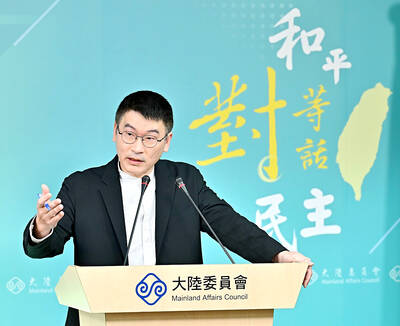
Two Taiwanese prosecutors were questioned by Chinese security personnel at their hotel during a trip to China’s Henan Province this month, the Mainland Affairs Council (MAC) said yesterday. The officers had personal information on the prosecutors, including “when they were assigned to their posts, their work locations and job titles,” MAC Deputy Minister and spokesman Liang Wen-chieh (梁文傑) said. On top of asking about their agencies and positions, the officers also questioned the prosecutors about the Cross-Strait Joint Crime-Fighting and Judicial Mutual Assistance Agreement, a pact that serves as the framework for Taiwan-China cooperation on combating crime and providing judicial assistance, Liang
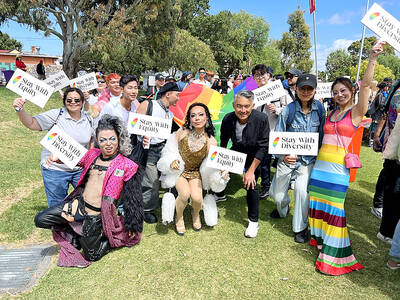
A group from the Taiwanese Designers in Australia association yesterday represented Taiwan at the Midsumma Pride March in Melbourne. The march, held in the St. Kilda suburb, is the city’s largest LGBTQIA+ parade and the flagship event of the annual Midsumma Festival. It attracted more than 45,000 spectators who supported the 400 groups and 10,000 marchers that participated this year, the association said. Taiwanese Designers said they organized a team to march for Taiwan this year, joining politicians, government agencies, professionals and community organizations in showing support for LGBTQIA+ people and diverse communities. As the first country in Asia to legalize same-sex
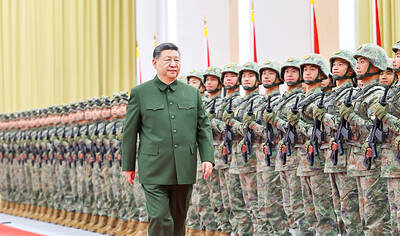
MOTIVES QUESTIONED The PLA considers Xi’s policies toward Taiwan to be driven by personal considerations rather than military assessment, the Epoch Times reports Chinese President Xi Jinping’s (習近平) latest purge of the Chinese People’s Liberation Army (PLA) leadership might have been prompted by the military’s opposition to plans of invading Taiwan, the Epoch Times said. The Chinese military opposes waging war against Taiwan by a large consensus, putting it at odds with Xi’s vision, the Falun Gong-affiliated daily said in a report on Thursday, citing anonymous sources with insight into the PLA’s inner workings. The opposition is not the opinion of a few generals, but a widely shared view among the PLA cadre, the Epoch Times cited them as saying. “Chinese forces know full well that


 RSS
RSS