

The Chinese Nationalist Party (KMT) caucus yesterday disputed President Tsai Ing-wen’s (蔡英文) nomination of Chen Chu (陳菊) as Control Yuan president, saying that her tenures as Kaohsiung mayor and Presidential Office secretary-general were fraught with scandals, making her unfit for a post whose main responsibility is to investigate potential corruption.
Local media cited sources as saying that Chen has been nominated by Tsai to head the Control Yuan, while former Taitung County commissioner Justin Huang (黃健庭) has been nominated as her deputy.
KMT caucus whip Lin Wei-chou (林為洲) told a news conference that Control Yuan members during Chen’s time as Kaohsiung mayor from 2006 to 2018 opened 58 cases involving the municipal government, including three impeachment cases and 30 corrective actions.
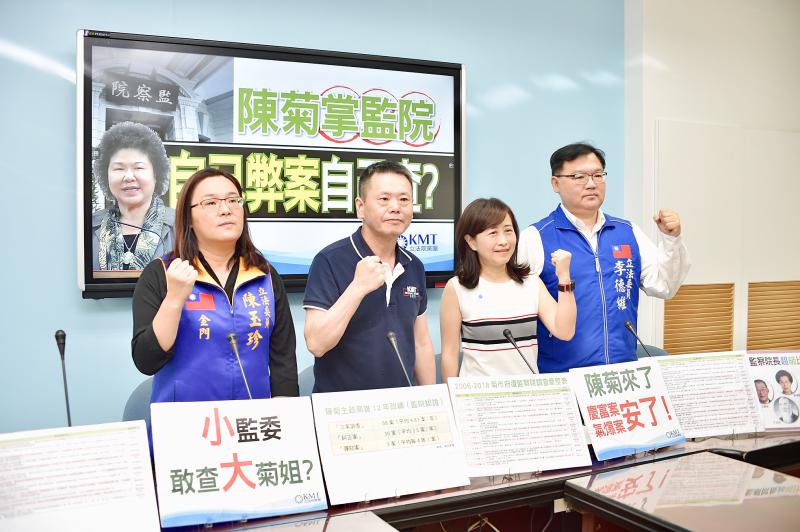
Photo: Tu Chien-jung, Taipei Times
Notably, the Control Yuan in 2015 censured Chen’s administration over the gas pipeline explosions that tore through the city’s Cianjhen (前鎮) and Lingya (苓雅) districts, killing 32 people and injured 321, Lin said.
In addition, the Control Yuan last year impeached then-Kaohsiung Marine Bureau director-general Wang Tuan-jen (王端仁), who was accused of exerting undue influence to help Ching Fu Shipbuilding Co secure space at Singda Harbor (興達港) to develop minesweepers, he said.
Lin asked if Chen became Control Yuan president, whether investigations into the 58 cases would continue, and if they would, whether Chen would resign if illegalities were found.
The Democratic Progressive Party (DPP) has long advocated eliminating the Control Yuan, yet it insists on nominating Chen and 27 Control Yuan members so it can engage in pork-barrel politics one last time, he said.
The KMT caucus would not accept the DPP’s double standards and faulty logic when asked to vote on the nominees in an extraordinary session scheduled to begin on June 29, Lin said.
Chen was Presidential Office secretary-general when a duty-free cigarette smuggling scandal that implicated officials from the office and China Pacific Catering Services erupted, KMT caucus secretary-general Lin Yi-hua (林奕華) said.
Chen might be a fitting candidate to serve as chairperson of the National Human Rights Commission at the Control Yuan — a post that is assumed by the Control Yuan president under the Organic Act of the Control Yuan National Human Rights Commission (監察院國家人權委員會組織法), Lin Yi-hua said, referring to Chen’s time as a political prisoner after the Kaohsiung Incident.
However, Chen is to date the most unfit candidate for Control Yuan president, she said.
Separately yesteday, the Taiwan People’s Party (TPP) legislative caucus also criticized Chen as a possible pick, with TPP caucus convener Lai Hsiang-ling (賴香伶) saying: “This is a blatant political appointment.”
The appointment goes against Tsai’s proclaimed principles of appointing people to government positions who are above party differences, accepting different opinions, appointing individuals from different fields and de-escalating confrontation, Lai said.
“Tsai has not lived up to her goals and has instead become the ‘unreformed KMT’ that she critiques,” Lai said.
TPP caucus deputy convener Chang Chi-lu (張其祿) said that the DPP is contradicting its own political stance that Taiwan move from separation of five powers to separation of three powers.
The DPP should be establishing a parliamentary system and abolishing the Control Yuan and Examination Yuan, instead of handing out positions in organizations it itself calls “unnecessary” and “out-moded,” Chang said.
The government should suspend the nomination process instead of pursuing a controversial nomination, Chang said.
Additional reporting by CNA

A Hualien pomelo farmer refused to sell to China after the country announced it would permit more Taiwanese pomelo imports, prompting widespread support from Taiwanese consumers, who rallied to buy his fruit. China’s Taiwan Affairs Office last month said that China’s General Administration of Customs registered an additional 79 Taiwanese pomelo orchards and packing facilities in Hualien County, allowing more Taiwanese producers to export pomelos to China. “I am a Hualien fruit farmer and I refuse to sell to China,” Liu Tzu-hao (劉子豪) from Ruisui Township (瑞穗) said in an online post. Liu is a well-known farmer in the community and has served
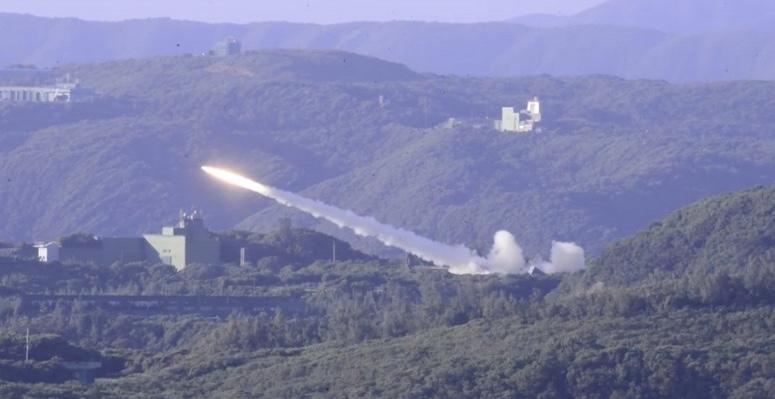
A Chinese military drone was spotted conducting reconnaissance off Taitung County as President William Lai (賴清德) visited Pingtung County this morning to inspect a drill of the armed forces’ precision-strike capabilities, prompting the military to closely monitor its actions. Today was the final day of a three-day military exercise at Jioupeng Base (九鵬基地) to test the joint combat capabilities of the armed forces and coast guard. The exercise began on Wednesday simulating air defense interception and yesterday tested long-range strike capabilities and new air defense weapons. This morning, the military conducted a final exercise involving air defense, anti-ship and drone operations. Military sources said

OCT. 31: The antiviral drugs Tamiflu and Eraflu have been distributed to about 4,000 medical facilities nationwide for people in seven groups who develop flu-like symptoms As the domestic influenza epidemic enters its peak season and continues to escalate, the Centers for Disease Control (CDC) yesterday announced that publicly funded influenza antiviral drugs for seven eligible groups have been extended to Oct. 31, allowing those who develop flu-like symptoms to receive the medication without undergoing a rapid influenza test. The CDC has extended the expanded use of flu antiviral drugs to seven groups: healthcare and influenza-prevention personnel; residents and staff at nursing homes, long-term care facilities and similar institutions; kindergarten and daycare workers and home-based caregivers; students from kindergarten through high school, vocational high school and the

Taiwanese Tsai Chin-shu (蔡金樹), who had been imprisoned in China for engaging in activity that “endangers national security,” said on Facebook on Friday that he has returned to Taiwan. Tsai, chairman of the Southern Taiwan Union of Cross-strait Relations Associations, had traveled frequently between Taiwan and China for years, and at one time ran a trading company in China’s Pingtan. In July 2018, he traveled to Quanzhou, Fujian Province, to attend a cross-strait food trade fair and stayed at a hotel in Xiamen. He checked out the following day and then disappeared. His family had made repeated appeals to the authorities


 RSS
RSS