


The Taipei High Administrative Court on Friday ruled against the Ministry of Education and its claim that the Chinese-language Mandarin Daily News (國語日報) is a government-funded institution.
On Sept. 25, 2017, the ministry sent a notice to the Mandarin Daily News — on the grounds that it was a juristic person founded and funded by the government — instructing it to convene a meeting of its board, amend its charter and hold new board elections.
The ministry said that the paper was founded under the then-Nationalist government’s program to promote Mandarin, and that it was registered as a taxable entity on Jan. 1, 1948.
The paper brought the case to court, stating that it is privately funded and should be considered a juristic person dedicated to social welfare and education.
BANKRUPTCY
While the paper received 10,000 in gold yuan (金圓券) and was first published in 1948, it failed after the first issue and declared bankruptcy in 1949, selling off its printing house and dismissing its workers, the court ruling said.
The gold yuan, introduced in 1948, was intended to be a limited currency issued by the Nationalist government in an attempt to rein in hyperinflation of the fabi (法幣), introduced in 1935.
The government-funded Mandarin Daily News collapsed a year after it was founded, the court said.
PRIVATE FUNDING
Whether the paper received funding before it was registered or up until its declaration of bankruptcy from the Taiwan Province Mandarin Promotion Committee up until the committee was abolished in 1999 does not change that the paper received private funding, it said.
The collegiate bench presiding over the case ruled against the ministry, saying that the ministry could not provide proof that the paper was government property or provide a paper trail proving that the government had funded the paper.
The ruling can be appealed.
ELUDING OVERSIGHT?
The ministry later on Friday said that the court had ignored the 83 items of proof and evidence that it submitted.
The paper cannot be allowed to slip further away from governmental oversight, the ministry said, adding that it would appeal the ruling.
The paper said that it is too bad that the ministry does not respect the judiciary, even after the civil and administrative courts ruled against its claims in 2017.

Taiwan has received more than US$70 million in royalties as of the end of last year from developing the F-16V jet as countries worldwide purchase or upgrade to this popular model, government and military officials said on Saturday. Taiwan funded the development of the F-16V jet and ended up the sole investor as other countries withdrew from the program. Now the F-16V is increasingly popular and countries must pay Taiwan a percentage in royalties when they purchase new F-16V aircraft or upgrade older F-16 models. The next five years are expected to be the peak for these royalties, with Taiwan potentially earning
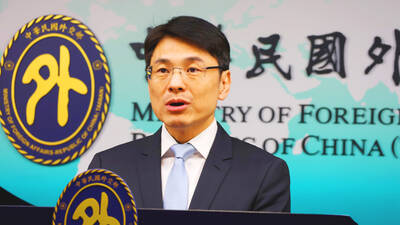
STAY IN YOUR LANE: As the US and Israel attack Iran, the ministry has warned China not to overstep by including Taiwanese citizens in its evacuation orders The Ministry of Foreign Affairs (MOFA) yesterday rebuked a statement by China’s embassy in Israel that it would evacuate Taiwanese holders of Chinese travel documents from Israel amid the latter’s escalating conflict with Iran. Tensions have risen across the Middle East in the wake of US and Israeli airstrikes on Iran beginning Saturday. China subsequently issued an evacuation notice for its citizens. In a news release, the Chinese embassy in Israel said holders of “Taiwan compatriot permits (台胞證)” issued to Taiwanese nationals by Chinese authorities for travel to China — could register for evacuation to Egypt. In Taipei, the ministry yesterday said Taiwan
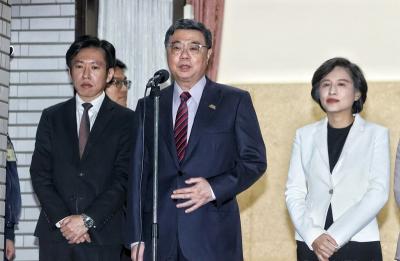
Taiwan is awaiting official notification from the US regarding the status of the Agreement on Reciprocal Trade (ART) after the US Supreme Court ruled US President Donald Trump's global tariffs unconstitutional. Speaking to reporters before a legislative hearing today, Premier Cho Jung-tai (卓榮泰) said that Taiwan's negotiation team remains focused on ensuring that the bilateral trade deal remains intact despite the legal challenge to Trump's tariff policy. "The US has pledged to notify its trade partners once the subsequent administrative and legal processes are finalized, and that certainly includes Taiwan," Cho said when asked about opposition parties’ doubts that the ART was
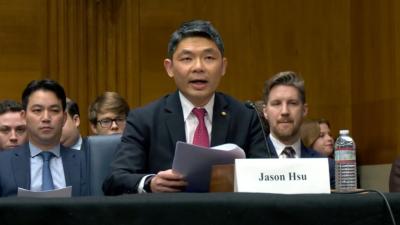
If China chose to invade Taiwan tomorrow, it would only have to sever three undersea fiber-optic cable clusters to cause a data blackout, Jason Hsu (許毓仁), a senior fellow at the Hudson Institute and former Chinese Nationalist Party (KMT) legislator, told a US security panel yesterday. In a Taiwan contingency, cable disruption would be one of the earliest preinvasion actions and the signal that escalation had begun, he said, adding that Taiwan’s current cable repair capabilities are insufficient. The US-China Economic and Security Review Commission (USCC) yesterday held a hearing on US-China Competition Under the Sea, with Hsu speaking on


 RSS
RSS